On-Demand Protein Synthesis for Same-Day Assay Workflows
Cell-free protein synthesis delivers functional assays in hours instead of days.
What CFPS does and why removing the cell changes the timeline
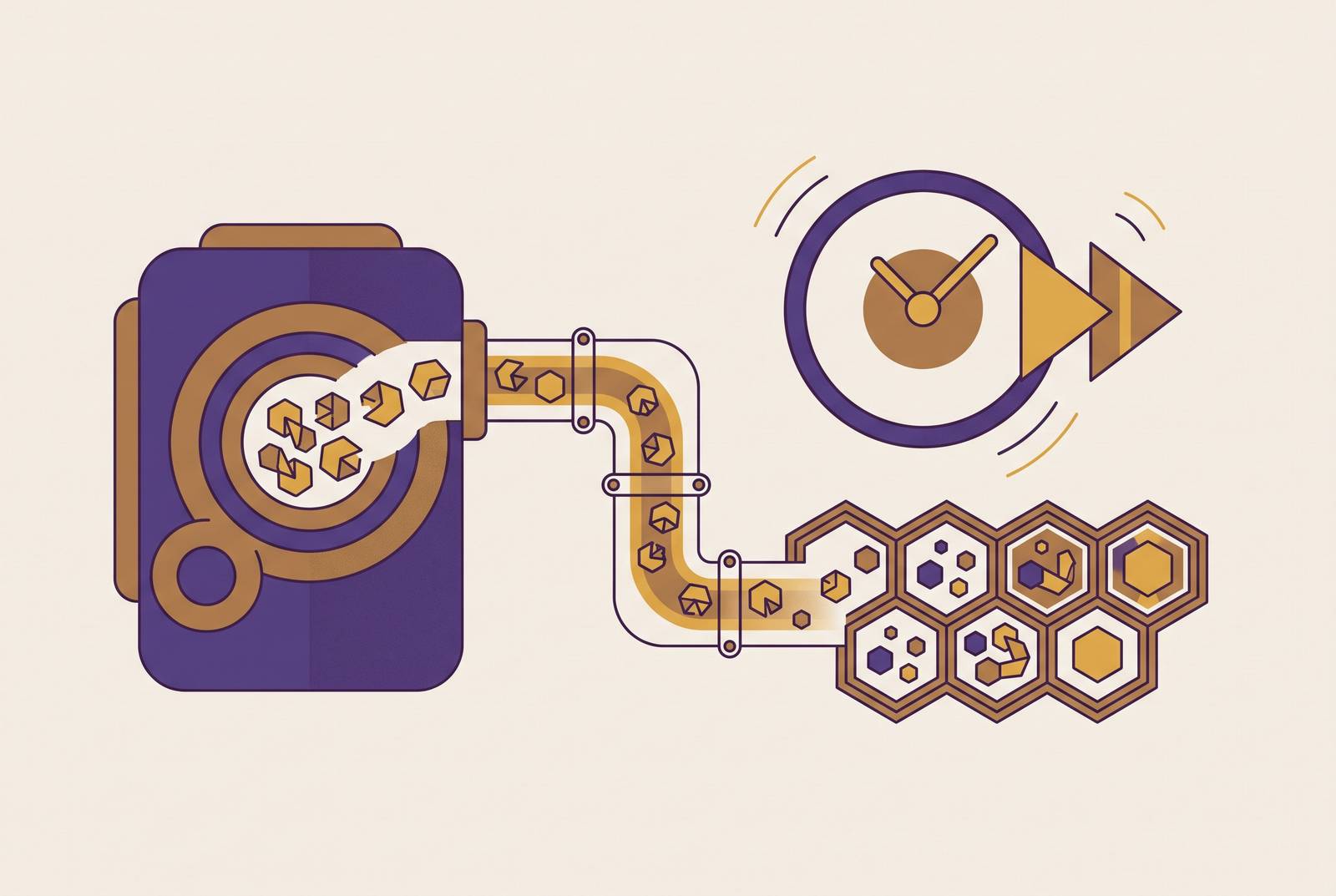
The lag between having a DNA template and running a functional assay usually eats up days, sometimes weeks. Cell-free protein synthesis (CFPS) collapses that gap to a single working day: DNA in hand in the morning, protein sitting in assay buffer by afternoon. Researchers at the University of Washington's Institute for Protein Design called for "a simple assay-agnostic workflow for the production and initial characterization of hundreds of proteins per day in a standardized and cost-effective manner" to speed up protein design work, in a paper accepted this year by Nature Communications. That's a specific bar to clear: hundreds of proteins a day, method-agnostic, cheap enough to run routinely, and it's worth asking plainly whether CFPS clears it or just gets close.
Most protein production runs through a living cell: transform it, grow it, lyse it, purify what's inside. Every one of those steps costs time the cell insists on taking for itself, on its own schedule, not the scientist's. CFPS skips the growing part. It uses a cell lysate, the ribosomes and enzymes scraped out of cells rather than the cells themselves, to run transcription and translation in a tube. Three pieces make up the reaction, and each can be swapped or tuned on its own: the lysate doing the actual synthesis work, an energy system that regenerates ATP and feeds the small molecules the reaction burns through, and the DNA template telling the machinery what to build.
That separation is what buys back the days. There's no transformation step, no colony picking, no overnight culture waiting to hit the right density. Templates can be plasmid DNA or a PCR product straight off the thermocycler, and PCR fragments work directly in the reaction, so cloning and transformation drop out of the process entirely for screening work. A review in Microbiology (Reading) puts a full CFPS reaction at a matter of hours from start to finish, against the overnight-to-multiday span a cell culture demands.
Extract choice shapes what a lab actually gets out the other end, and here's where most people pick wrong for their use case. E. coli extracts pulled from cells in exponential growth give the highest yields of the common sources, full stop, but they come with a limited post-translational modification profile. Wheat germ and rabbit reticulocyte extracts trade some of that yield for better modification handling. Insect cell and mammalian extracts, HEK293 in particular, do better still: a study reported a HEK293-based CFPS system producing up to 300 μg/mL of a reporter protein. Cell-free reagents also freeze-dry well, so a kit can sit at room temperature until someone rehydrates it right before use, a detail that matters more for lab logistics than it sounds like it should. None of this needs a bioreactor, a sterile culture suite, or containment for a live organism. It needs a tube, a heat block, and the reagents.
The steps that compress a multi-day workflow into one day
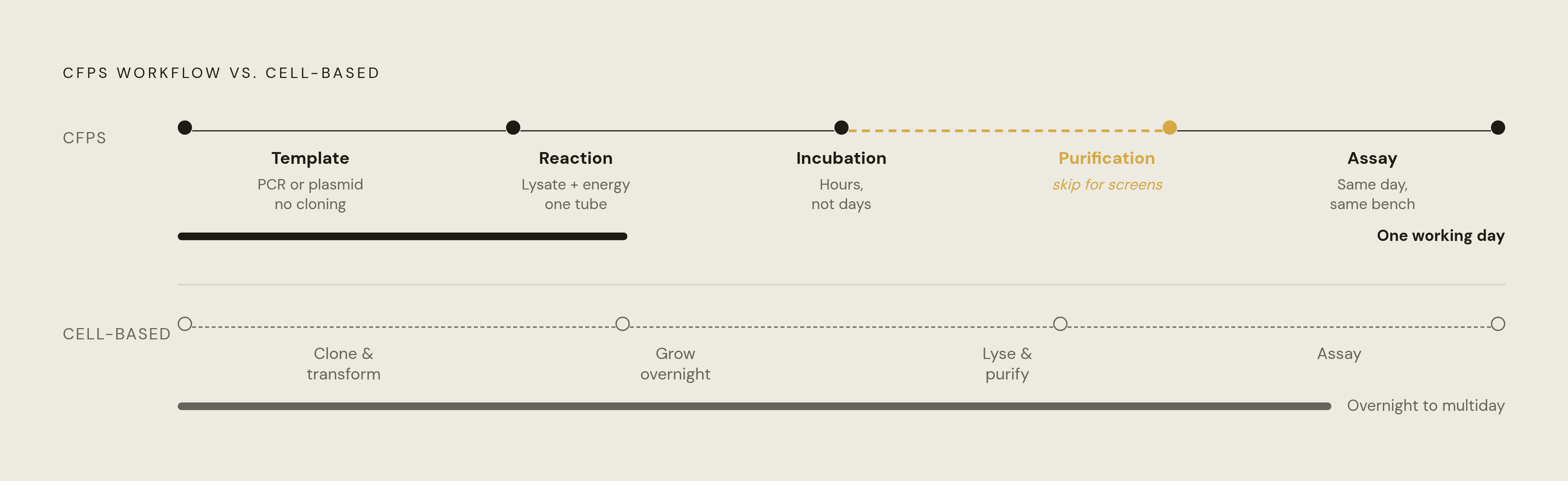
Five steps make up the workflow, and none of them requires waiting on biology to grow. Template preparation comes first: PCR-amplify the gene of interest, or pull an existing plasmid off the shelf. No cloning needed if the goal is screening rather than a finished construct.
Reaction setup is the second step, combining lysate, energy mix, template, and whatever else the protein needs (chaperones for folding, detergents for a membrane protein, cofactors) in one tube or one plate well. Incubation is step three, and it's where the hours-not-days math actually plays out: the reaction runs its course and finishes well within a working day. Step four skips something most cell-based workflows can't skip: for activity screens, binding assays, and biosensor readouts, the reaction mixture goes straight into the assay format with no purification step in between. Step five is the assay itself, same day, same bench.
Purification still has a place, and pretending otherwise would be dishonest. Milligram-scale work, or assays that demand precise quantification, often needs a cleanup step first. But initial screening and activity assays frequently skip it, which is the whole point of running cell-free. Reaction volume scales from nanoliters in a microfluidic chip up to milliliters in a preparative batch, and both ends of that range still fit inside one day. Because the reaction happens in an open tube rather than inside a living cell, pH, temperature, redox state, and cofactor levels can all be adjusted between runs without touching a genome. Iterating on a cell line never moves this fast, and it never will, because the cell has its own schedule and no amount of automation changes that.
Protein targets that cell-based expression cannot deliver on the same timeline
Some proteins can't be made fast in cells for a simple reason: the cells die first. A toxic protein accumulating inside a host cell often kills that host before enough product builds up to harvest. CFPS sidesteps the problem by using a lysate instead of a living cell, so there's no host left to poison. Cell-free synthesis and functional characterization of two AB₅ toxins, cholera toxin and heat-labile enterotoxin, has been demonstrated using CHO- and Sf21-based eukaryotic cell-free systems, proteins that would be a serious liability to express in a growing culture.
Membrane proteins carry a similar problem, though the failure mode looks different. Forcing them through E. coli usually means they misfold into inclusion bodies, dense clumps of aggregated protein that have to be solubilized and refolded, if refolding even works, and often it doesn't. CFPS lets detergents go directly into the reaction without shutting down the translation machinery, so the protein folds straight into detergent micelles as it's made rather than clumping first and getting rescued later, or not rescued. A 2025 paper lays out exactly that approach. Insoluble or aggregation-prone proteins get a similar fix: chaperones added straight into the open reaction, no strain engineering required. Multi-domain proteins benefit from the same tunability, since redox potential and cofactor availability can be set independently for each target, something no living cell allows without disrupting its own growth.
The time savings compound hardest for these difficult cases. Cell-based work on toxic or membrane proteins usually means rounds of strain engineering, each round adding days or weeks before an assay is even possible. CFPS removes almost all of that iterative phase. It is not a universal replacement, though, and anyone selling it as one is overstating the case: proteins that depend on complex, cell-specific post-translational modification for biological activity may still need a mammalian expression system to function. The same-day advantage is sharpest exactly where toxicity, aggregation, or membrane insertion is the actual bottleneck, and weakest everywhere else, so CFPS shouldn't be the default choice for every hard target.
The same-day format enabling high-throughput variant screening, not just single-protein production
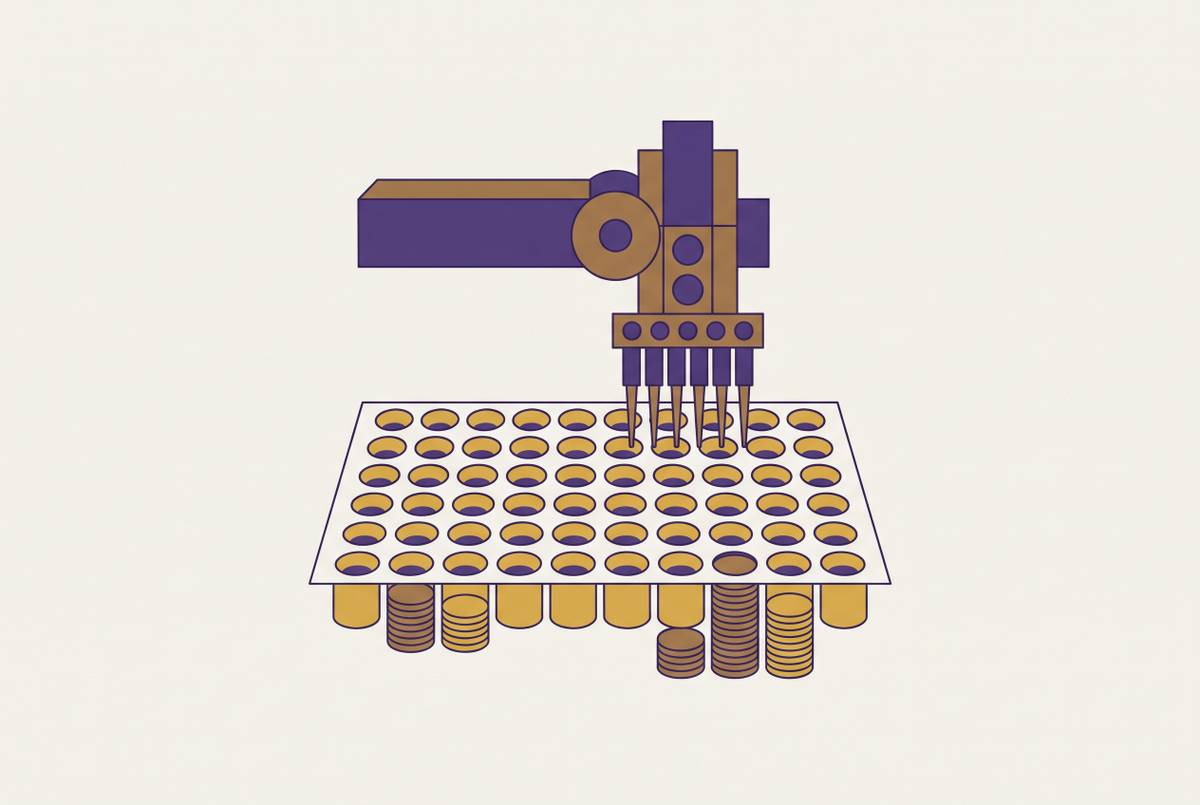
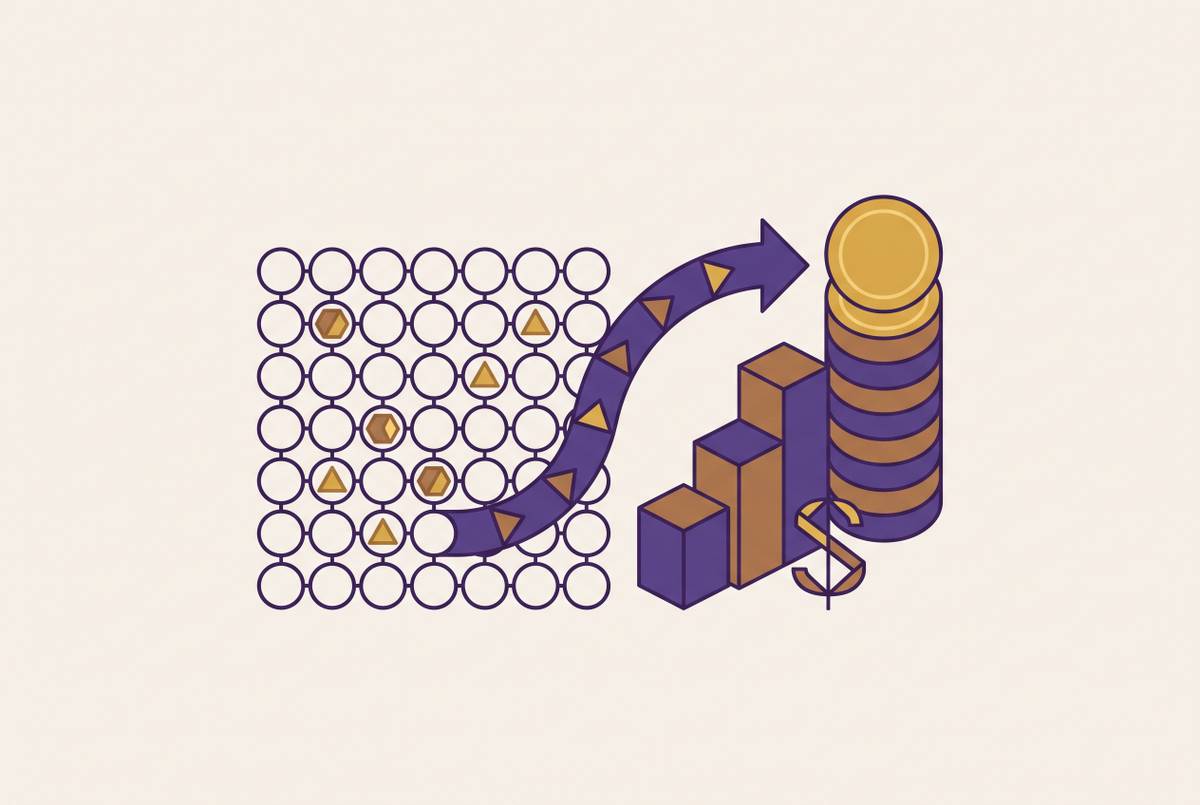
Because each CFPS reaction is a self-contained, open system, dozens or hundreds of them run side by side in a microplate on the same afternoon. That parallelism is what turns CFPS from a single-protein shortcut into a screening engine, and it's the more important of the two use cases, not the same-day single-protein trick that gets most of the attention. A 2025 paper in ACS Synthetic Biology demonstrated CFPS scoring protein variant activity inside machine-learning-driven workflows, moving through a fitness landscape with far less hands-on lab time than expressing each variant in cells would demand.
The logic behind that pairing forms a loop: a model proposes variants, CFPS expresses them, a protease or activity assay scores them, and the scores train the next round of proposals. CFPS is what makes the "test" step of that loop fast enough to keep pace with the model, compressing a cycle that might take a month in cells down to about a week. Detection has kept pace too. A September 2025 paper in iScience validated Split-GFP and HiBiT luminescence readouts for plate-based CFPS, giving labs both kinetic tracking of expression as it happens and a final yield number at the end.
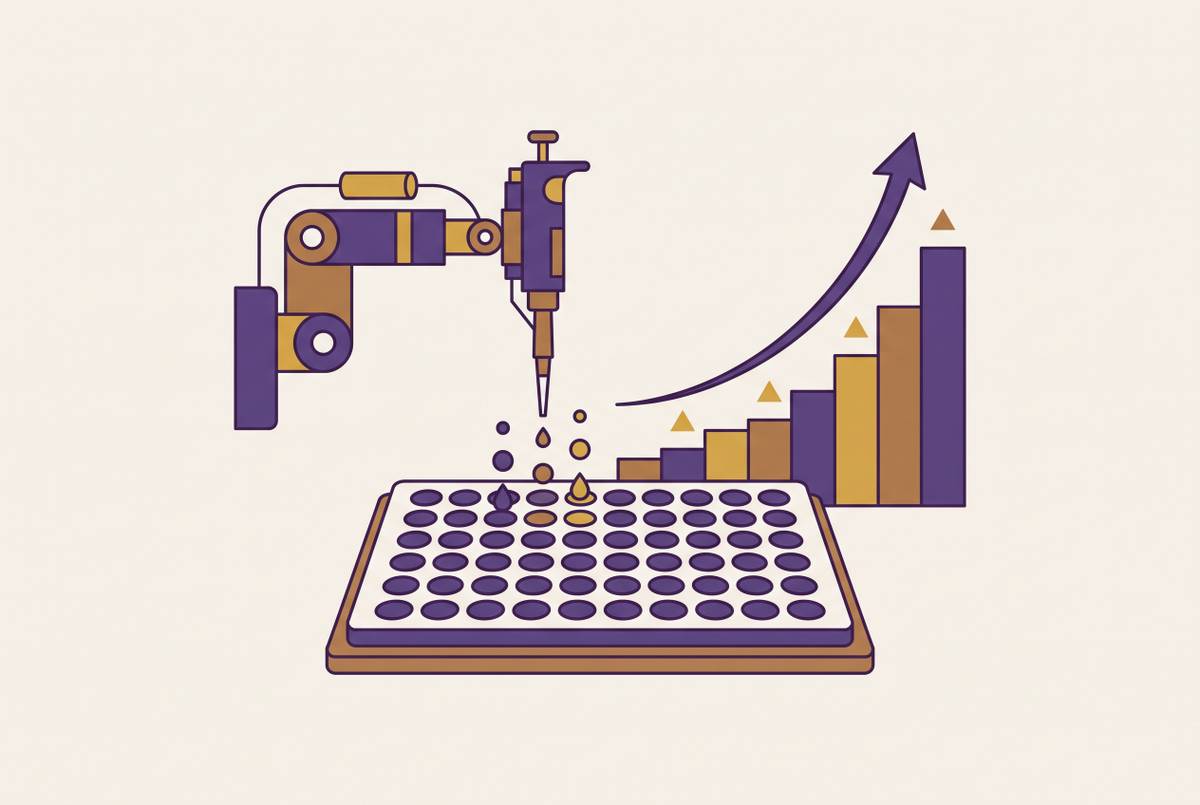
Robotic liquid handling adds another layer, automating reaction setup so a scientist spends less time at the bench and more time reading the data. Researchers at Tsinghua University pushed the parallelism further still, integrating CFPS with microarray technology to synthesize and screen thousands of variants on a single chip using nanoliter reaction volumes and real-time fluorescence monitoring. Biofoundries have folded CFPS into automated Design-Build-Test-Learn pipelines as well; the same iScience paper describes a fully automated DBTL pipeline with active learning built around CFPS optimization. None of this demands a separate protocol from the single-assay version described above. Running the same reagents and the same basic steps in a plate instead of a tube turns a same-day assay into a same-day screen of hundreds of candidates.
What the reagents must deliver for the same-day promise to hold
A same-day schedule has no slack for troubleshooting. If a reaction fails at two in the afternoon, there's no time to diagnose it, order a new lysate, and start again before the day is gone. Batch-to-batch consistency in the lysate and energy mix is the entire premise the schedule depends on, and most labs underestimate how much it matters until a run fails for no visible reason and a full day of screening evaporates with it.
A 2026 paper by Olsen and colleagues in Nature Communications (17:3478) tested exactly this kind of consistency. The optimized reagent formulation held up across different batches of lysate, different users, different labs, and across the synthesis of more than twenty different proteins, including fifteen therapeutically relevant targets and full-length aglycosylated monoclonal antibodies. That's the kind of evidence a same-day workflow actually needs: not a claim of quality, but data showing the reagent performs the same way twice.
Reliability in practice comes down to a few concrete things. Lot-level QC data has to be published and checkable, not held back as a trade secret. Formulations need documenting well enough that a failed reaction gets diagnosed instead of thrown out and rerun blind. Component concentrations need standardizing so a result generated in one lab means the same thing in another lab three states away.
A long-running tradeoff between purification cost and reliability produces this problem. PURE systems, built from purified, defined components, give precise control over composition but have historically been expensive and hard to access at scale. Crude lysates are cheap and high-yield but carry more batch variability, because lysates retain uncharacterized cellular components that shift from batch to batch, sometimes for reasons nobody upstream can fully explain. A same-day workflow needs the reliability of the first option at something close to the cost of the second, and that combination is rare enough that most vendors quietly pick one and hope the other doesn't matter as much. A December 2025 bioRxiv preprint describes one attempt at closing the gap: i-POPFLEX, a modular system in which 34 translation factors are each synthesized separately in vitro, then assembled by automated liquid handling into a complete, ready-to-use system within two days. Reproducible science runs on lot-level QC data. Without it, same-day scheduling is a bet, and a bad one.
How OpenCFPS fits into a same-day assay lab
The requirements above point toward one kind of product: reagents that perform well, cost little enough to run at plate scale, and stay transparent enough to fix mid-day when something goes wrong. OpenCFPS is built around two modes that map onto the two use cases already covered here, screening protein variant libraries and producing protein at the milligram scale.
Priced at $25 per milliliter, OpenCFPS is built to make plate-based screening affordable at the well level, not to undercut competitors on a spreadsheet. Its formulations are published, so a scientist running the reaction can see what's in the tube instead of trusting a black box. That's the transparency a same-day schedule demands when something needs fixing fast, and it ships with lot-level QC data, the same foundation the Nature Communications robustness study treats as the baseline requirement for standardized, reproducible results.
It's built to drop into an existing lab rather than replace one: standard plates, standard incubators, common liquid-handling robots, no new infrastructure required. And it's engineered specifically for the protein classes where same-day CFPS has the biggest edge over cell-based methods: targets that are toxic, unstable, insoluble, or built from multiple domains. In practice, that means a lab chasing a difficult target can set up plate reactions in the morning, read out activity that afternoon, and feed the results straight into the next round of variant design before the day ends, using reagents whose formulation and QC data are already on record rather than locked in a vendor's private file.
When a different strategy is warranted instead of same-day CFPS
CFPS reactions run for hours, not days, and that caps how much protein a single batch can produce. Fine for a screen or an assay. It rules out continuous, large-volume manufacturing in one run, no way around it. For the highest-volume bulk production, where the number that matters is cost per gram at industrial scale, cell-based fermentation still wins, and by a wide margin. CFPS yields have climbed steadily, but they haven't closed that gap, and nothing in the current research suggests they will anytime soon.
Post-translational modification is the other real limit, and it's not a minor asterisk. Mammalian cell lines still handle complex glycosylation and other modifications that many proteins need for full biological activity, and a CFPS reaction built on E. coli extract won't replicate that without a lot of engineering bolted on top of the base system, engineering that starts to erode the same-day advantage the whole approach is built on.
The pattern across the research is CFPS front-loading the decisions that used to eat weeks, not CFPS replacing cell-based production. Use it to screen variants, test conditions, and settle on a construct fast, then hand the winning candidate off to a cell-based system for production at scale. That hybrid sequencing is where the time savings actually land; cell-free reactions do not take over manufacturing, and treating them as a manufacturing substitute misreads what the data supports. Extract batch variability remains a real risk wherever the reagent system behind it isn't rigorously standardized, and the transparency and QC requirements laid out earlier aren't optional extras tacked on for marketing copy.
Same-day CFPS earns its place when speed of iteration is the priority, when the target is one cells struggle with, and when the assay can be built around what a cell-free reaction actually delivers. It isn't a stand-in for a fermentation tank at scale, was never meant to be one, and the labs that get the most out of it are the ones that never confuse the two.