CFPS Compatibility With 96-Well Plate and Liquid Handler Workflows
Five physical parameters determine whether plate-based CFPS actually works.

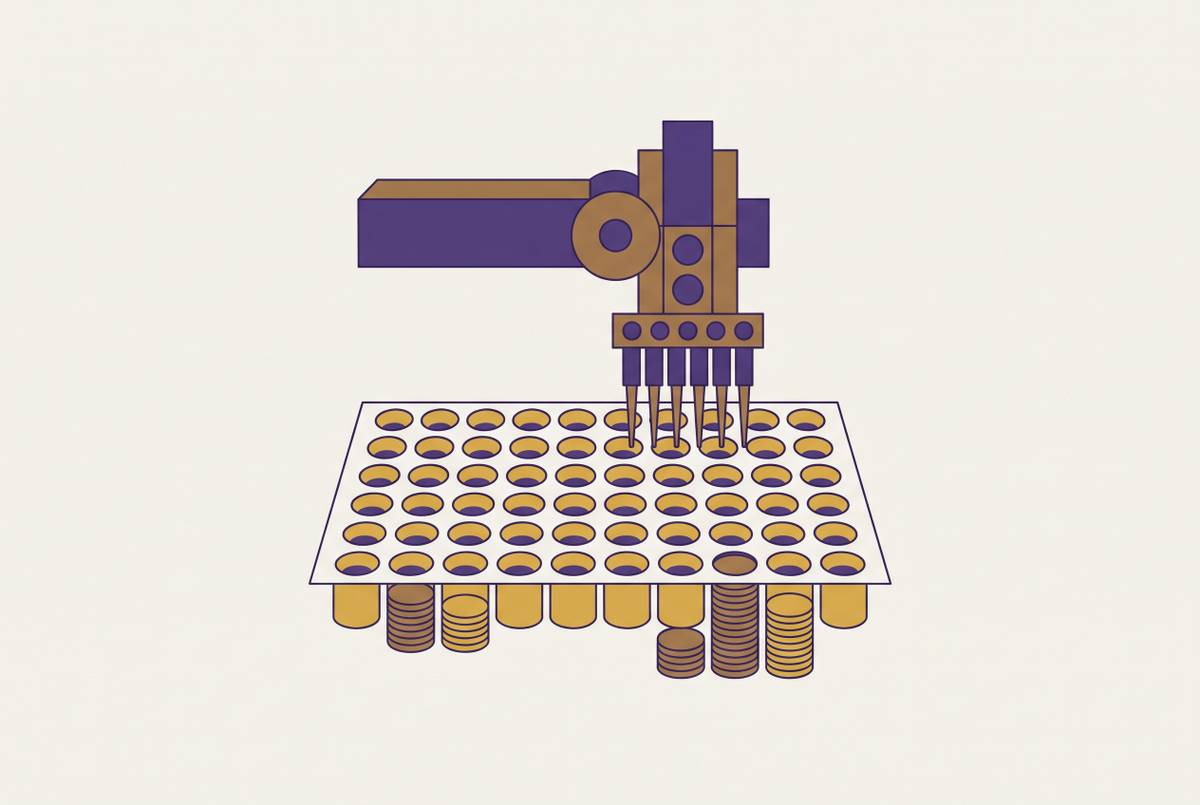
CFPS reactions are small, sealed-tube events with no colony to grow and no culture to babysit overnight. That makes them a natural fit for 96-well plates and the liquid handlers built to fill them, but fit on paper and performance in practice are different animals, and most labs discover the gap only after a run has already been scored and the numbers don't add up. Getting a plate-based CFPS run to work, at yield and with well-to-well consistency, comes down to a short list of physical parameters: volume, evaporation, surface area, mixing, and dispensing precision. Get any one of them wrong and the plate still runs. It just lies to you about what it's showing, and the lie is usually the hardest part to catch, because it looks exactly like real biology until someone traces it back to plate geometry or a bad tip calibration.
None of this is a novel adaptation. High-throughput CFPS in plate formats has been used to screen target protein genes at scale, and Nomura's group later synthesized a large number of human proteins using high-throughput CFPS, with the large majority showing real biological activity. That kind of output only happens when reactions run in parallel, across plates, on a schedule a liquid handler sets. CFPS already belongs in a plate. The parameters below determine how it behaves once it gets there.
Reaction volume and its downstream consequences for plate choice
CFPS reactions typically run in the low-microliter range already, so moving into 96-well or 384-well formats doesn't require shrinking anything down through heroic engineering. The volume in each well determines how much protein comes out per well, how much is enough for whatever assay comes next, and how many variants a given batch of extract can cover before running dry.
Batch reactions in standard wells are the simplest to set up. For most screening work, they're also the right call. Continuous-exchange formats get more attention than they deserve for routine screening. They're real: a 2014 Springer Nature protocol using microfluidic 96-well CECF devices reported protein synthesis yields up to 87 times higher than conventional batch setups, and separate CHO lysate-based CECF work reached membrane protein yields up to 980 micrograms per milliliter, the highest reported at the time for a microsome-containing eukaryotic system. But batch reactions are limited by substrate depletion, not by some inherent ceiling. Once the amino acids and energy components in the well run low, synthesis stalls regardless of how much time is left on the incubator clock, and for a screen that needs a few nanograms of protein for a fluorescence readout, that ceiling is never the bottleneck.
That 87-fold number is easy to misread as a mandate. That 87-fold number is not a mandate for every assay, because the right plate format depends on the assay's minimum detectable quantity. Match the plate format to the assay's minimum detectable quantity, not to the theoretical ceiling of the reaction. A screening assay running a fluorescence readout has no business burning the yield of a high-output CECF system, or absorbing the hardware complexity bundled with it, just because the number on the paper looks better. Volume decisions here set up the next problem directly: less liquid per well means evaporation costs more, proportionally, than it does in a full-volume tube.
Evaporation: the silent yield killer in open-plate CFPS
In a closed 1.5 mL tube, evaporation barely registers. In an unsealed 96-well plate at 25 to 37°C for several hours, it turns into one of the biggest threats to a clean dataset. Some optimized CFPS systems finish synthesis in as little as three hours, but plenty of protocols run considerably longer, and evaporation compounds across every one of those hours.
The chemistry consequences are specific. As water leaves the well, salts and substrates concentrate, and CFPS reactions in E. coli extract are known to be sensitive to exact magnesium and potassium levels. Pushing those ions even modestly out of range drops yield, sometimes sharply. Worse, evaporation doesn't hit a plate evenly: wells along the edge lose volume faster than wells in the center, because they sit closer to the plate's exposed perimeter and catch more airflow. That builds a spatial gradient in yield that looks, to an untrained eye, like a real biological signal. It is a plate geometry artifact, nothing more.
A few fixes handle most of it, and skipping them is a choice, not an oversight. Sealing films, chosen to allow either optical reads or piercing access depending on the downstream assay, cut evaporation substantially. Humidity-controlled incubators help. Some protocols use a mineral oil overlay on individual wells to physically block the air-liquid interface, and a trick borrowed from other plate-based assays, filling the outermost ring of wells with plain water as a sacrificial buffer, reduces the edge effect on the wells that actually matter. Skipping this step doesn't just cost yield. It erodes the statistical power of the entire screening run, and no amount of lot-level reagent QC after the fact fixes a plate that was never sealed properly to begin with.
Surface area, surface-to-volume ratio, and oxygen availability during synthesis
Shrinking a reaction from a 1.5 mL tube down to a 10 to 30 microliter well does more than change the numbers on a pipette. It changes the ratio of reaction volume to the surfaces touching it, so more of the reaction sits in contact with plastic walls and air per unit of liquid.
That shift matters most for oxygen. E. coli CFPS reactions are sensitive to solution conditions, and a larger air-liquid interface relative to volume can push that chemical balance around, with consequences for disulfide bond formation and the energy regeneration systems that keep synthesis going. This bites harder in CFPS than it would in a live cell, since one of the real advantages of a cell-free system is the freedom to tune solution conditions in ways that would kill an intact E. coli cell. That advantage only holds if the redox environment stays where it belongs, and surface-to-volume shifts knock it off course fast at small well volumes.
Surface adsorption gets far less attention than it should. Extract proteins and lipids stick to plastic, particularly untreated polystyrene, and every molecule lost to the well wall is one less molecule doing useful work in solution. Treated or low-binding well surfaces cut that loss, and plate material is worth evaluating directly for the specific extract and target protein in question. Well shape plays in too: different well geometries handle mixing and pipette recovery differently at small volumes, and no single plate spec wins across the board. A datasheet won't settle it. Test the specific extract and target protein directly, on the actual plate, before committing a run to it.
Mixing and mass transfer inside a sealed plate well
A tube on a rocker gets gentle, continuous agitation almost for free. A sealed plate well is a closed little world, and getting the same mixing benefit into it takes real thought about hardware, not a shrug and a hope that diffusion handles it.
Poor mixing causes problems in a few predictable ways. Substrates deplete locally around the ribosome pool even when the bulk concentration in the well still looks fine on paper, which slows synthesis with no obvious cause on the readout. Nascent protein aggregates at the bottom of the well, cutting into soluble, recoverable yield. And if the plate sits flat on an incubator shelf instead of an orbital shaker, thermal gradients form across the plate, since not every incubator and plate reader shares the same thermal uniformity.
Orbital microplate shakers are the standard fix, but rpm needs calibration specific to the assay, not a default setting borrowed from a different one. Push it too fast in small-volume wells and reactions splash into neighboring wells, contaminating a run in a way that's nearly impossible to catch after the fact. Thermomixer-style blocks that combine heating with agitation are another option. CECF microfluidic devices, the same ones behind the 87-fold yield figure above, handle mass transfer by design rather than by external shaking, at the cost of more complex hardware. Enzyme engineering work that pairs robotics with CFPS to screen large numbers of variants at once depends entirely on consistent mixing across every well in the run, proof the problem is solvable at scale and not just on a bench of five. Shaking speeds up surface evaporation too, so mixing and evaporation control have to get solved together, not one after the other as if they were separate problems.
Liquid handler compatibility: where dispensing precision determines data quality
CFPS lysate is viscous and dense with protein. It behaves nothing like the aqueous buffers most liquid handler methods are calibrated against out of the box, and treating it like water is where a lot of automated runs quietly go wrong.
Several failure modes are specific to this reagent. Standard tip calibration built for buffer misjudges lysate volume every time, so each liquid handler needs its own calibration run using the actual CFPS reagent, not a water proxy. Pipetting too aggressively generates foam, and foam in a CFPS well isn't cosmetic: it displaces reaction volume and drags in air bubbles that disrupt the chemistry. At sub-10 microliter dispenses, tip dead volume becomes a real fraction of the total reaction rather than a rounding error, so tip type and cutoff need to stay fixed across a run. Because lysate is sticky, inadequate tip washing carries active extract and template between wells, and that cross-contamination produces an inexplicable false positive later that nobody can trace back.
Order of addition matters too. Aqueous components go in first, then template, then extract last, which keeps the reaction from starting prematurely in the first wells filled while the last wells on a 96-well plate are still waiting their turn. Extract should stay cold through the dispensing step, since reaction rate climbs sharply with temperature, and a plate sitting at room temperature while a liquid handler works through 96 wells one by one ends up with a real timing gap between the first well filled and the last.
Lyophilized CFPS reagents, stored at room temperature and reconstituted at the bench, cut cold-chain handling out of the dispensing step entirely, which simplifies automated loading by a fair margin. OpenCFPS from Sepia Biosciences was designed with automation compatibility in mind, with standardized lot-level QC and documented formulations that give a liquid handler program a more consistent composition to work against. The stakes are concrete: a 1 to 2 microliter error in a 10 microliter reaction is a 10 to 20 percent swing in extract concentration, easily enough to push yield outside the expected range for a given lot. Dispensing precision and reagent standardization are the same problem, viewed from two ends.
Template delivery in a plate format: PCR products, plasmids, and linear DNA
CFPS takes PCR product directly, no cloning step and no transformation required. The DNA template for each well can itself come out of a plate-format PCR run, so the whole workflow, template through translation, stays inside one plate-compatible pipeline from start to finish.
Some extract-based CFPS systems express two dozen different open reading frames in a single day, and that pace only holds if template prep runs parallel to the expression step, not as a separate task finished days earlier on a different bench. PCR fragments are the fastest option, often usable without purification, though concentration has to stay consistent well to well, since template turns rate-limiting fast at low concentrations. Plasmid DNA generally gives higher yield per reaction in some systems and can sit arrayed in a source plate for a liquid handler to cherry-pick from. Linear DNA assembly done in vitro has already been used in antibody discovery workflows targeting SARS-CoV-2, evidence that upstream DNA prep can live inside the same automated pipeline as expression itself, rather than as a hand-off between separate teams.
One catch: crude lysates carry nuclease activity that degrades linear DNA, and that matters specifically when PCR products go in unpurified. Some protocols use formulation adjustments to reduce this loss. A subtler risk sits in the source plate itself. A liquid handler delivers uniform volume reliably, but the source plate's DNA concentration may not be uniform, especially if it wasn't mixed evenly before dispensing began. Normalize template concentration in the source plate ahead of time, and run an internal fluorescence control template in a subset of wells. That catches dispensing failures while the run is still happening, not after the data's already been collected and the damage is done.
Downstream detection without leaving the plate: purification-free readout strategies
Because CFPS is open and cell-free, unpurified supernatant goes straight into a downstream assay with no purification column anywhere in the process. That's one of the most underrated advantages of running CFPS in a plate, and it's also the reason a lot of screening timelines that look impossible on paper turn out to be routine.
A concrete example makes the point. CFPS supernatant, injected directly into a surface plasmon resonance biosensor using His-capture, screened 200 variants in four and a half hours, with synthesis itself taking up three of those hours and eleven positive binders identified at the end. That turnaround only happens because nothing between the reaction and the readout requires a purification step.
Fluorescence gives another route in. GFP or luciferase fusions work as in-well yield reporters, read directly by a plate reader with no transfer and no lysis needed. The same fluorescence-based approach underlies robotics-driven screens of thousands of enzyme variants for thermal stability, run at a scale that would be impractical if each variant needed individual purification first. ELISA-style formats work too: His-tag or FLAG-tag capture directly in the well, with the right surface coating, turns the expression plate into its own capture plate. Magnetic bead-based His-tag pulldown inside the well, followed by a transfer to a separate detection plate, adds one liquid handler step but still skips chromatography.
Skipping the column doesn't make the protein a lesser product. Protein made through cell-free synthesis folds correctly and retains binding activity equivalent to protein made inside living cells, which settles the standing worry that plate-format CFPS trades convenience for biologically inert output. Detection method choice, though, has to feed back into decisions about well volume and plate format made much earlier in the process, not get bolted on at the end as an afterthought. Build the workflow end to end, template through detection, before locking in a plate type. It saves a lot of rework later.
Reagent standardization as the foundation of reproducible plate-scale CFPS
Everything above assumes the extract itself behaves the same way twice, and that assumption is exactly where plate-scale CFPS tends to break if nobody's watching it closely. A shift in extract activity between batches, one that a single-tube experiment absorbs without anyone noticing, turns across a full 96-well plate into a systematic bias baked into every well of the run, or an irreproducibility that makes one week's results incomparable to the next week's.
Quality control and batch-to-batch consistency remain some of the harder practical problems in CFPS adoption. Pretending otherwise is how labs end up chasing phantom biology that's actually a reagent lot number. Extracts prepared without standardized quality control carry compositional shifts between batches that can change protein synthesis outcomes, unlike a commercial reagent kit made to a fixed specification. At single-tube scale, a researcher notices this kind of variability as one odd result and reruns the reaction, no harm done. At plate scale, across 96 or 384 wells run in parallel, that same variability appears differently depending on where it is measured across the wells. It appears as a bias across the entire dataset, and by the time anyone catches it, the screening run is finished and every conclusion drawn from it is already in question.
Every parameter covered here, volume, evaporation control, surface material, mixing, dispensing precision, template normalization, rests on the assumption that the extract behaves the same way in one well as it does in another, and the same way this month as it did last. Standardized reagents with documented, lot-verified formulations are what make that assumption safe to lean on. Without that foundation, plate-scale CFPS is 96 separate experiments that happen to share a plastic tray. It's 96 separate experiments that happen to share a plastic tray.