Protein Variant Library Screening Throughput Economics
Cell-free synthesis slashes cost per variant while accelerating iteration cycles.
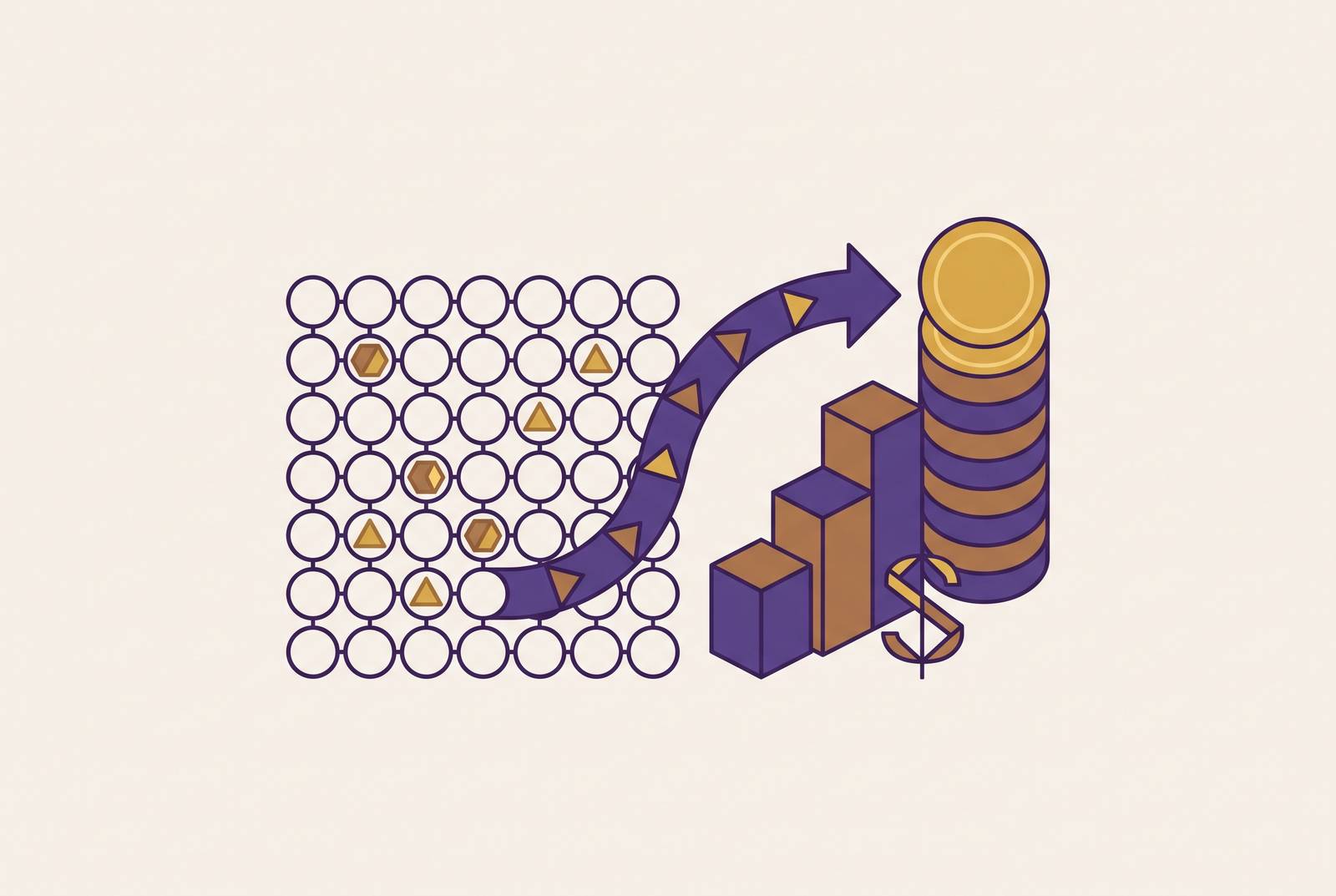
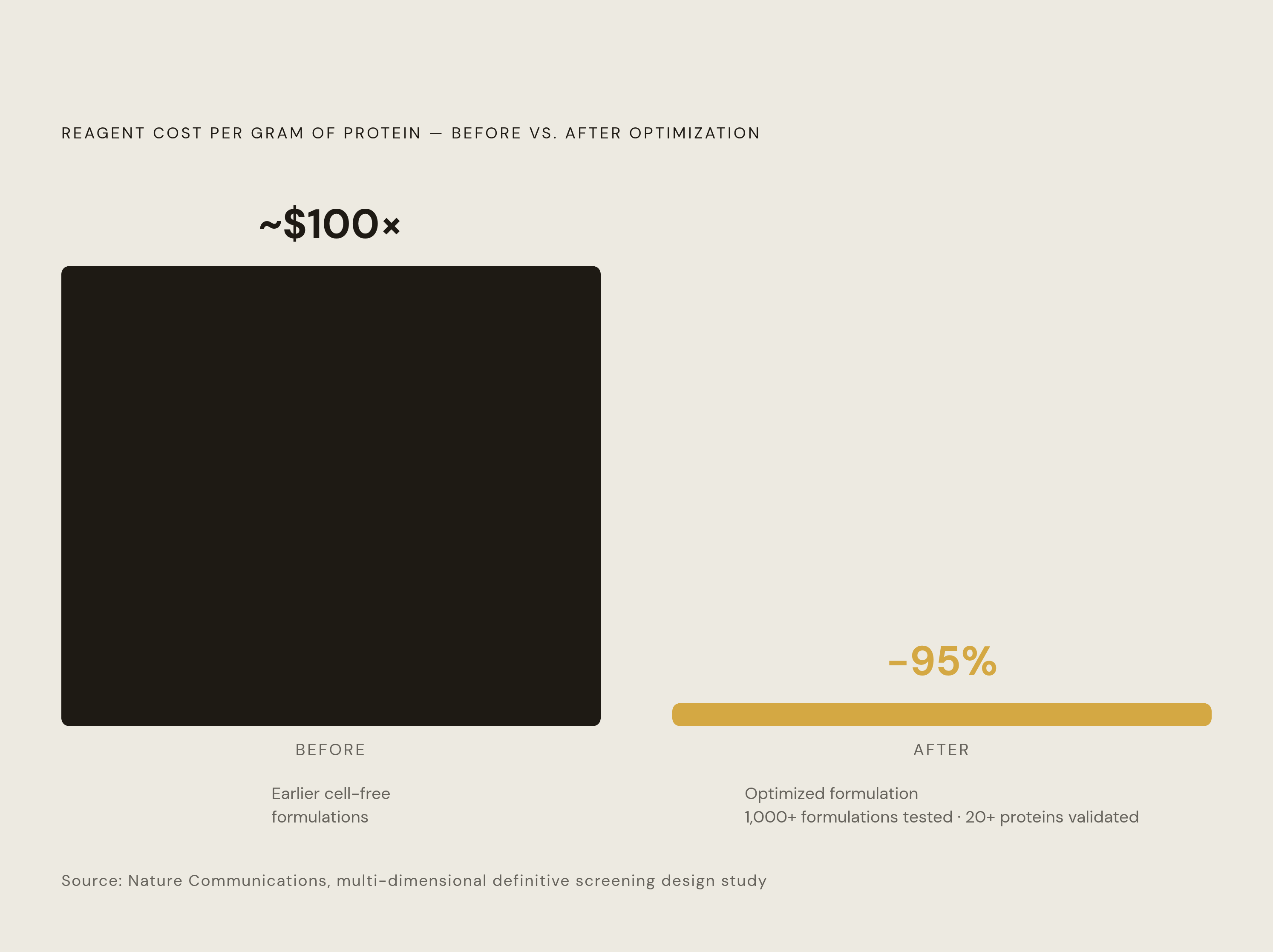
A protein engineer staring at a library of a few hundred variants knows the arithmetic before running a single plate: each construct needs its own transformation, its own colony pick, its own growth curve, and the whole cycle runs on a clock measured in days, not hours. That clock is not a matter of poor lab technique or underfunded equipment. Compressing the transformation-growth-induction-harvest cycle takes days to weeks no matter how the strain or the media is optimized. Toxic proteins and membrane proteins make the problem worse: membrane protein overexpression is generally toxic to living cells and caps yield, and some cytotoxic targets cannot be produced in a living host at any yield. Cloning and transformation also impose a fixed cost on every single variant; a design-of-experiments-driven study published in Nature Communications used a multi-dimensional definitive screening design across more than a thousand different reagent formulations, demonstrating an average reduction in cost per gram of protein of roughly 95% over previous cell-free reagent formulations, with the optimized formulation producing protein robustly across batches, users, locations, and more than 20 different proteins.
How CFPS changes the economic variables that govern throughput
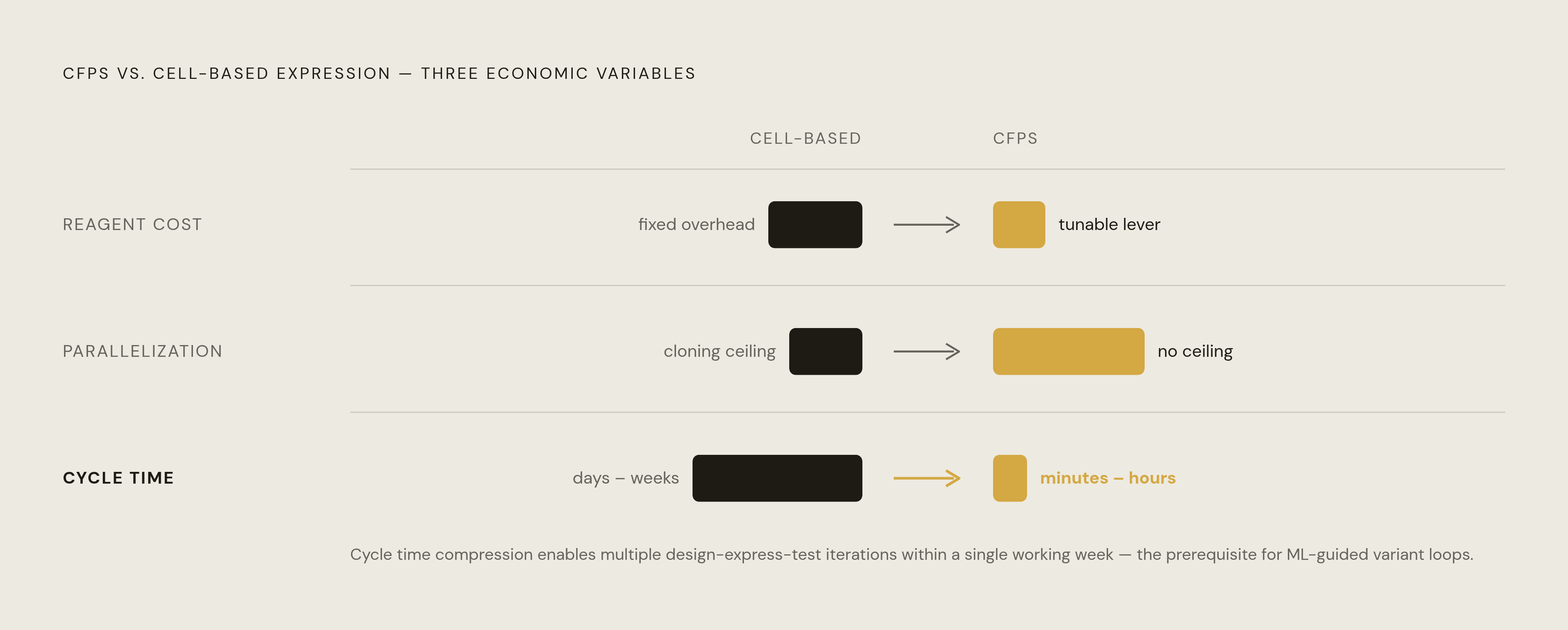
Cell-free protein synthesis changes the underlying accounting rather than just speeding up one stage of it, because it separates protein production from the question of whether a cell stays alive to make it. Three variables govern the economics of any variant screening campaign: the reagent cost of each individual reaction, how many reactions can run in parallel, and how long each design-express-test cycle takes. CFPS moves all three at once. Reagent cost per reaction becomes the main lever rather than culture scale, because an open reaction vessel allows real-time control over pH, temperature, and substrate concentration, and those parameters can be tuned directly to raise yield per microliter. Parallelization is no longer bounded by cloning and transformation: cell-based expression takes days to weeks, CFPS operates on a minutes-to-hours timescale, and iteration speed shifts to minutes or hours, so a researcher can run several design-express-test cycles inside one working week instead of waiting one week per cycle. These three variables do not move independently. When cycles run faster, each dollar spent on reagent produces more data points over the same stretch of time, and when parallelization rises, the cost of each data point falls as the library gets bigger instead of rising, which reverses how cell-based screening behaves as it scales.
How cell-free chassis choice affects cost, yield, and reproducibility
None of those three variables is a fixed property of CFPS as a category. Each shifts depending on which cell-free chassis a lab picks, and the right pick depends on what the target protein needs. E. coli extracts deliver the highest protein yield among the common chassis, the lowest reagent cost, and the least batch-to-batch variation, which makes them the default for most variant screening work where the protein does not need post-translational modification. The economic advantage of E. coli extracts compounds because the chassis optimizes all three variables together: lowest cost per reaction, highest yield per microliter, and a reproducibility profile that holds up across batches. That is why suppliers building around E. coli as the primary chassis, rather than as an afterthought, can keep driving formulation costs down through dedicated quality control.
Wheat germ and rabbit reticulocyte lysates produce less protein and cost more than E. coli extracts, but they matter for eukaryotic proteins where the folding environment changes the outcome, and commercial eukaryotic CFPS kits run substantially more expensive than their E. coli counterparts. The PURE system takes a different approach: a fully recombinant set of defined components removes extract-to-extract variability at the cost of higher reagent expense and a smaller biochemical toolkit, making it the right choice where reproducibility across batches is the priority over raw throughput or yield. Insect cell lysates derived from Sf21 cells carry translationally active endogenous ER membranes, which support signal peptide-mediated translocation, signal peptide cleavage, N-glycosylation, and lipid modification, making this chassis the natural choice for membrane proteins and glycosylated targets that need that processing. Pichia pastoris cell-free systems show how fast a non-E. coli chassis can close the cost gap: an optimized version built around a modified Kozak sequence, PEG-6000, and spermidine achieved a tenfold increase in protein yield alongside an 89% reduction in cost per gram. The claim that eukaryotic CFPS is too expensive to use for screening is getting weaker as this kind of chassis-specific optimization accumulates, but for most campaigns that don't require PTMs, E. coli extracts remain the rational default on cost grounds alone.
Reagent cost structure
The economic argument against CFPS always had real numbers behind it. Reagent costs were genuinely prohibitive at the scale a serious screening campaign demands, and that fact shaped a decade of skepticism toward the format. Those numbers have since moved substantially, and understanding why requires knowing where the money actually goes inside a cell-free reaction. Reagent cost makes up the large majority of total operating expense in CFPS, and within that reagent bill, the nucleotide triphosphates, ATP, GTP, CTP, and UTP, account for the single biggest line item. The cost figures that critics still cite mostly date to a period when reagent formulations were relatively crude and batch variability was high, so an argument built on those numbers is arguing against a target that no longer exists.
A design-of-experiments study published in Nature Communications tested more than a thousand distinct reagent formulations using a multi-dimensional definitive screening design, and the optimized formulation that came out of it cut cost per gram of protein by roughly 95% compared to earlier cell-free reagent formulations, while producing protein robustly across different batches, different users, different locations, and more than 20 different proteins. A separate effort, an autonomous LLM-driven lab, achieved a substantial reduction in the specific cost per gram of CFPS output accompanied by a meaningful increase in protein production titer, suggesting that algorithmic optimization of reaction conditions is an independent and continuing source of cost improvement. These gains do not eliminate batch-to-batch inconsistency in extract quality and activity. Keeping extract quality and activity consistent across batches is still genuinely hard, and batch variability can quietly corrupt dose-response data across an entire screening campaign. The Nature Communications result answers that concern directly by demonstrating cross-batch robustness, though it covers a finite set of proteins rather than every possible target. Transparency changes the economics of troubleshooting in practice: when a researcher knows what is in a reaction and can check it against lot-level quality control data, batch variability becomes diagnosable rather than a mystery that burns a week of bench time. That gap, between an open reagent system a lab can inspect and a sealed kit it has to trust blindly, is the real operational line between formats.
Three cases where CFPS throughput economics determined what was possible
The case for CFPS in variant screening does not rest on projections. Three recent studies map onto the three variables directly.
On iteration cycle time, researchers at the University of Edinburgh, publishing in ACS Synthetic Biology in 2025, used CFPS in microplate format to screen protease variants generated by a machine-learning model. The CFPS screen finished in hours what cell-based validation of the same variant set took a full working week to complete, and the best performer, a variant called TB27, showed fitness fourfold higher than the original Con1 protease. That speed difference is what made the ML-CFPS iteration loop possible in the first place: a model proposing new variants needs fast feedback to improve its next round of proposals, and a week-long cell-based cycle would have throttled the loop before it could learn anything useful.
On whether purification has to happen before a variant can be ranked, a 2026 study in FEBS Open Bio looked at staphylokinase, a fibrin-specific thrombolytic protein, and found that activity rankings generated from crude, unpurified CFPS reaction mixtures closely tracked rankings from purified protein, measured with a chromogenic plasminogen-activation assay. That result removes one of the standard objections to using CFPS for functional screening, since it means purification, a real cost and time sink in any screening workflow, is not required at the early stage where the job is simply finding which variants are worth pursuing further.
On the parallelization ceiling, a Harvard platform published in JACS in July 2025 paired cell-free expression with droplet microfluidics to multiplex screening by orders of magnitude beyond what plate-based CFPS alone can reach. Applied to Bacillus subtilis Lipase A, the platform found multiple variants carrying roughly a dozen substitutions each, with thermotolerance improved by more than 40°C after a single round of mutagenesis. Reaching that result through cell-based screening would have demanded a campaign large enough to make the attempt impractical for most labs. These three studies span different points on the throughput spectrum: tens of variants at Edinburgh, hundreds in the staphylokinase work, and into the millions with the droplet platform. All three rely on CFPS as the technology that made the result reachable.
Where cell-based expression retains a genuine advantage
None of this makes cell-based expression obsolete. The stronger and more defensible claim is narrower: CFPS should be the first expression decision for variant screening, with cell-based systems kept in reserve for the specific situations where biology still requires them. Post-translational modification is the clearest of those situations. PTMs produced in prokaryotic CFPS systems frequently differ from the native versions, so for glycosylated targets, CFPS functions as an early-stage screening tool rather than a platform for final production. That limitation applies to a specific category of targets, glycoproteins and certain secreted proteins, and to a specific stage of work, late-stage characterization that depends on native-like glycoforms, not to the variant screening stage this piece is about. Eukaryotic chassis close part of that gap. Insect cell lysates from Sf21 cells support signal peptide-mediated translocation, signal peptide cleavage, N-glycosylation, and lipid modification, which addresses much of the membrane protein PTM problem, though at a higher reagent cost than E. coli systems.
Milligram-scale production is the other place cell-based expression keeps its footing. When a final characterization assay needs more protein than CFPS can deliver economically, or needs native PTMs the assay depends on, cell-based production is the right tool for that stage. The practical rule that falls out of these two limits is straightforward: use CFPS to find the best variants in a large library quickly and cheaply, then switch to cell-based expression to produce milligram quantities of the finalists for PTM-sensitive assays and final characterization. Treated this way, the two formats are stages in a single pipeline, not rival technologies competing for the same job.
Reagent transparency and lot standardization compound the throughput advantage
The economic gains described above depend on screening data from one day and one lot being trusted against data from another day and another lot. Reagent transparency is the condition that makes the throughput math hold. When a reagent formulation is opaque and a researcher can't inspect what's driving an unexpected result, unexplained lot variation forces a choice: run replications that add cost and time, or discard data that compounds the cost, and either way it eats directly into the throughput advantage CFPS was supposed to deliver. Lot-level quality control data turns that uncertainty into something measurable: a team running a screening campaign that spans several weeks can check its own results against published lot QC figures instead of working backward from first principles every time a plate looks off.
A second multiplier comes from infrastructure compatibility. CFPS reactions run in standard microplates inside standard incubators, the same hardware already used for other high-throughput assays, so gains in throughput stack on top of whatever automation a lab already runs rather than requiring new dedicated equipment. Reagent cost per reaction becomes the primary lever precisely when a CFPS system is engineered from the start for plate-based parallelization and automated screening, a design choice some suppliers, Sepia Bio among them, build directly into formulation and pricing rather than bolting on later as a compatibility feature. That design decision is also why documentation and lot-level QC data matter in practice: a researcher scaling a screen across dozens or hundreds of parallel reactions needs to know precisely what's in each well and needs confidence that batch-to-batch consistency will hold across the full experimental matrix. Sepia Biosciences' OpenCFPS™ reagents are built specifically for plate-based, high-throughput variant screening and for milligram-scale production, with formulations and lot-level QC data documented rather than kept proprietary, and that transparency is what turns troubleshooting into a diagnosable process instead of a guessing game, which is the same quality that makes a large screening campaign something a lab can actually plan around rather than merely attempt. The transformation overhead that cell-based screening imposes on every variant is not just a delay. It creates a pricing cliff that makes large combinatorial libraries irrational to attempt under cell-based economics, and cell-free systems remove that cliff only if the reagent itself is formulated and priced for genuine parallel use, because a system built primarily for milligram-scale production and adapted afterward for screening will still run into the same economics it was meant to escape.
Sources
- Cell-Free Protein Synthesis as a Method to Rapidly Screen Machine Learning-Generated Protease Variants - PMC
- Ultrahigh-Throughput Multiplexed Screening of Purified Protein from Cell-Free Expression Using Droplet Microfluidics | Journal of the American Chemical Society
- Cell-Free Protein Synthesis as a Method to Rapidly Screen Machine Learning-Generated Protease Variants | ACS Synthetic Biology
- Rapid screening of staphylokinase protein variants using an unpurified cell‐free expression system - PMC
- Optimizing Pichia Pastoris Cell‐Free Protein Synthesis to Improve Economics - Wu - 2026 - Biotechnology and Bioengineering - Wiley Online Library
- Design-driven optimization of low-cost reagent formulations for reproducible and high-yielding cell-free gene expression
- GPT-5 lowers the cost of cell-free protein synthesis
- Rapid screening of staphylokinase protein variants using an unpurified cell‐free expression system - Tomková - 2026 - FEBS Open Bio - Wiley Online Library