CFPS Reagent Pricing Models for High-Volume Screening Labs
Choosing the right pricing model determines how many variants a lab can screen.

For high-volume protein variant screening, the reagent pricing model governs how many variants a lab can actually afford to test. Three procurement paths exist: per-reaction commercial kits, volume-negotiated supply agreements, and open-formulation systems, and each produces a different cost curve as reaction count climbs into the thousands. A lab running a 384-well campaign across a library of several thousand variants is choosing, through its reagent contract, how large that library is allowed to get.
CFPS as the right platform for high-volume protein variant screening
Cell-based expression systems hit a ceiling that has nothing to do with how clever the variant library is. Transformation efficiency limits how many constructs enter cells at once, cellular toxicity responses kill off expression for some fraction of variants before they can be measured, and metabolic burden distorts the readout for whatever survives. Cell-free protein synthesis (CFPS) removes those constraints by producing protein outside a living cell. Patsnap Eureka's October 2025 analysis frames the technology's purpose in high-throughput screening as accelerating discovery and optimization of novel proteins and enzymes, free of cellular viability requirements, transformation efficiencies, and the kind of complex cellular environment that can mask how a protein actually performs.
The payoff appears in cycle time. A design-build-test-learn loop that takes one to two weeks when it depends on live cells compresses to one to two days when run through CFPS, and that compression is what turns iterative variant screening from a slow, batch-limited process into something a lab can run continuously. Thornton and colleagues, writing in Protein Science in 2024, describe the pattern this enables in practice: design tens to hundreds of sequences, rank them by a predicted property, express a subset through CFPS, measure activity, and carry the best performers forward. CFPS sits as the filter between computational design and the far more expensive step of cell-based validation. If a platform can, in principle, run thousands of these reactions in parallel without the biological ceilings that cap cell-based systems, the question becomes what else is capping it instead.
Reaction scale, format, and variant testing capacity
The answer starts with format. Whether a lab runs reactions in tubes, 96-well plates, or 384-well plates changes how many variants a fixed reagent budget can cover, which makes the choice of plate format a scientific decision as much as a logistical one. CFPS reactions run on standard plate-based automation already sitting in most molecular biology labs: liquid-handling robots, digital microfluidics platforms, and ordinary incubators, with no specialized hardware required to get started.
A 2026 autonomous lab study, cited in research covering CFPS optimization work, ran successful 20-microliter reactions primarily in 384-well plates, with lower-throughput follow-up checks done separately in 96-well plates and 2-mL tubes. The 384-well format packs the most reactions into the smallest reagent footprint. It dominates the highest-throughput work. CFPS has already been used to map enzyme variant activity landscapes inside machine-learning-guided workflows, but full robotic automation of those pipelines at the scale of thousands of variants is still just a stated future direction. A concrete instance of the pattern already exists: in 2025, a paper in ACS Synthetic Biology used CFPS specifically to screen protease variants generated by a machine learning model, putting the computational-design-to-CFPS-filter pipeline into production use rather than leaving it theoretical. Even reagent architecture is being built for this kind of automation. The modular i-POPFLEX system assembles 34 translation factors, each synthesized individually in vitro, through automated liquid handling, which shows that component-level modularity, not just plate format, is being engineered for compatibility with high-throughput workflows.
Sepia Bio's OpenCFPS™ reagent line is built specifically for this kind of plate-based automation, compatible with 96-well and 384-well formats, standard liquid-handling robots, and ordinary incubators, so that shrinking reaction volume translates into real per-variant savings instead of just a change in plate geometry. That distinction matters because miniaturization alone does not save money under every pricing model. As reaction volumes shrink, the amount of reagent consumed per variant drops sharply, but under commercial kit pricing, the cost charged per reaction stays fixed no matter the volume. That mismatch, between what a smaller reaction actually consumes and what a lab is charged for it, is where the economics of high-throughput screening are decided.
The three reagent procurement models a screening lab can choose from
Three structurally different models govern how a lab pays for CFPS reagents at scale, and each produces a different cost curve as reaction count rises: per-reaction commercial kits, volume-negotiated or custom supply agreements, and in-house or open-formulation systems.
Commercial kits charge a fixed price per reaction no matter how many reactions a lab runs, so total cost scales linearly with reaction count and carries no built-in discount for high throughput. Research documenting CFPS reagent pricing points to at least one commercially available kit whose list price illustrates just how extreme that per-reaction ceiling can get, with costs compounding by an order of magnitude once a screen reaches library scale. The advantages of this model are genuine: no in-house preparation overhead, known batch-to-batch consistency, vendor-run quality control, and a ready-to-use format that suits labs running occasional or low-volume experiments. The limitation becomes visible at scale. For a lab running hundreds of 384-well plates, linear cost scaling at kit prices turns a large library screen into something that is simply not affordable without a separate budget intervention.
Volume-negotiated or custom supply agreements work the way bulk procurement works in any other industry. Large core facilities, CROs, and pharmaceutical buyers routinely secure substantial discounts off list price through volume commitments or annual contracts, and the same logic applies directly to CFPS reagent purchasing. This model keeps some of the vendor quality-control benefit while it lowers per-reaction cost, but it demands volume commitments that small and mid-size labs often cannot make, and the underlying formulation stays undisclosed either way. Negotiated rates are also not made public, so a lab signing one of these contracts has no real way to confirm whether the rate it secured is actually competitive.
In-house or open-formulation systems represent the third path, and recent work has made this option far more accessible than it used to be. Lang and colleagues, in a 2025 bioRxiv preprint, showed that the essential core reaction components of an E. coli CFPS system can be cut from 35 down to 7 without sacrificing expression level, directly lowering the barrier to preparing reagents in-house. Open-formulation systems give a lab full visibility into what it is running, along with the ability to troubleshoot and standardize batches, though they require upfront investment in protocol development and extract preparation. Sepia Bio's OpenCFPS™ occupies a distinct spot inside this category: a commercially supplied, fully documented, open-formulation reagent system sold at a published per-mL price, combining the convenience of buying a commercial product with the transparency and cost structure usually associated with building reagents in-house. None of these three models is wrong on its face. Which one fits depends on how many reactions a lab actually needs to run.
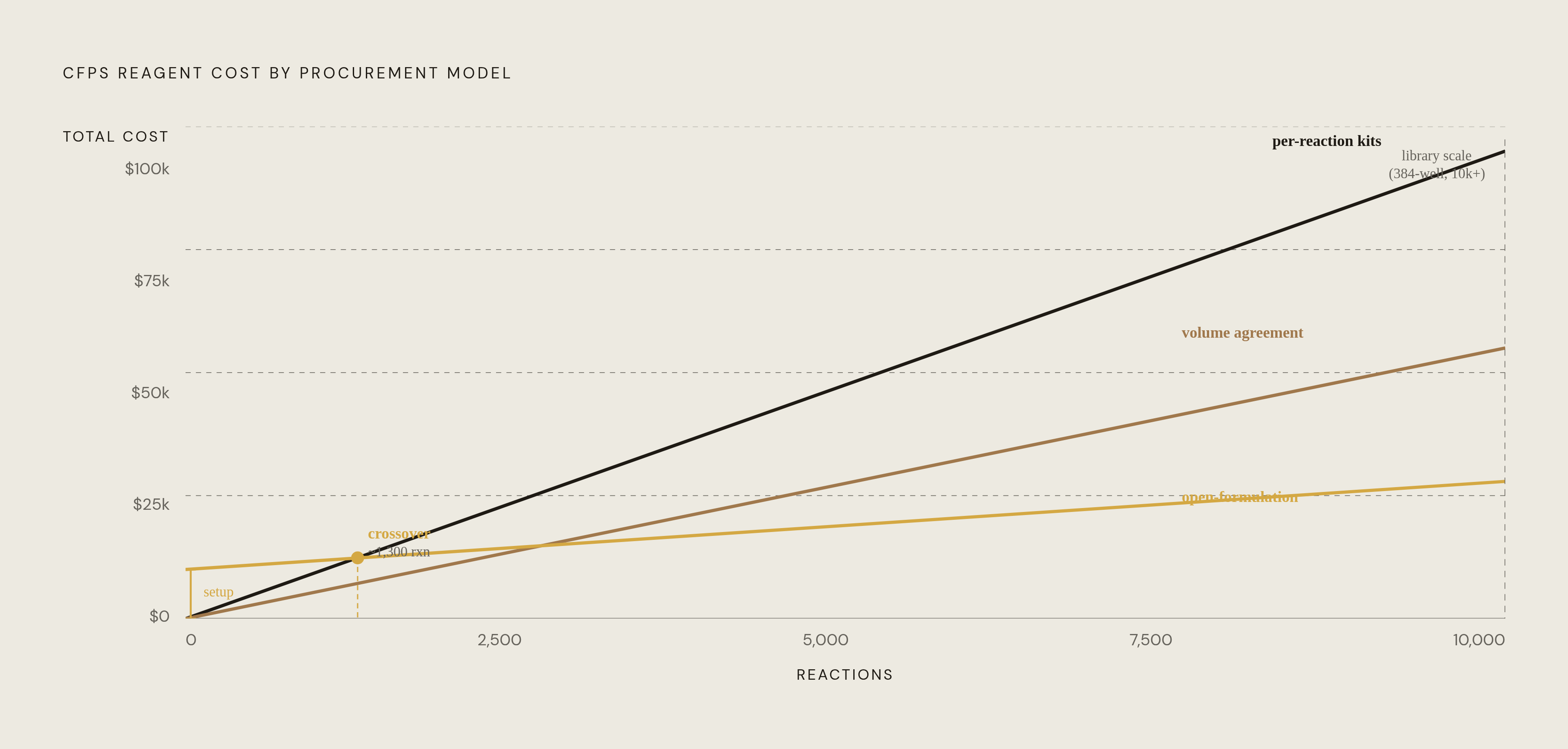
Commercial Kit Pricing at Scale
Under per-reaction kit pricing, total reagent cost rises in direct proportion to library size. That linear relationship means the pricing model, not the underlying chemistry, sets the practical limit on how many variants a team can afford to test. Before recent optimization work reshaped the cost structure of cell-free expression, reagent costs made up most of all material costs tied to a CFPS campaign, and commercial kit pricing still reflects that older, more expensive baseline.
Olsen and colleagues, publishing in Nature Communications in 2025 out of the Michael Jewett lab, screened over a thousand reaction mixtures and achieved an average cost reduction of roughly 95 percent over previous cell-free reagent formulations. The 2026 autonomous lab study pushed further still, and it produced sfGFP at a substantially lower cost per gram than the prior state of the art. Set against commercial kit list pricing, the gap between what an optimized formulation costs to run and what a kit charges per reaction spans orders of magnitude, not just a marginal percentage difference.
Consider what that gap does to a real campaign. A lab running a 384-well plate screen across a library of several thousand variants is purchasing a fixed, large number of individual reactions. Every dollar of per-reaction price difference between a kit and an optimized open formulation gets multiplied across every plate in that campaign, and the total campaign cost becomes a variable the pricing model controls more directly than the science does. Kit pricing does bundle in things an in-house system has to budget for separately: quality control, batch consistency, and preparation time, so the fair comparison is total cost of ownership rather than sticker price per reaction alone. Even when you account for that preparation overhead, the cost differential between kit pricing and optimized open formulations stays large enough that open-formulation approaches remain cost-competitive once volume gets high enough. The open question for any given lab is simply where that crossover point sits for its own volume and staffing.
The current cost optimization frontier
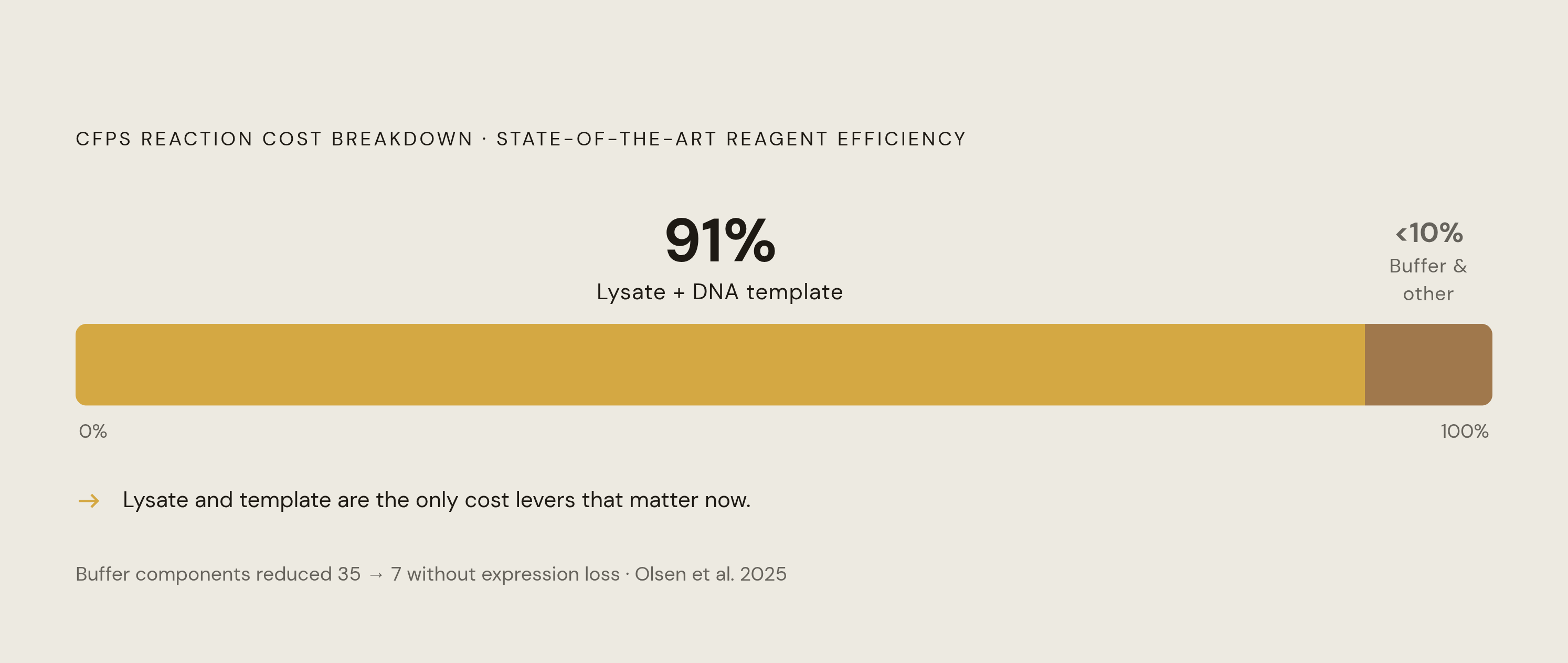
The economics of CFPS are moving, and where the frontier currently sits tells a lab which part of its reagent budget is actually worth optimizing. The 2026 autonomous lab study found that cell lysate and DNA template now account for more than 90 percent of total CFPS reaction cost at state-of-the-art reagent efficiency, so reaction buffer chemistry no longer drives cost and complexity the way it once did, and Olsen et al. (2025, bioRxiv) show that reducing core buffer components from 35 to 7 is achievable without sacrificing expression. The next round of cost gains in reagent economics will come from supply chain decisions and formulation transparency around lysate and template.
For a lab buying commercial kits, though, lysate composition is typically undisclosed, so there is no way to tell from the outside whether that lysate is driving cost, driving quality, or both. For labs running open-formulation systems, lysate sourcing and quality become a variable they can actually tune, and lot-level quality-control data becomes essential for distinguishing variability caused by the lysate itself from variability caused by how the protocol was executed.
The i-POPFLEX system takes a different route to the same underlying problem. By synthesizing all 34 translation factors in vitro and assembling them through automated liquid handling (with the exception of T7 RNA polymerase, which is not itself produced in vitro), it substantially reduces the cell-derived extract variability that comes from working with a crude lysate, at the cost of a more complex set of components to manage. A lab that has no visibility into what is actually in its reagent has no way to know which lever to pull when costs need to come down or performance needs to improve. Sepia Bio's disclosure of reagent formulations and lot-level quality-control data gives labs a basis for benchmarking their own per-reaction economics against the actual composition of what they are running. Formulation transparency functions as an operational requirement for cost optimization at scale, not simply a preference some labs happen to have.
Reagent variability as a scientific problem pricing models hide or expose
High variability between CFPS reagent lots is not just a cost nuisance. It threatens the validity of comparative screening data outright, and pricing models that keep formulations undisclosed make it structurally harder for a lab to find or fix the source of that variability.
Interlaboratory studies show the scale of the problem clearly. When three separate laboratories ran a single shared CFPS protocol using materials prepared independently and exchanged between sites, the coefficient of variation came in well above what any screening program could tolerate, but it came in much lower when a single operator ran the same protocol across multiple days using one set of materials. The source of that discrepancy was not the lysate itself. Extract preparation did not explain the variability observed in that study, while reagent preparation and handling did. The problem lives in formulation and protocol discipline rather than in the underlying biology of the lysate.
Variability within a single lab is a more solvable problem. One bacterial CFPS system showed meaningful differences in output between different lysate lots, but less than 5 percent variability between replicate experiments run on the same lot, pointing to lot-level standardization as the single most effective lever for improving reproducibility inside one lab. Optimized protocols back this up directly: coefficient of variation can be cut dramatically through careful extract preparation, full solubilization of master mix components, and tightly controlled reaction mixing. The variance CFPS labs fight is a function of protocol and formulation discipline.
The trouble is that the attributes known to actually drive CFPS performance, ribosomal integrity, protease concentration, nuclease inhibitor levels, are difficult to measure directly in a complex lysate. That makes a black-box commercial formulation especially hard to troubleshoot when a screen turns in a result nobody expected. A lab running thousands of variants through a kit whose formulation it cannot see has no way to tell whether an odd result reflects a real biological finding or a lot that shifted quietly between shipments. Formulation transparency is what lets a lab tell those two things apart, and a lab's pricing model decides whether it has access to that transparency.