Cost-per-Reaction Breakdown for Commercial CFPS Kits
How to calculate the true cost of cell-free protein synthesis reactions.
Cost-per-reaction math for commercial cell-free protein synthesis (CFPS) kits usually stops at one division problem: list price divided by number of reactions. That number is wrong more often than it's right, sometimes by a factor of ten, because it skips over reaction volume, protein yield, and the way scale changes both at once. What follows breaks the true cost apart piece by piece, using published kit data and cost studies, so a comparison between two kits actually means something before money changes hands.
The variables that determine cost per reaction
Four numbers set the floor for any honest calculation: kit list price, the reaction volume in microliters, the number of reactions per kit, and the yield each reaction produces. If one of them is skipped, the whole comparison falls apart. A kit priced for 10 reactions isn't a clean per-reaction slice of that price if each reaction only draws 15 µL of lysate while the rest of the money goes to buffer, template, and an amino acid mix sold as separate line items.
The number people skip most often is the cost per microliter of the lysate or reconstituted component itself, the actual unit that scales. Reaction volume, reaction count, kit size: all of that just multiplies on top of that base rate. Energy regeneration reagents matter too. After labor, they're usually the second-biggest expense line in a PANOx-SP-style reaction, and the choice of energy regeneration substrate can meaningfully affect that cost line. Add the amino acids and cofactors bundled into "all-inclusive" kits versus bought separately, then add labor on top of that. The Genetic Code Kit cost analysis valued technician time at $25 an hour and found it made up a real share of total reaction cost even at bench scale, not some rounding error tucked at the bottom. Template DNA, whether it's a miniprepped plasmid or a synthesized linear fragment, is almost never included in kit pricing. Someone still pays for it, and that someone is rarely accounted for on the budget line labeled "kit."
Scale changes the arithmetic on its own terms. A Nature Communications study ran the same reagent formulation at 15 µL and got 2.4 ± 0.3 g/L of protein; at 4 mL, with oxygen added, yield climbed to 3.7 ± 0.2 g/L. Same chemistry, same formulation, and the economics land in completely different places. Throughput pulls the same lever from a different angle: a 10-reaction pack and a 100-reaction pack of the same kit from the same vendor often carry meaningfully different per-reaction costs, and the catalog page rarely lists that bulk pricing anywhere. Converting list price to a per-microliter figure is the first real step in this math. Yield, scale, throughput: all of it builds off that one number.
Kit class as the cost ceiling before any other variable is considered
Before yield, before scale, before any secondary variable gets involved, the kit's underlying architecture sets a hard ceiling on what it can possibly cost. Two dominant classes exist, and they are nowhere near each other on price.
Reconstituted systems, the PURE-type kits, rebuild the translation machinery from individually purified components. Every protein, every factor, every ribosome subunit goes in on purpose, which buys a defined, protease-free, nuclease-free system with a level of reproducibility crude lysate can't touch. Crude lysate systems run the opposite way: the cell extract keeps its full native complement of translation machinery, so the system stays less defined, but the yield ceiling sits far higher and cost per microliter drops with it.
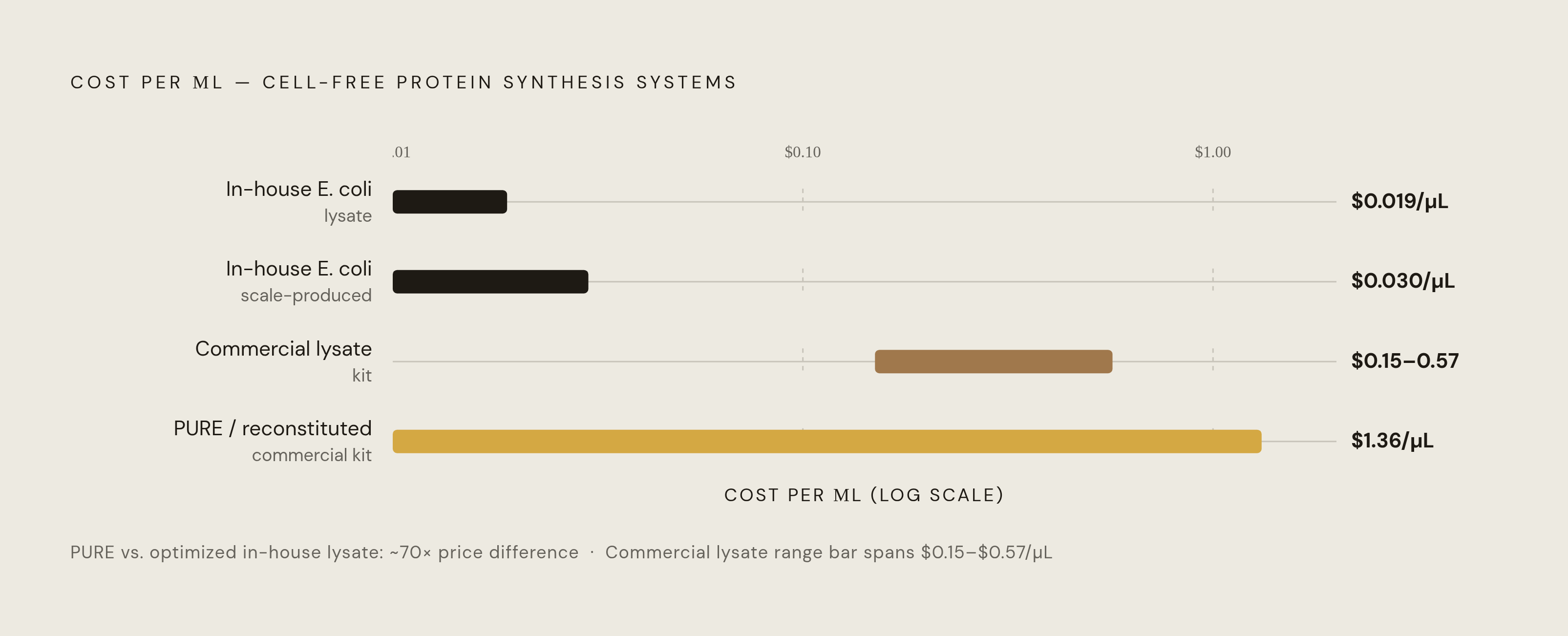
The gap between the two classes isn't a rounding difference, and treating it as one is where most budget comparisons go wrong. Commercial PURE kits run around $1.36 per microliter, the most expensive class sold today. Commercial lysate kits run $0.15 to $0.57 per microliter. In-house E. coli lysate, prepared rather than bought, drops to roughly $0.019 per microliter, and lysate produced at scale has been reported near $0.03 per microliter. A researcher running routine protein screens on a PURE kit pays somewhere between 25 and 70 times more per microliter than a lab running well-optimized in-house lysate, before yield differences even enter the picture.
That premium buys something real, but only for a narrow set of experiments. Mechanistic studies, genetic code reprogramming, quantitative biochemistry where an undefined lysate background would wreck the readout: these are the places where a reconstituted system earns its price tag. Picking PURE for anything else makes the choice stop making sense. High-throughput screening of variant libraries, milligram-scale production runs, anything cost-sensitive: all of it points toward crude lysate instead. E. coli-based systems already hold the largest share of the commercial CFPS market, 47.1% in 2024 according to MarketsandMarkets, which suggests most researchers have already settled into the cheaper lysate tier whether or not they ever ran the per-microliter math themselves.
What specific commercial kits cost, broken down per reaction
Reconstituted E. coli kits built on the PURE architecture typically run a 25 µL reaction with around 250 ng of template DNA and 20 units of RNase Inhibitor, incubated two hours at 37°C. At the roughly $1.36-per-µL benchmark, a single 25 µL reaction carries a reagent cost near $34 before markup or discount, though the actual number needs checking against the current vendor listing rather than assumed from a class average. Specialized variants for non-natural amino acid incorporation, isotope labeling, and ribosome-free reconstitution carry their own per-microliter pricing that should be confirmed directly against current vendor listings. DIY efforts aimed at undercutting commercial PURE pricing have had mixed results at best: one such effort, TraMOS PURE, brought cost down from $1.36/µL to $0.96/µL but only reached about 20% of the protein yield of the commercial kit it was measured against. On a cost-per-gram basis it actually came out worse despite the lower sticker price, which is the whole trap of judging these kits on list price alone.
Lysate-based E. coli kits get marketed explicitly around cost-effectiveness, and commercial lysate kits broadly land inside that $0.15 to $0.57 per microliter range. Pinning down an exact per-reaction number means knowing the specific reaction volume and current list price together, since vendors don't always publish both in the same place.
A newer generation of E. coli lysate kits supports both Sigma 70 and T7 promoter-based expression from linear or plasmid templates, with a helper plasmid for T7 expression included in every kit size. The published yield benchmark is 0.25 mg/mL of a fluorescent reporter protein across tested promoters after 16 hours of expression, useful for anyone trying to back into a cost-per-milligram figure. Bulk formats matter most for high-throughput users here, since per-reaction cost can drop substantially at volume even though the custom pricing itself isn't published anywhere public.
A related kit formulated for disulfide-bond-containing proteins, aimed at antibody fragments like VHH, ScFv, Fab, and IgG constructs, reports a yield over 100 µg of ScFv from a 400 µL reaction, enough for multipoint ELISA and surface plasmon resonance work. That 400 µL reaction runs 16 times larger than a standard 25 µL PURE reaction, so stacking a cost-per-reaction number against a PURE kit without normalizing for volume first produces a meaningless comparison.
Eukaryotic lysate kits built for coupled transcription and translation in a single tube offer better fidelity for post-translational modifications, but pricing for at least one major system in this category is missing from the vendor's product page. It requires a direct quote, which is its own kind of transparency problem for anyone trying to budget ahead of time.
A plant-based eukaryotic system, drawn from Nicotiana tabacum BY-2 cells, ships in a 60-reaction format at 50 µL each, bundled with lysate aliquots and two expression vectors. Batch-mode yield for an eYFP reporter reaches 3 mg/mL, notably higher than prior benchmarks for established CFPS platforms, which at 50 µL per reaction works out to roughly 0.15 mg of protein per reaction. The system also carries native eukaryotic post-translational modification, including disulfide bond formation and N-glycosylation, through microsomes carried over from the endoplasmic reticulum and Golgi.
A wheat germ-based kit runs at a larger 5.5 mL sample scale per kit, yielding 0.5 to 1 mg of protein, built around straightforward linear scale-up and high solubility for hard-to-express targets: kinases, GPCRs, transporters, multimeric complexes, toxic proteins spanning 10 kDa to over 220 kDa. Wheat germ systems generally land in a middle tier, between E. coli lysate and mammalian lysate, on both cost and eukaryotic modification capability.
The one fully costed, publicly documented benchmark that includes labor comes from an educational, open-source E. coli kit described by Oza and colleagues (2020): $4.08 per student for four CFPS reactions, working out to $1.02 per 30 µL reaction, materials, reagents, and labor at $25 an hour all counted. It isn't a commercial product, but it's the only source here that shows the full, unhidden cost stack from top to bottom.
At least eight commercial E. coli CFPS platforms exist on the market right now. The kits detailed above are simply the subset where published yield or volume data is complete enough to support real per-reaction analysis.
Yield per reaction and its reshaping of cost comparisons that look settled on list price alone
Per-microliter cost is necessary, but it settles nothing by itself. A kit priced at $0.57 per microliter that produces ten times the protein of a kit priced at $0.15 per microliter is the cheaper kit, full stop, once the comparison runs per milligram of product instead of per reaction. Anyone still ranking kits by sticker price alone is comparing the wrong thing.
The historical baseline here is the PANOx-SP system, long cited at roughly $4,083 per gram of protein, high enough that commercial CFPS simply couldn't compete with cell-based E. coli production for most applications. That baseline has moved, and moved hard. Warfel and colleagues, in Nature Communications, screened 1,231 candidate reagent formulations down to a 12-component optimized mix producing 2.4 ± 0.3 g/L at 15 µL scale, around $60 per gram of protein, and 3.7 ± 0.2 g/L at 4 mL scale with oxygen supplementation, around $39 per gram. That's roughly a 95% cost reduction against earlier cell-free reagent formulations, and it came from stripping out expensive secondary energy substrates, not from reinventing the underlying lysate chemistry from scratch. The formulation held up across different batches, different users, different labs, and more than 20 proteins across different batches, users, and labs.
The PURE side has its own version of this story. The i-POPFLEX formulation delivered several times the protein yield alongside a real cost reduction, pulling per-microliter cost down to a fraction of the $1.36 benchmark for commercial PURE kits. Yield gains and cost cuts don't always trade off against each other. Sometimes a formulation change buys both at once, and i-POPFLEX is the clearest evidence of that on record.
Kit cost divided by expected yield in milligrams is the calculation that matters. Kit cost divided by number of reactions is the one most people actually run, and the two can point to opposite conclusions about which kit is cheaper. Yield itself isn't a fixed property stamped on the kit either, it's protein-dependent. A kit posting strong numbers for a soluble reporter like GFP or deGFP can underperform badly on a toxic, insoluble, or multi-domain target. The benchmark number on the box predicts a lot less than it looks like it should, and treating it as gospel is how budgets go sideways mid-project.
Throughput and scale changes to the economics in ways single-reaction pricing cannot capture
Reaction scale doesn't just move yield, as the 15 µL versus 4 mL comparison already showed. It changes which kit counts as the rational purchase to begin with. A kit that looks like the budget option at small scale can turn into the expensive one the moment a lab needs milligram quantities, and a kit priced at a premium per reaction can end up cheaper per milligram once it's ordered at the volume a real production run actually requires.
None of the per-reaction or per-microliter numbers above capture that shift, because every one of them assumes a single reaction run once. Throughput changes the denominator. A 100-reaction pack priced below the per-reaction rate of the 10-reaction version of the same kit rewards labs running variant libraries or dose-response panels, where dozens or hundreds of reactions run side by side. A lab running one or two expression tests a month gets none of that benefit and pays the small-pack rate no matter what the catalog implies is possible further up the scale.
Bulk and custom formats make spec-sheet comparison even harder, since custom pricing at volume almost never gets published anywhere public. A kit's list price describes one point on a cost curve. Getting the real number means asking three questions against the actual planned experiment: what volume per reaction, how many reactions per run, and what yield is realistic for the specific protein going in, using that protein's own yield rather than the reporter protein sitting on the datasheet. If any one of those questions is skipped, the "cost per reaction" line on the budget spreadsheet is a guess wearing arithmetic as a disguise.
Sources
- Cell-free protein synthesis (CFPS) reaction costs for in-house and... | Download Scientific Diagram
- Cell-free Protein Synthesis Market Report 2025-2030, By Offering, Method, and Geo
- Design-driven optimization of low-cost reagent formulations for reproducible and high-yielding cell-free gene expression | Nature Communications