Automation ROI for Plate-Based CFPS in Core Facilities
Automation compounds returns across throughput, reagent economics, and reproducibility.

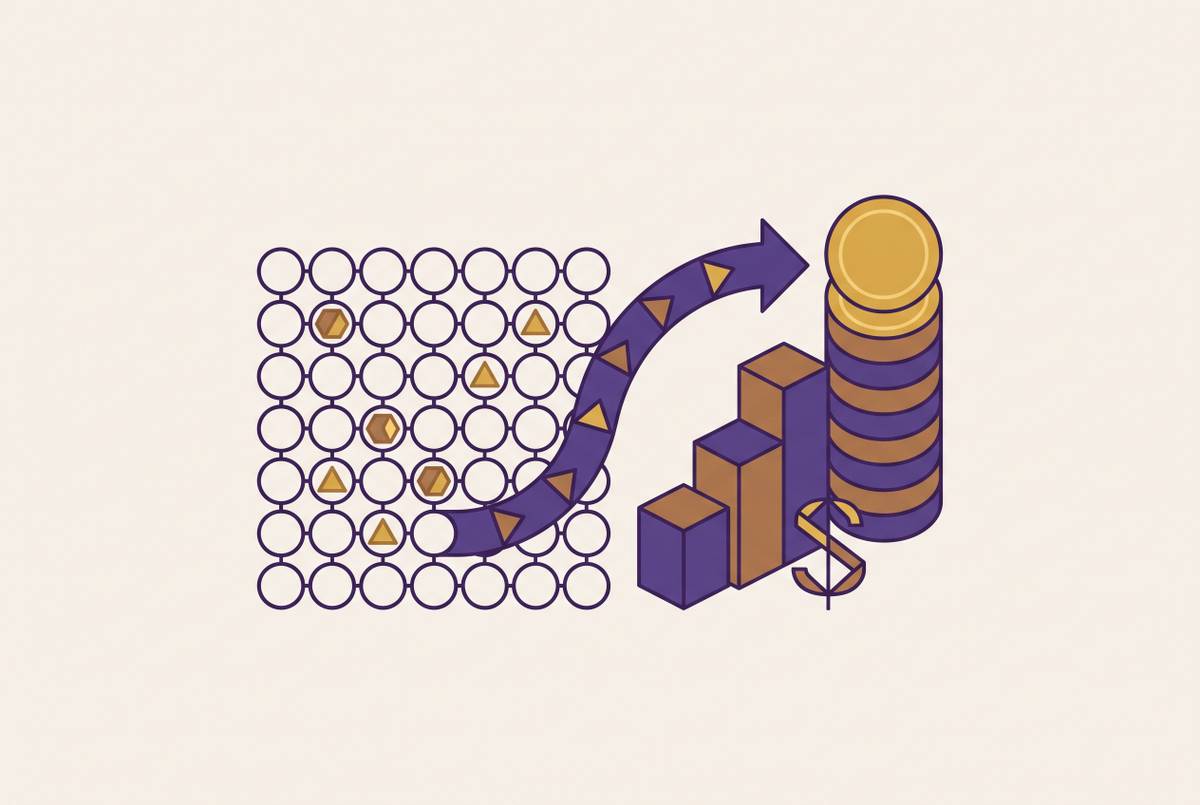
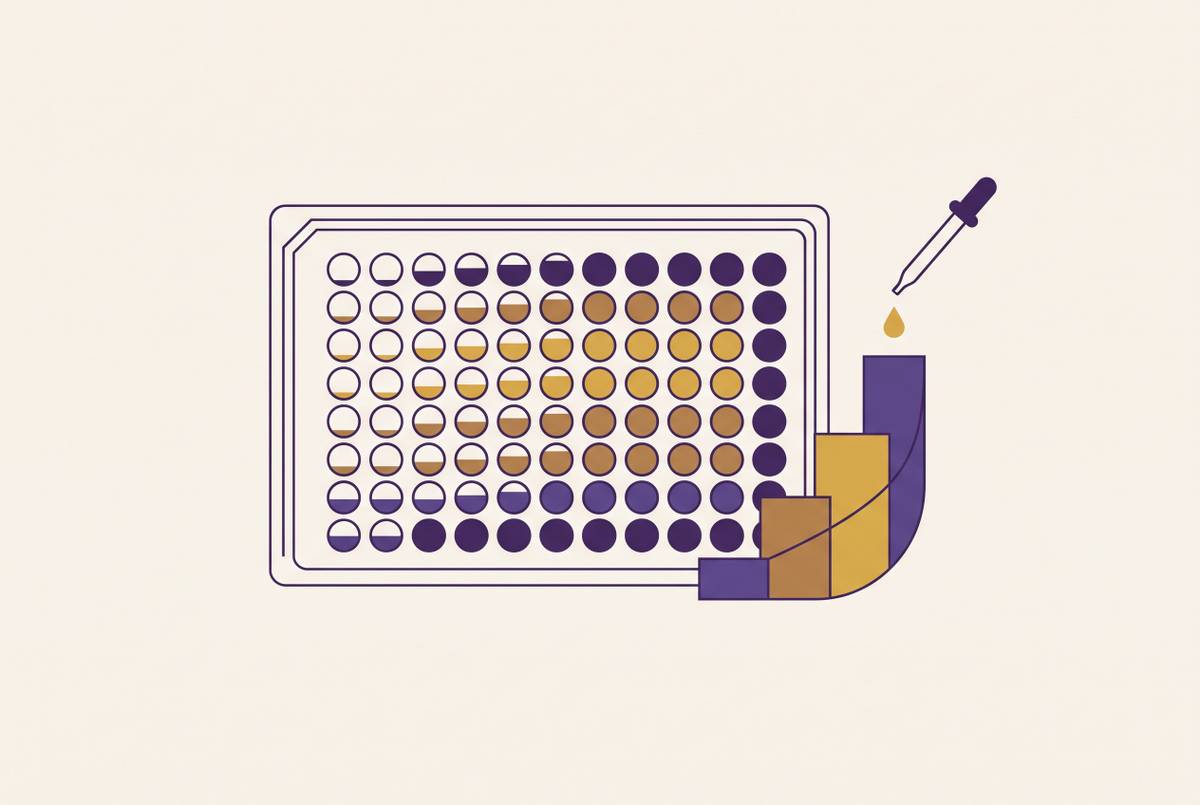
Automation ROI for a core facility running plate-based cell-free protein synthesis is not a single payback number you can pull from a spreadsheet. This piece maps three compounding return components, throughput, reagent economics, and reproducibility, and then shows how the cost structure of the reagent itself ends up setting the size of each.
The automation calculus of plate-based CFPS in a core facility setting
A core facility doesn't run one project. It runs many, for many principal investigators, often at the same time, which means a throughput bottleneck or a reproducibility failure doesn't stay contained to a single experiment, it ripples across every group waiting in the queue. That's a structurally different risk profile than a single lab absorbing its own bad week.
Plate-based CFPS compounds this because it isn't just a smaller version of a tube reaction. Volume standardization, compatibility with liquid handlers, and the per-well economics of reagent all shift once the format changes, and each of those shifts changes the underlying cost and throughput math in ways that don't scale linearly from bench-scale intuition.
So calculating whether automation pays for itself requires more than asking "does automation pay for itself". It's a set of interlocking returns, labor hours recovered, throughput multiplied, reagent waste reduced, and reproducibility enforced across users and across time, and each of those returns has its own driver and its own failure mode. None of those audiences accepts the same argument, which is why a single ROI figure doesn't hold up as a business case. The business case a facility manager must make is multi-stakeholder: justify capital to administration, justify service costs to PIs, and justify reproducibility standards to scientists who will use the data downstream.
The capabilities of CFPS at plate scale beyond cell-based expression
Cell-free protein synthesis breaks the dependency between making a protein and keeping a cell alive to do it. There's no culture cycle, no transformation step, no waiting on colonies to grow, a reaction goes from a DNA template to product in hours rather than days. That's the mechanistic advantage that everything else in this piece rests on.
The timeline compression is visible concretely in published work. Staphylokinase variant screening that would traditionally require a 4 to 5 day process, including a full purified-protein step, was compressed to completion within 5 to 6 hours in microplate format using CFPS pmc.ncbi.nlm.nih.gov ACS Synthetic Biology. That's not an incremental gain, it's a different category of turnaround, and it changes what a screening campaign can realistically attempt in a week.
CFPS also opens up targets that cell-based expression handles poorly. Proteins that are toxic to a host cell, that aggregate insolubly, or that localize to a membrane and disrupt it during overexpression, all of these have historically been hard to produce in living systems. Data from Nature Reviews Methods Primers on E. coli membrane protein targets found cell-free expression synthesized 63% of 120 targets attempted, against 44% achieved in vivo sciencedirect.com nature.com. That's not a marginal edge; it's a substantial share of targets that a cell-based pipeline would simply fail on.
And because CFPS reactions don't require a living host per well, the format scales in parallel in a way cell-based expression structurally cannot. Published work using liquid handling automation ran 3,682 unique cell-free reactions, across libraries of 127 and 134 transcription factor variants, in under 48 hours ACS Synthetic Biology pubs.acs.org. No colony-based workflow gets there in the same window, because you'd need that many independent transformations, platings, and viability checks running in parallel, which is not how cell biology works. Short cycle time, no viability constraint, and a template that can be a raw PCR product rather than a cloned plasmid: that combination is the reason automating at plate scale is worth doing in the first place. A facility investing in automation here isn't speeding up something that was slow to begin with, it's multiplying a process that was already fast.
Compound throughput returns from automation applied to plate-based CFPS
Throughput return isn't one number either. It has two layers, reactions completed per day and reactions completed per full-time staff member, and automation moves both at once rather than trading one for the other.
Manual plate work runs into a ceiling that has nothing to do with the chemistry. Pipetting precision degrades with repetition, fatigue sets in, and everything has to happen in series, one well, one plate, one operator. Someone running 96- or 384-well plates by hand hits a physical limit well below what the CFPS reaction itself is capable of supporting. The chemistry can go faster than the human dispensing it.
Liquid handling automation is what removes that serialization ceiling. The 3,682-reaction run in under 48 hours from published transcription factor library screening exceeds what manual work can match at equivalent precision, given the error rate and fatigue curve at that scale ACS Synthetic Biology pubs.acs.org. That's the throughput multiplier in concrete terms.
What makes this compound rather than simply add up is what more reactions per run actually buys a project. More reactions per run means more data per experiment, which means fewer experimental cycles needed to reach a decision, shortening the decision timeline for user projects. Throughput isn't just a bigger number of reactions, it's fewer weeks between a hypothesis and a decision. This shows up clearly in workflows that pair CFPS with machine-learning-guided screening: a 2025 ACS Synthetic Biology study screened 48 random protease variants within 6 hours and found catalytic rate improvements up to fourfold sciencedirect.com pubs.acs.org. That kind of iterative, ML-guided cycle is only economically sane if each round of screening is cheap and fast enough to repeat, and the CFPS screen's speed is what makes the iteration affordable in practice sciencedirect.com ACS Synthetic Biology pubs.acs.org.
For a facility manager, the metric to put in front of administration isn't reactions per day in the abstract. It's projects served per quarter, plates billed per instrument-hour, and how much queue time gets cut for the PIs waiting on results. But none of that throughput gain means anything if the reagent cost per well doesn't scale in the facility's favor as volume goes up, which is where the case gets more complicated.
Reagent cost structure and the size of every other return
At plate scale, reagent stands as the dominant recurring cost, and the single biggest lever on what a per-reaction number actually looks like once volume goes up. It's the dominant recurring cost, and it's the single biggest lever on what a per-reaction number actually looks like once volume goes up.
Crude lysate systems have been demonstrated at costs near USD 0.03 per microliter, a price point that makes large-scale screening economically workable in a way purified-component systems, at equivalent volume, are not sciencedirect.com. That gap doesn't matter much at small scale. It matters enormously at 384-well scale, where even a few cents of difference per well multiplies across a plate and then across a run schedule into a real gap in total reagent spend.
This is a documented barrier to adoption. Published literature on CFPS identifies high reagent costs and inconsistent product yields as significant barriers to industrial adoption. A facility evaluating automation has to reckon with the fact that the reagent cost doesn't disappear once the liquid handler is installed, it just becomes the next constraint in line.
There's a cost here that doesn't appear on any invoice, too. When a reagent's formulation is undocumented and batch performance drifts for reasons no one can pin down, someone has to spend hours troubleshooting, and reagent gets burned on runs that fail for unclear reasons. That time and material cost doesn't appear anywhere in the catalog price per milliliter, even though the hours of troubleshooting and burned reagent are real expenses. A documented, lot-traceable formulation lets a facility isolate whether a performance shift traces to the reagent lot, the template quality, or the incubation conditions, instead of re-running whole plates just to locate the problem. One example of a reagent built around that principle is a cell-free system priced starting at $25 per milliliter with published formulations and lot-level QC data made available to the user, which turns cost transparency and batch documentation into standard features rather than something a facility has to request or reverse-engineer.
The number that belongs in a business case, then, is reagent cost per well, reagent cost per successful result, and reagent cost per billable project. It's reagent cost per well, reagent cost per successful result, and reagent cost per billable project, three different denominators that tell three different stories about what the facility is actually spending to get usable data.
Reproducibility as an ROI component: what it costs when runs fail to agree
A reproducibility failure in a core facility costs more than the same failure in a single PI's lab, because a repeat run there consumes instrument time, reagent inventory, and technician labor that were already billed or already scheduled for something else. The opportunity cost is doubled: the failed run wastes resources, and it displaces whatever else was supposed to happen in that slot.
CFPS carries its own specific reproducibility risk, and it comes from the reagent itself. Crude lysates have undefined composition, and maintaining consistent extract quality and activity from batch to batch is a documented limitation in the published literature on CFPS barriers. This isn't a problem automation alone can fix.
Automation covers one axis of consistency, pipetting precision, timing, temperature uniformity across a plate, but it says nothing about whether the reagent behaves the same way from one lot to the next. Neither axis alone is sufficient, and treating automation as a complete reproducibility fix produces unexplained variance months later.
Lot-level QC data is what closes that gap. When a facility can trace a performance shift to a documented reagent lot rather than guessing at an automation parameter, troubleshooting moves faster, and the failed run becomes an exception instead of a recurring line item. There's a trust dimension here too: scientists pulling data from a shared facility need confidence that their results are comparable to their own earlier runs and to other users' runs, and a standardized, documented reagent system supports that confidence in a way an opaque one structurally cannot.
For the business case, reproducibility ROI is the frequency of failed or discordant runs, multiplied by the fully loaded cost of a repeat run in labor, reagent, and instrument time. Facilities that actually run this calculation tend to find the number is larger than they expected, mostly because the fully loaded cost of a repeat run is easy to underestimate when instrument time and technician hours aren't tracked against the specific run that failed.
The components of a defensible automation business case for plate-based CFPS
A defensible case isn't a single payback calculation presented to administration and left at that. It's a structured argument built across three return types, throughput measured as capacity and billing, reagent economics measured per well and per project, and reproducibility measured as the cost of failure avoided.
The throughput piece starts with the current manual plate capacity, projects the multiplier automation delivers on reactions per day, and converts that into something administration actually cares about: additional billable projects per quarter, or measurably reduced queue time for the PIs waiting in line. The reagent economics piece has to be built at the plate level, not pulled from a catalog page, and it needs to include the cost of lot failures and repeat runs baked in, showing that a lower-cost, well-documented reagent system reduces total spend non-linearly as volume climbs rather than just linearly. The reproducibility piece quantifies the current failure rate and prices out the fully loaded cost of a repeat run, then shows that automation paired with a standardized reagent addresses both axes of variability at once. This last piece is often the argument that lands hardest with the scientists on the user side, since it speaks directly to whether they can trust the data.
Timing matters too.
Reagent selection belongs in this conversation from the start. A reagent built for plate and automation formats, standard volumes, consistent viscosity, documented stability, cuts down instrument qualification time and avoids the cost of reformulating a protocol after the automation is already paid for. Published pricing, documented formulations, and lot-level QC data give a facility manager real numbers to plug into the reagent-economics and reproducibility parts of the model, instead of relying on a vendor's estimate for a formulation nobody outside the company has actually seen.
The clearest sign a facility is ready to make this case isn't a projection at all. It's a facility already running plate-based CFPS by hand, already watching a throughput bottleneck form, and already absorbing the hidden cost of reagent variability in wasted technician time. Automation ROI is highest exactly where those costs are already visible and already being paid, whether or not anyone has written them down yet. SOURCE PAGES (what the pages behind the outline's links say).