Lot-Level QC Data Standards in CFPS Reagent Supply
Meaningful lot-level QC must measure function, not just identity, to guarantee CFPS performance.

Cell-free protein synthesis reactions fail or succeed based on what's in the tube, down to the concentration of a single ion. Lot-level QC data is the only mechanism that actually guarantees a reagent lot will perform the way the last one did, and most certificates on the market today don't measure the things that matter. This piece works through what that data has to include, how to read a certificate without getting misled by it, and what it costs a lab when that data is missing.
Why CFPS reactions are uniquely sensitive to reagent composition
CFPS takes the transcription and translation machinery out of a cell and runs it in an open tube. There's no membrane, no regulatory network, no feedback loop keeping things in balance. Whatever is in the lysate is what drives the reaction, full stop. A living cell can sense that ATP is running low or that a cofactor is off-balance and adjust its own metabolism to compensate. A CFPS reaction can't do any of that.
That means every input has to be right, on its own, with nothing downstream to catch a mistake. The lysate itself carries ribosomes, elongation factors, chaperones, and also the endogenous nucleases and proteases that come along for the ride regardless. Cofactor balance, magnesium and potassium especially, along with polyamines, sits inside a narrow window; drift too far in either direction and yield drops. And the template, whether it's plasmid DNA, a PCR fragment, or mRNA, has to be clean and intact to begin with.
The reaction mix itself is not simple. It holds a long list of reagents, and how well it performs depends heavily on how fast it's prepared and by what method, which makes the whole system unusually exposed to pipetting error and reagent degradation. Shifting the harvest timing on the lysate, changing the energy substrate concentration a little, or letting the magnesium ratio drift raises problems visible directly in yield, in how well the protein folds, and in whether the final product is even active.
None of this is a flaw to apologize for. The same openness that makes CFPS fragile is what makes it tunable: direct access to every knob in the reaction is why the platform is useful for screening, for expressing toxic proteins, for running reactions no living cell would tolerate. But that power only holds if reproducibility gets built in at the reagent level. It can't be assumed the way it sometimes gets assumed in cell-based work.
What "batch inconsistency" means in a CFPS context
Extract quality and activity are hard to hold steady from one batch to the next, and this remains one of the persistent, documented problems in comparisons of CFPS against cell-based expression.
Where does the inconsistency actually come from? Start with the cells the lysate is made from. E. coli extracts pulled from cells harvested mid-log, while they're still growing exponentially, tend to produce a lot more protein than extracts made from cells at other growth stages. Lysis method matters too: mechanical disruption and chemical lysis don't leave the same ratio of intact, working components behind.
The deepest problem is the gap between total protein and active protein. A Bradford assay tells you how much protein is in the lysate. It says nothing about what fraction of the ribosomes and translation factors in that protein pool are actually still functional. A batch that reads identically on a Bradford assay may perform very differently once run in an actual CFPS reaction, since the assay measures total protein without regard to functional activity. That gap is where most of the surprise sits.
For the researcher, the consequence is blunt: a protocol optimized on one lot can fail outright, or need a full re-optimization, on the next lot that arrives. It undermines the validity of comparing results across lots at all, which is a problem for any lab trying to build on its own prior work. A 2026 perspective on microbial CFPS singles out reproducibility, alongside fragile supply chains and the absence of any CFPS-specific quality or regulatory expectations, as a structural barrier to industrial use, not an incidental one. If inconsistency is the disease, the only real treatment is QC data specific enough to catch the variation that actually drives it. PubMed explicitly names high reagent costs and inconsistent product yields as significant barriers to industrial adoption.
What lot-level QC data for CFPS reagents must measure
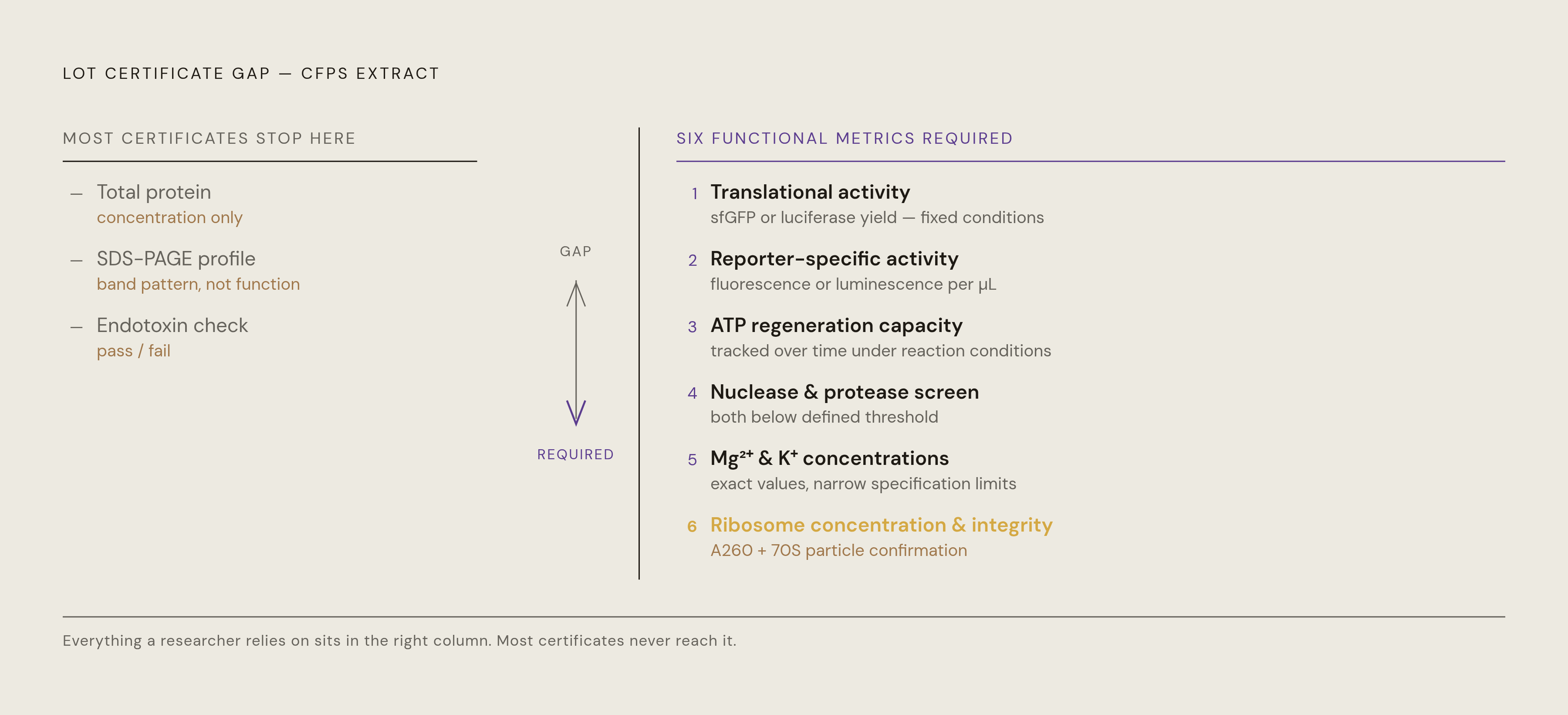
Identity testing and functional testing are not the same thing, and a lot certificate that only offers the first one is answering the wrong question. Total protein concentration, an SDS-PAGE profile, an endotoxin check: these tell you what's present. None of them tell you whether the lysate will actually synthesize protein when you use it. Necessary, but nowhere near sufficient.
Functional metrics are the only data that predicts how a lot will behave in an actual reaction, and a handful of specific measurements belong on any certificate worth trusting.
The most direct one is a translational activity assay: expression yield of a defined reporter, sfGFP or luciferase are the common choices, run under fixed, standardized conditions. This is the single clearest signal of how a lot will perform. Yield alone isn't quite enough either; reporter-specific activity, fluorescence or luminescence per unit volume rather than just total protein made, captures whether the protein folded correctly rather than merely whether it got synthesized. Energy regeneration capacity needs its own measurement too: ATP regeneration tracked over time under reaction conditions, because a lot with degraded pyruvate kinase or creatine kinase will run out of energy before the reaction finishes, even if everything else about it looks fine. A nuclease and protease screen has to be part of the panel as well, since nuclease contamination chews through the mRNA template mid-reaction and protease activity degrades the finished product, and both need to sit below a defined threshold. Magnesium and potassium concentrations belong on the certificate as exact numbers, not descriptions, because the optimal windows are narrow and small lot-to-lot drift in either ion shifts the whole yield curve. And ribosome concentration and integrity need checking directly, an A260 reading paired with confirmation that the ribosomes are intact 70S particles and not degraded subunits drugdiscoverynews.com.
None of this means anything unless the assay itself is standardized. The reporter gene, the template concentration, the reaction volume, the incubation temperature, and the exact time point of measurement all have to stay fixed from lot to lot. Without formulation disclosure, a researcher who receives a failing lot has two options, return it or empirically re-optimize, and neither generates transferable knowledge. Every QC run should also carry an internal positive control from a validated reference lot, so that whatever lot is being tested now can be benchmarked directly against the one before it.
A certificate worth the name reports specific numbers with units, upper and lower specification limits, the assay method used, and the date of the test. "Typical yield" and "approximately" are not specifications; they're placeholders. Activity rankings pulled from crude CFPS reactions in a recent staphylokinase screening study lined up closely with rankings from purified protein. That kind of agreement only holds if the CFPS system itself stays consistent across every reaction in the screen. Functional QC is load-bearing in screening workflows.
How to read a lot certificate
Reading a certificate well means reading it like a scientist checking whether a number will hold up, not like an auditor checking a box. Start with the yield figure. Is it an absolute number, say, micrograms per milliliter of sfGFP, or just a pass/fail stamp? Absolute values let you compare across lots and across time. Pass/fail tells you almost nothing beyond the day it was issued.
Check next whether the conditions the QC assay ran under actually match the conditions of the intended use. A certificate generated at 29°C in batch format doesn't necessarily predict how the same lot performs at 37°C in a high-throughput plate run. And where possible, look for historical lot data as well as the current lot's numbers. A supplier willing to publish how lots have performed over time is giving a researcher a way to see drift coming before it wrecks an experiment.
What's missing from a certificate often says more than what's on it. No reporter yield, only a protein concentration figure: that supplier is measuring what's convenient, not what predicts performance. "Typical yield" with no stated range: no real commitment behind the number, and nobody accountable if the next lot falls short. No nuclease or protease data at all: a known failure mode that's simply gone unmeasured. No energy substrate concentration listed: the single most variable part of the whole energy regeneration system, left invisible. And if QC was performed on a different format than what is sold, say a 50 µL batch reaction while the product is sold for 384-well use, the certificate may simply not transfer, since format-dependence of CFPS performance means the certificate may not transfer.
Scientists have gotten used to treating reagent formulation as proprietary territory not worth asking about. In CFPS that habit carries a real performance cost, because a formulation nobody can inspect is a formulation nobody can troubleshoot. A certificate that can't answer the question of what yield to expect on a specific reporter under a specific set of conditions is a shipping document with a logo on it.
Lot-to-lot variation's propagation into experimental error in real workflows
High-throughput screening is where lot inconsistency does the most damage, because the whole method depends on comparing wells against each other. CFPS enables simultaneous protein synthesis in multiwell plates, in 96-well or 384-well formats, often using direct PCR-template inputs without cloning. In a variant screening campaign, the entire point is ranking protein variants by activity, and that ranking only means something if synthesis yield is roughly even across the plate. A lot with uneven activity from well to well introduces a systematic bias that looks exactly like a real functional difference between variants, except it isn't one.
The staphylokinase screening case mentioned earlier depends entirely on this kind of uniformity: crude-mixture rankings matched purified-protein rankings only because reagent performance held steady across every well in the plate. Swapping in an inconsistent lot breaks that agreement, either flattening real differences between variants or inventing ones that were never there.
Difficult protein targets sit in an even tighter spot. Toxic, unstable, membrane-associated, and multi-domain proteins already express at lower yields than a simple soluble reporter does, so they're working inside the narrow productive band of the reaction to begin with. A lot with even a modest drop in ribosome activity, or a slightly elevated protease level, can push a marginal target below detection. What that looks like from the bench is a failed protein, not a failed reagent, so it gets diagnosed as the wrong thing. Membrane proteins carry the highest stakes here: they make up the targets behind more than 60 percent of FDA-approved drugs, and their solubilization depends on detergent or lipid additives working together with a translation system that's actually performing drugdiscoverynews.com. A lot that's underperforming even slightly can collapse the entire workflow for a target like that drugdiscoverynews.com.
Cross-lab reproducibility takes the same hit. A protocol built and optimized on one lot, then handed to a collaborator running a different lot, won't necessarily replicate if the two lots differ in ways the certificate never disclosed. The 2026 microbial CFPS perspective names reproducibility directly as a persistent, structural barrier to industrial adoption, not a theoretical worry sitting in a review article somewhere. It has actually stalled adoption decisions.
The costliest part is the diagnostic trap. A lab without lot-level QC data that hits a wall almost always assumes the protocol is broken. Conditions get re-optimized, template concentrations get adjusted, incubation times get stretched or shortened, and weeks pass before anyone thinks to question the reagent itself.
Why formulation transparency is a prerequisite for meaningful QC
A certificate can tell a lab that yield fell below spec. It can't tell them why, not unless they know what's actually in the tube. Without that, a researcher holding a failing lot has exactly two options: send it back, or start re-optimizing empirically from scratch. Neither one produces anything the next person can build on.
Formulation transparency changes what's possible on the troubleshooting side directly. If the energy substrate concentration is disclosed and a lot is showing weak ATP regeneration, the fix is to supplement it, a targeted correction instead of tearing the whole protocol apart. It changes cross-lab work too: a formulation that's actually published can be independently checked and reproduced elsewhere, while an opaque one can't. Reproducibility ends up depending on the supplier rather than on the science itself. And it changes purchasing decisions before a single reaction gets run, since a researcher who can actually read the formulation can judge whether a reagent fits the application.
This isn't a new observation in the field. The same protocol paper that flagged the reaction mix's exposure to pipetting error and reagent degradation was pointing, implicitly, at the same fix: transparency about composition is the only systematic way to get ahead of that fragility.
Transparency does more than satisfy curiosity. It's what makes a QC number mean something specific. A ribosome concentration figure reads differently depending on context, a minimally supplemented lysate versus one with exogenous elongation factors added will report different numbers for entirely legitimate reasons. Published QC data paired with a published formulation lets a researcher build an actual mental model of the system, and to distinguish a lot that just needs a bit of supplementation from one that's genuinely degraded and not worth salvaging. One CFPS supplier, Sepia Biosciences, builds its OpenCFPS™ product around exactly this idea, publishing both formulations and lot-level QC data so a researcher can read the certificate, understand what's actually in the reagent, and troubleshoot with both pieces of information in hand instead of guessing at a black box.
A defensible QC standard for CFPS reagents across the field
The 2026 Aw perspective (Microbiology) names something specific: the absence of CFPS-specific quality and regulatory expectations as a persistent barrier to industrial adoption (the field does not yet have agreed QC norms the way established bioprocessing does). Established bioprocessing has decades of agreed QC norms behind it. CFPS doesn't have an equivalent yet, and that gap is a structural one, not a paperwork problem.
A real field-wide standard would need functional testing to be mandatory: reporter yield under fixed conditions, reported as an absolute number with real specification limits rather than a qualitative pass or fail. Energy system characterization would need to be a required lot attribute as well, ATP regeneration capacity measured and reported every time, not left as an extra a supplier can skip. Nuclease and protease screening, tested inconsistently across suppliers today, would need to become a release criterion across the board. A shared reference standard, a common benchmark lot that every commercial lot gets calibrated against, would give the field something other in vitro biology categories have long relied on. And even partial formulation disclosure, component classes and rough concentration ranges rather than a full recipe, would be enough to make lot certificates genuinely interpretable by the people actually running the reactions.
None of this is exotic. It's the same discipline other biotechnology sectors settled on once reproducibility stopped being optional and started being the thing the whole field's credibility rested on. CFPS is arguably at that point now.
Sources
- pmc.ncbi.nlm.nih.gov
- Quantification of Interlaboratory Cell-Free Protein Synthesis Variability | ACS Synthetic Biology | ACS Publications
- Microbial cell-free protein synthesis and its progression toward industrial use | Microbiology Society
- Key reaction components affect the kinetics and performance robustness of cell-free protein synthesis reactions | Computational and Structural Biotechnology Journal
- Methods to reduce variability in E. Coli-based cell-free protein expression experiments - ScienceDirect