Rapid Antigen and Research Reagent Production for Antibody Discovery Programs
Cell-free protein synthesis speeds antigen production for antibody discovery.

Cell-free protein synthesis is becoming a practical way to make the antigens and research reagents that antibody discovery programs need. Its value lies in matching expression to discovery’s iterative pace, with same-day production of variant panels, direct control over difficult folding conditions, and continuity from screening to milligram quantities. Those gains depend on treating functional validation and reagent standardization as part of production.
Why antibody discovery programs are bottlenecked at the reagent production step
AI-driven screening platforms can generate thousands of antibody candidates in weeks, but the expression infrastructure needed to evaluate them has not kept pace. Sino Biological’s XPressMAX™ launch focuses on this gap between generating candidates and testing them in experiments. Traditional transient transfection in mammalian cells typically requires 4–7 days per construct. Each revision thus means waiting through another round of production before a program can get binding data. Candidate generation is no longer the only rate-limiting step.
Discovery requires enough correctly folded, functionally validated antigen and fragment material to support comparisons across candidates. Proteins that burden or kill host cells can yield poorly, while aggregation and inclusion-body recovery reduce the active fraction available for assays. Membrane proteins are especially hard to produce because low expression can limit the material on hand before antibody development begins. Even when production succeeds, inconsistent reference antigen adds assay noise, leaving programs with both a supply problem and a comparability problem.
What CFPS actually is and why its open-reaction architecture matters for this problem
CFPS runs transcription and translation in a cell lysate outside a living cell. A reaction contains a genetic template, supplied as linear DNA or plasmid, and a lysate that provides the transcriptional and translational machinery. Supplied energy sources and cofactors, including ATP, GTP, and magnesium ions, support synthesis. No living host has to remain viable. Redox state, chaperone concentration, cofactor levels, and amino acid composition can therefore be adjusted directly rather than through a cell’s coupled requirements for metabolism, growth, and protein synthesis.
The extract still defines the starting biochemical environment. E. coli extracts offer the highest yields and lowest cost among the main extract classes, but provide a prokaryotic folding environment. Wheat germ and rabbit reticulocyte lysates offer alternatives, while eukaryotic systems including mammalian cell-derived lysates are available for targets requiring post-translational modifications. Those options are generally less efficient and more expensive than E. coli counterparts. Extract choice remains a target-dependent decision.
PCR can generate linear expression templates in days without the cloning and transformation cycle required for plasmid-based cell expression. Because the template, lysate, and supplied reaction components can be varied separately, sequence changes and folding conditions become experimentally accessible within the same open architecture.
How CFPS compresses the timeline from sequence to expressed antigen panel
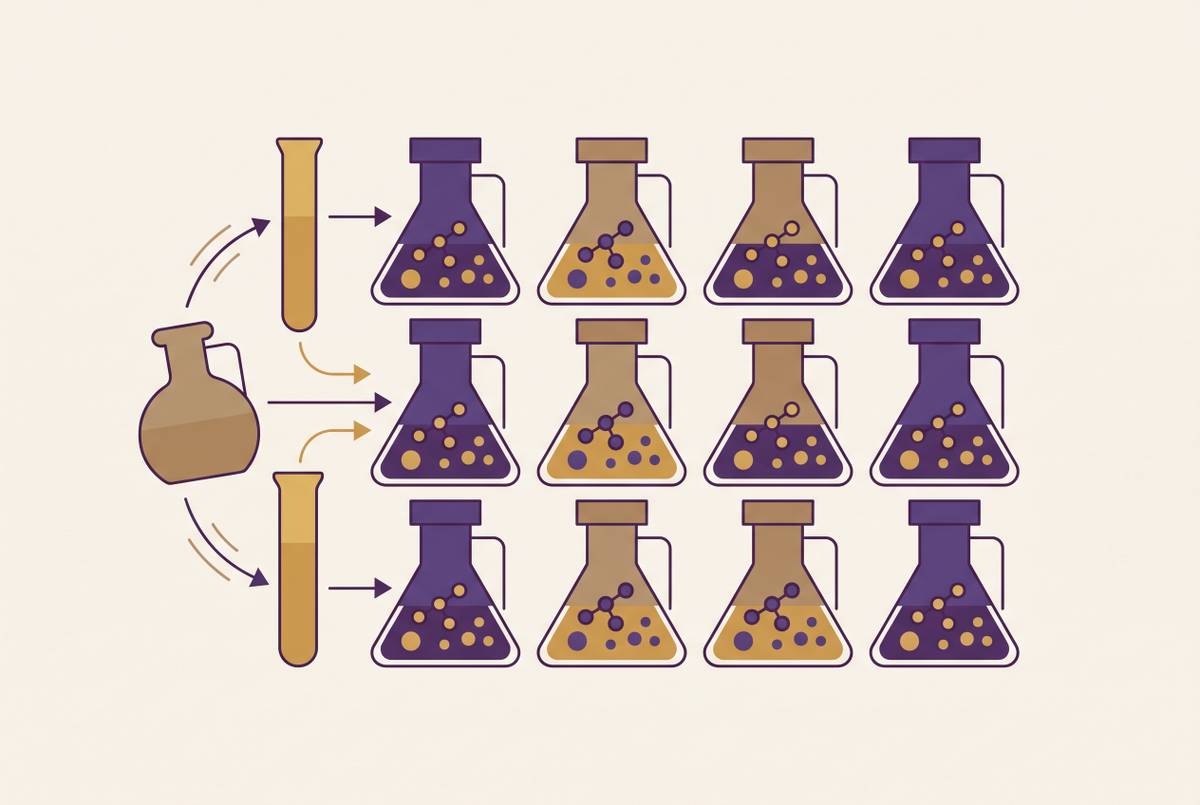
CFPS workflows can complete setup and expression within a day or two, replacing the longer production interval associated with transient transfection. Runs within a single day can cover 24 open reading frames at the same time. Instead of waiting for constructs to move through separate cell-based production cycles, a program can express an antigen panel in parallel and bring its variants into evaluation together.
Direct use of PCR products removes another delay between design and experiment. A sequence change decided Monday can be expressed and in hand for binding assays by Wednesday without a cloning step. The Jewett Lab demonstrated a deep screening workflow that moved from an antibody variant library to binding affinity data against SARS-CoV-2 spike protein in a single 3-day experiment. The antigen was itself produced cell-free, so the workflow compressed production on both sides of the binding pair.
Speed, however, does not establish that a reagent works. A rapidly expressed panel is useful only if its proteins adopt the structures needed for the intended assay. CFPS makes that complication accessible to direct engineering, but it does not remove the need to demonstrate folding and activity.
Producing difficult antigens, including toxic proteins, membrane proteins, and disulfide-rich fragments
When expression kills or burdens the cell, production competes with the system’s ability to survive. CFPS removes that viability constraint without guaranteeing that every target will be soluble or active. A 2025 preprint showed that cell-free production could make active BsaI restriction enzyme, a protein that is toxic and difficult to express. The same work also demonstrated functional assembly of vimentin, extending the evidence beyond a simple soluble target.
Membrane proteins require a different form of support. They account for roughly a third of the proteome and roughly half of drug targets, making poor expression a substantial obstacle for antibody programs. A wheat germ-based CFPS system efficiently synthesized 25 different GPCRs using liposomes for stabilization through a bilayer-dialysis method. Here, the open reaction permits direct addition of the environment needed to stabilize the product.
Disulfide-rich fragments need control over oxidation and folding. scFvs and Fabs depend on correct disulfide formation for binding activity, and CFPS allows deliberate adjustment of redox conditions. Lawrence Livermore National Laboratory’s 2025 preprint by Nikfarjam et al. developed a two-stage refolding protocol that recovered active scFvs from misfolded precipitates. Large multi-domain proteins can also aggregate in the absence of cellular quality control. Chaperone supplementation, redox tuning, and accessory factor addition provide distinct ways to address these failures without redesigning a host organism.
Antibody fragment formats CFPS handles well and how binding validation connects to expression
VHHs provide a heavy-chain-only binding domain, scFvs provide a compact recombinant antigen-binding format, and Fabs retain a full antigen-binding domain that is more structurally similar to IgG. Their simpler structures and ease of engineering make smaller fragments useful for high-throughput screening. XPressMAX™ is designed for expression and validation of VHH, scFv, Fab, and Miniprotein formats from plasmid or PCR templates, with support for complex disulfide bonding.
Expression can then feed directly into binding characterization. Fluorescence correlation spectroscopy, or FCS, requires little material and fits the small reaction volumes used in screening. The Livermore study demonstrated binding equilibrium constant measurements between cell-free-produced scFvs or Fabs and conventionally mammalian-expressed SARS-CoV-2 spike RBD.
The Jewett Lab provides a more integrated example. Its deep screening workflow combined linear DNA assembly with E. coli CFPS optimized for disulfide formation, then measured synthetically dimerized antigen-binding fragments against SARS-CoV-2 spike. A machine learning algorithm coupled to a language model helped analyze the images. The workflow identified scFvs with up to 5,200-fold increased binding affinity, linking variant construction, expression, and functional comparison within the short experimental cycle described above.
Plate-based automation and how CFPS slots into existing lab infrastructure
Screening reactions at 60 µL per well fit directly into standard 96-well formats as a native operating format. Labs can therefore use their existing plate-handling workflows to express the variants without setting up another production system.
IMAC purification has been demonstrated in 96-well plates using 50 µL of resin per well, allowing expressed variants to move into purified-protein evaluation without leaving the plate workflow. Selection campaigns that used plates have screened between 400 and 1,500 colonies per selection campaign.
Reagent logistics also fit standard laboratory practices. Available lyophilized preparations permit room-temperature storage and rapid reconstitution. Even when the equipment fits, teams still need to make plate runs comparable. Documented formulations and lot-level QC data provide the basis for standardizing reaction conditions across plates and campaigns. Without that information, a laboratory can automate dispensing while leaving the biochemical inputs insufficiently defined.
Scaling from screening hits to milligram quantities for assay and characterization work
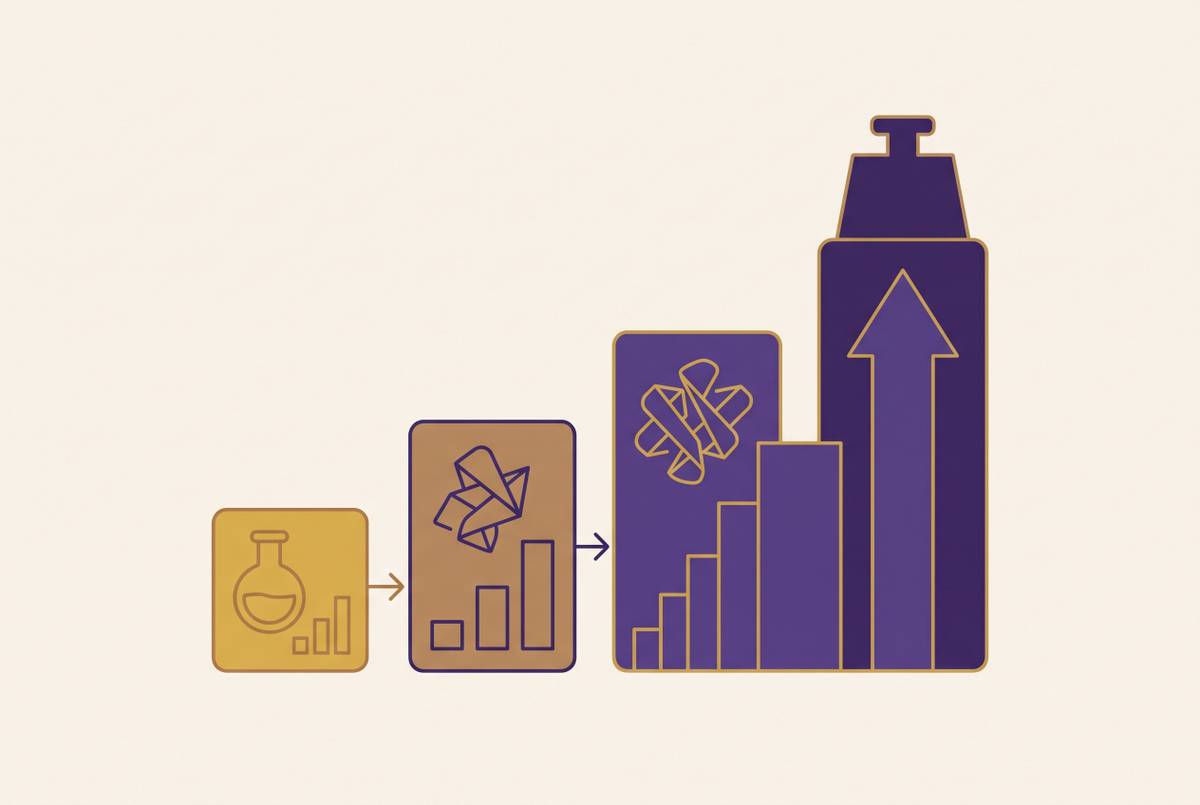
A screening platform loses some of its value if every hit has to move to another expression system for characterization. CFPS can instead produce milligram quantities for biophysical analysis, assay development, and early-stage reagent preparation using the same reaction chemistry. Caschera and Noireaux’s 2014 study demonstrated an upper published benchmark of 2.3 mg/mL in an all-E. coli transcription-translation system. That benchmark establishes production capacity.
Continuity of conditions is the practical hinge. Redox state, chaperone loading, and template design optimized during screening can move forward into larger reactions. The team is not changing hosts and starting a new folding optimization problem simply because more material is needed. This preserves the relevance of screening-stage process knowledge when a selected reagent enters more demanding characterization work.
Cell-free reactions have reached approximately 100 liters for therapeutic antibody production, showing that the platform is not confined to microliter or bench-scale use. For discovery programs, however, milligram production is the more immediate requirement. The difficult-target work on BsaI and vimentin supports the prospect of using that capacity for functional, structurally demanding proteins as well as easier expression targets.
Reagent cost and the economics of running CFPS at discovery throughput
CFPS economics are most useful when evaluated across the discovery workflow rather than against the per-gram cost of large-scale fed-batch cell culture. Cloning, transformation, cell maintenance, failed expression attempts, and repeated assays all contribute to the cost of obtaining usable binding data. A faster reaction is not automatically a cheaper workflow. How much it saves depends on the production steps it removes and whether the reagent it makes works in a valid assay.
Reagent expense has nevertheless been a genuine adoption barrier. In the past, reagents made up roughly three quarters of all material costs in a cell-free reaction. A 2026 study published in Nature Communications reported an optimized formulation with an average cost reduction of roughly 95% relative to previous cell-free reagent formulations. The researchers identified it by screening 58 reagent components across more than a thousand reaction combinations. This demonstrates how strongly formulation can change the cost base, although it does not establish equivalent pricing for every commercial system.
Commercial formats still span different cost positions. Fully purified PURE kits are at the high end of that range, so their costs do not reflect those of the whole platform. At discovery throughput, formulation documentation also has economic value because it makes underperformance more tractable. Lot-level QC complements that transparency by helping teams address reagent variation before it results in repeated assays and additional material consumption.
Reagent standardization and lot-level QC as the foundation of reproducible antigen panels
Bristol-Myers Squibb’s pilot study on recombinant soluble LAG-3 demonstrated that reference antigen definition can change assay consistency. Defining the reagent by functional performance, using assay-specific concentration in place of total protein concentration, made kinetic binding parameters more consistent and sharply reduced lot-to-lot variation in immunoassay responses.
That distinction becomes more consequential across an antigen panel. Variation in a CFPS reagent can propagate into every protein expressed with it, complicating the separation of a genuine binding change from a batch effect. Lot-level data provide a basis for investigating that distinction. Documented formulations add diagnostic leverage because an underperforming lot can be examined through specific hypotheses about its components.
Reproducible discovery needs a documented relationship between reaction inputs, functional protein output, and assay behavior. Teams that standardize their CFPS reagent platform early build an institutional knowledge base about which conditions support their targets and formats. That knowledge grows with each discovery campaign, so teams can build each later panel with a production system they have already characterized instead of starting a new expression attempt from scratch.