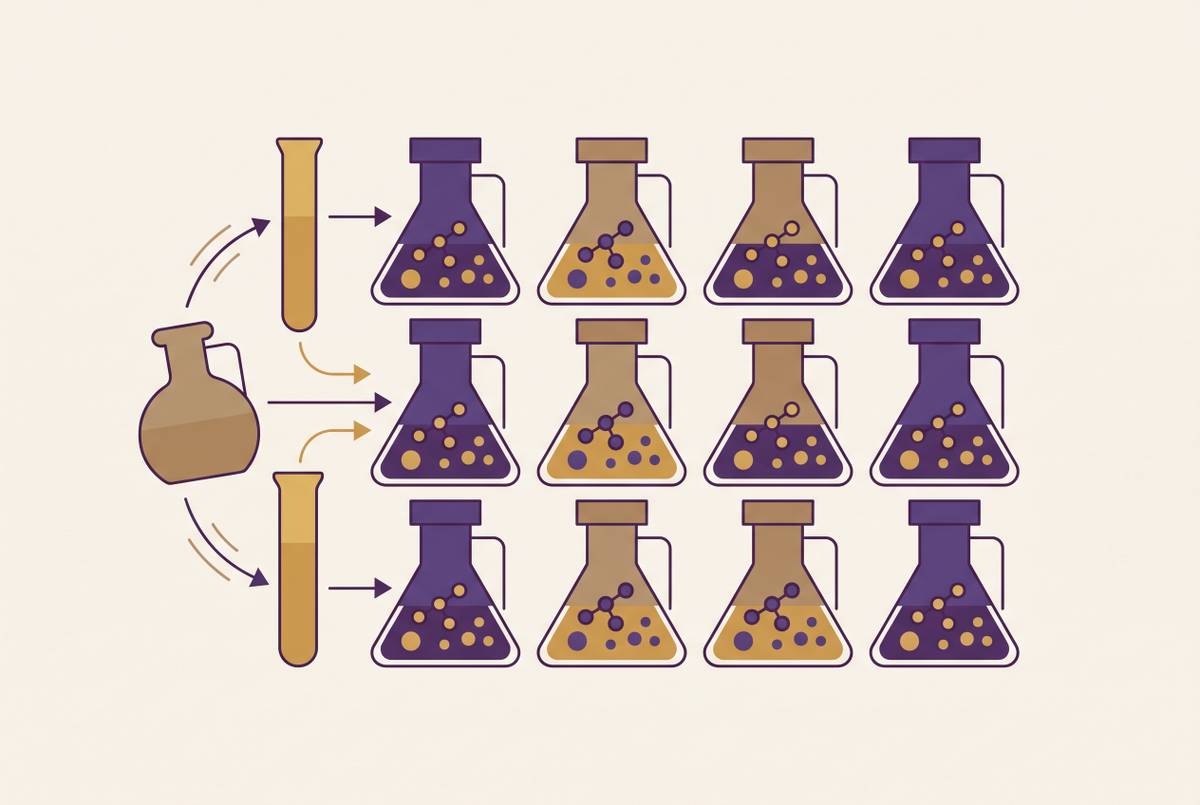
CFPS Versus E. Coli Recombinant Expression Decision Framework
Cell-free protein synthesis outperforms E. coli for toxic, membrane, and disulfide-bonded targets.

Choosing between cell-free protein synthesis (CFPS) and E. coli recombinant expression requires a project-specific decision. Protein properties, throughput, timeline, and workflow constraints determine the fit. When those criteria favor CFPS, Sepia Bio’s OpenCFPS™ is one reagent option for screening and milligram-scale production, with documented formulations and lot-level QC data to support optimization.
Why expression system choice is a decision problem, not a default
E. coli became a first-choice heterologous host for sound reasons, including simplicity, fast growth, and cost-effective cultivation and protein extraction. Those strengths explain its established position, but they do not make it suitable for every target. Familiar protocols can become a default even when the protein’s biology conflicts with the host’s requirements. In that case, more optimization may take time without fixing the mismatch. A useful framework separates a tractable expression problem from a poor system fit by examining four axes, namely protein properties, throughput requirements, timeline, and workflow constraints.
How each system uses — or avoids — a living cell, and why that distinction drives everything downstream
In cell-based E. coli expression, transcription and translation occur inside intact cells. Production therefore depends on managing the host’s growth environment, physiology, and metabolic burden while keeping the cells alive. Cell growth adds a required stage before harvest, purification, and assessment of protein quality and activity. The cell boundary also limits access to the environment where synthesis occurs. Adding a folding aid to a culture is not equivalent to placing it directly into the protein synthesis reaction.
CFPS uses cellular machinery outside living cells, with ribosomes, tRNAs, amino acids, and energy regeneration systems supporting synthesis in vitro. The reaction still needs the right biochemical conditions, but it has no growing host to keep alive. PCR products can serve directly as templates, bypassing cloning and transformation. Most importantly, CFPS provides an open reaction into which chaperones, redox buffers, or lipid vesicles can be added directly.
Protein properties that make E. coli cell-based expression structurally unsuitable
Protein properties are the first filter because they can rule out an otherwise convenient workflow. Making cytotoxic or growth-disrupting proteins puts the host’s survival at odds with production of the target. Without a living host, that conflict goes away, though the reaction conditions still need optimization. Abd El-Baky et al. 2022 produced soluble, functionally active human TNF-α in an E. coli-based CFPS system optimized by response surface methodology. This provides a concrete example of cell-free production for a cytokine that presents challenges in living expression systems.
Membrane proteins and disulfide-bonded proteins present a different problem, which is control over folding conditions. An open CFPS reaction permits direct addition of detergents, lipid vesicles, or nanodiscs to support membrane protein folding. For disulfide-bonded targets, it permits active redox management rather than dependence on the intracellular environment. Direct addition of DsbC and DnaK also improved the solubility of antibody fragments in PURE-based reactions. These interventions address distinct folding requirements rather than treating all difficult proteins as one category.
Glycosylation creates a further biological constraint because E. coli lacks endogenous glycosylation machinery. Yet taking away the cell boundary does not supply the modification machinery that is missing. A CFPS system must be able to make the required modification, and more complex needs may call for eukaryotic expression. The decision rule is therefore to test protein compatibility before optimizing yield or cost. For cytotoxic targets, membrane proteins, disulfide-bonded proteins requiring redox management at scale, or glycoproteins in a prokaryotic context, suitably configured CFPS may be the only viable path of the two.
How throughput requirements and experimental stage change the calculus
If the protein’s properties allow both systems to work, the choice then depends on whether the project is testing candidates or making a confirmed target. During engineering, dozens to hundreds of variants may need to be tested before any one construct is ready for scale-up. Repeating cloning and transformation for those candidates can make template preparation the bottleneck. CFPS removes those steps when PCR-direct templates are suitable. Its value at this stage comes from the number of useful experiments completed.
Protein Production Sweden (PPS) at the University of Gothenburg deployed a fully automated CFPS workflow using an Opentrons OT-2 robot. The workflow supported a single construct through 96 unique reactions in parallel, with DNA-to-purified-protein turnaround in under four hours. Cell-based workflows retain transformation, colony selection, and culture requirements for each variant, even when those operations are organized in parallel. Ahn, Keum & Kim 2011 likewise used CFPS to screen 552 fusion constructs for solubility-enhancing partners. That application shows how cell-free expression can make combinatorial optimization practical.
A 2025 preprint on machine-learning-directed protease engineering used CFPS to screen 138 variants, with individual variants produced and screened in hours and many tested on the same plate. The result supports CFPS for short iterative design-build-test cycles, without establishing that every engineering project will benefit equally. Once a lead is identified, the task changes from exploration to production. E. coli’s established fermentation and purification infrastructure, together with lower per-gram costs at large scale, then becomes more relevant. The stage-based rule favors CFPS for screening and a scale-appropriate system for production of the confirmed target.
Timeline differences between the two systems and how they interact with project urgency
Timeline matters when it constrains the next decision. A CFPS experimental procedure including extract preparation typically requires one to two days, while in vivo protein expression can require one to two weeks. These are workflow-level comparisons whose applicability varies by target. Abd El-Baky et al. 2022 demonstrated soluble, active recombinant human TNF-α production in two hours under optimized CFPS conditions. That result concerns an optimized expression reaction, rather than the time needed to establish the entire process.
For active exploration, shortening each expression cycle can bring the next hypothesis test forward. For routine production, however, a constructed and banked E. coli strain makes subsequent runs repeatable and their schedules predictable. The relevant distinction is whether the project is still changing constructs or repeatedly producing a validated one. CFPS has a direct planning advantage when iteration speed is the bottleneck. When production is steady and scheduled, the timeline difference becomes less decisive.
Workflow constraints — reagent cost, reproducibility, and infrastructure compatibility
A biologically appropriate system still needs workable reagent economics. Conventional CFPS reagents make up most of the cost of cell-free materials, which has long limited their use beyond small-scale discovery. Optimization work in 2026 screened over a thousand formulations and identified a minimal-component system with high sfGFP yields and an average reagent cost reduction of around 95% over previous formulations. That result shows that formulation can substantially change the economics. It does not establish the same cost reduction for every protein or commercial reagent.
Reproducibility is equally consequential because crude lysate quality can vary between batches. The optimized formulation was tested across lysate batches, users, locations, and different proteins, directly addressing several sources of variability. For documented workflows, raw material qualification must also include the components used for extract preparation and energy regeneration. Open formulations and lot-level QC data give scientists a basis for troubleshooting instead of treating each reaction as an opaque mixture. Transparency is especially valuable when optimizing chaperones, redox agents, or other additives, because those changes depend on knowing the starting composition.
Sepia Bio’s OpenCFPS™ line addresses these requirements through openly documented formulations, published lot-level QC data, and competitively priced reagents. It is engineered for rapid variant screening and milligram-scale production in E. coli-based CFPS systems. This makes it relevant both to early exploration and to confirmed-target production where cell-free expression remains appropriate. More broadly, the choice between purchased reagents and internally prepared formulations should account for documentation and reproducibility as well as material cost. For difficult proteins, screening needs to be affordable because the open reaction offers several ways to optimize conditions, each of which still needs testing.
Infrastructure completes the workflow assessment. CFPS runs in standard tubes, plates, and incubators, while the PPS example demonstrates compatibility with standard liquid-handling automation. OpenCFPS™ also fits standard plates, automation systems, and incubators without requiring fermentation equipment. By contrast, a laboratory with established bioreactors, cell banking, and downstream processing has already built much of the infrastructure needed for cell-based production. The relevant cost is therefore the cost of the workflow the laboratory can actually run.
The decision framework — mapping your project against the four criteria
Cytotoxicity, membrane association, redox requirements, or glycosylation needs can resolve the choice before throughput becomes relevant. Where a suitable CFPS system addresses a host-dependent limitation, the remaining criteria refine its implementation. Where modification requirements exceed prokaryotic CFPS capabilities, the choice must extend to eukaryotic systems. A well-behaved soluble protein without PTM requirements leaves both approaches available.
Only then does the process turn to throughput and project stage. Variant libraries and condition screens favor CFPS because direct templates and plate-based reactions remove repeated cellular preparation steps. With a single validated construct, the cost of routine production matters more. If the choice is still open after that, the timeline comes next. A binding need for rapid iteration favors CFPS, while predictable production from a banked strain gives E. coli a credible case.
Workflow constraints resolve the remaining tradeoff through available infrastructure, reagent cost, and documentation quality. Where standardization matters, lot-level QC data and open formulations need to be part of the buying decision. Reagent systems such as OpenCFPS™ keep milligram-scale cell-free production within the comparison when protein properties or laboratory infrastructure favor it. The outcome is a project-specific sequence. Many projects can use CFPS early and E. coli, or scaled CFPS, later.
Objections worth taking seriously before committing to CFPS
The first objection is prokaryotic CFPS’s limited post-translational modification capability, a valid concern especially for complex PTMs beyond N-glycosylation and disulfide bonds. An open reaction offers access, but access is not the same as the necessary biochemical machinery. For those targets, eukaryotic CFPS or cell-based eukaryotic expression can be more appropriate. The protein-properties criterion must therefore check whether the system can make the product needed as well as carry out translation.
Most CFPS studies report yields well below the gram-per-liter threshold, so the cost per gram is still higher than in cell-based production even with recent savings on reagents. Lower formulation costs narrow that gap but do not erase it for large-scale manufacturing. At screening scale, absolute yield is rarely the binding constraint, so this disadvantage may not control the decision. For large-scale production of well-behaved proteins, however, E. coli or other cell-based systems retain a strong economic case.
The third objection is crude lysate variability. It is a real technical concern, and institutional resistance cannot be answered simply by pointing to fast reactions. Robust formulations, qualified raw materials, and lot-level QC data help deal with the problem, but labs must check that these are available for the workflow they choose. PURE-based systems offer another way to deal with variability, though that choice comes with a cost tradeoff. That choice belongs under workflow constraints rather than supporting a blanket claim that CFPS is either reproducible or inconsistent.
Applying the framework — two worked examples that illustrate where each system wins
Consider first a cytokine engineering project that needs to screen variants quickly. The TNF-α work and the ML-directed protease study are distinct demonstrations that anchor the protein-properties and throughput arguments, respectively. The protease study achieved a 4-fold improvement in kinetic properties through iterative CFPS-ML cycles. Together, the examples support CFPS where host-dependent expression difficulty and rapid iteration coincide, without promising the same improvement for cytokines. If the target remains unsuitable for cells after screening, that protein constraint also supports continuing with CFPS for production.
The contrasting case is routine milligram-scale production of a well-characterized soluble enzyme for assay development. In this scenario, the target has no disulfide bonds, PTM requirements, or cytotoxicity, and the laboratory already has a validated construct and established fermentation and purification infrastructure. The cloning cost has already been paid, the schedule is predictable, and no variant library requires parallel screening. E. coli is therefore the appropriate choice because CFPS offers no clear structural advantage to offset its reagent cost. If the project later returns to variant engineering, the need to screen variants in parallel can change that answer. Resources such as Sepia Bio’s OpenCFPS™ support the cell-free pathway when it fits, but the governing skill is reasoned system selection.
Sources
- Expression Screening of Fusion Partners from an E. coli Genome for Soluble Expression of Recombinant Proteins in a Cell-Free Protein Synthesis System
- Cell-Free Protein Synthesis: Establishing an E. coli–based CFPS workflow and benchmarking mScarlet expression
- Cell-free glycoprotein synthesis (CFGPS) in prokaryotic cell lysates enriched with components for glycosylation
- Escherichia coli Extract-Based Cell-Free Expression System as an Alternative for Difficult-to-Obtain Protein Biosynthesis
- A De Novo Optimized Cell-Free System for the Expression of Soluble and Active Human Tumor Necrosis Factor-Alpha