CFPS as a First-Pass Filter Before Cell-Based Expression Campaigns
CFPS catches failed constructs in days, saving weeks of wasted cell-based work.
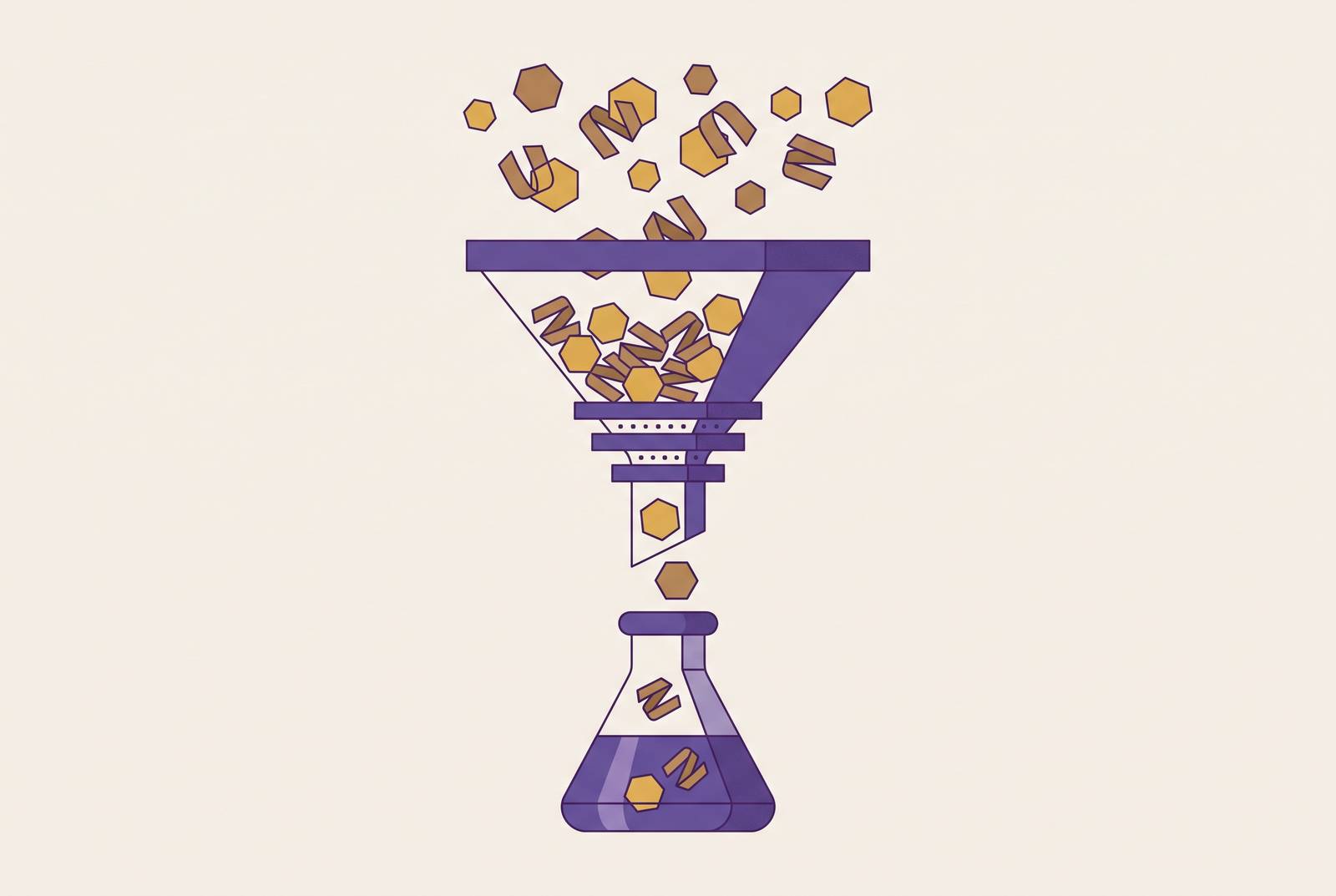
Cell-based protein expression fails late and expensively. A researcher spends two to three weeks cloning a construct, transforming it, growing up culture, inducing expression, and only then discovers the protein aggregates in inclusion bodies or never expresses. Cell-free protein synthesis (CFPS) offers a way to catch that failure in days instead of weeks, by running the expression test before any cell ever touches the construct. This piece lays out the operational logic of using CFPS as a filter: what it can tell you, what it can't, and how to read the data it produces without over-trusting or under-using it.
The traditional workflow is sequential by design. Gene cloning and vector construction come first, then transformation and colony screening, then culture growth and optimization, then induction, harvest, and purification. Each stage adds days to weeks, and none of them tell you whether the construct was ever going to work until you're several stages deep. Attrition, when it happens, happens late: a construct that misfolds or aggregates is usually only discovered after the lab has already committed cloning labor, incubator time, and purification reagents to it. The labor is front-loaded, but the failure is back-loaded, so the most expensive moment to learn a construct doesn't work is right after you've built the full pipeline around it.
Protein engineering has also changed scale in ways the traditional workflow wasn't built for. Computational design, directed evolution, and library screening routinely produce hundreds of candidate variants at once. Testing each one through a linear, weeks-long cell-based pipeline isn't just slow, it's arithmetically impossible within any reasonable budget or timeline. CFPS solves a specific piece of that problem: it lets researchers eliminate the constructs that were never going to work, before committing cell-based infrastructure to any of them.
What CFPS does in an expression workflow, and what it does not
CFPS reproduces transcription and translation outside a living cell, using either crude cell lysates or reconstituted purified components, supplemented with nucleotides, amino acids, an energy source, salts, and buffer. No cell membrane, no cell wall, no living host. That absence changes the operational profile of the reaction in ways that matter directly for filtering.
PCR products can go straight into the reaction. No cloning into a vector, no transformation, no colony picking. Reaction conditions, redox state, ionic strength, pH, cofactor concentration, chaperone presence, are all directly tunable in the tube, rather than being mediated by whatever a living cell's internal chemistry happens to allow. And because there's no host cell to keep alive, the reaction just runs until it exhausts its substrates. It doesn't have to negotiate with a growth curve. Process times run shorter than cell-based methods across the board.
Two broad classes of CFPS system exist, and they serve different purposes. Crude extract systems, E. coli-based lysates in particular, are cost-effective and high-yield, and they're the best-characterized option for throughput screening; bacterial and tobacco lysates in particular outperform other commercial extract options on raw protein output. PURE and other reconstituted systems strip out the contaminating enzymes present in crude extract, buying tighter reaction control at the cost of yield, which makes them better suited to studying translation mechanisms in detail than to screening large numbers of constructs.
What CFPS cannot do matters just as much as what it can. It cannot replicate the full complexity of authentic post-translational modification, glycosylation patterns in particular, which still require the complete cellular machinery that only a living cell provides; cell-based expression remains the dominant system for that reason. It says nothing about large-scale manufacturing economics or scalability, because that was never its job. And it cannot predict how a protein will behave under the specific stresses of downstream purification at manufacturing scale. CFPS answers an early question. It was never built to answer a late one.
The filtering logic: what a CFPS screen is testing
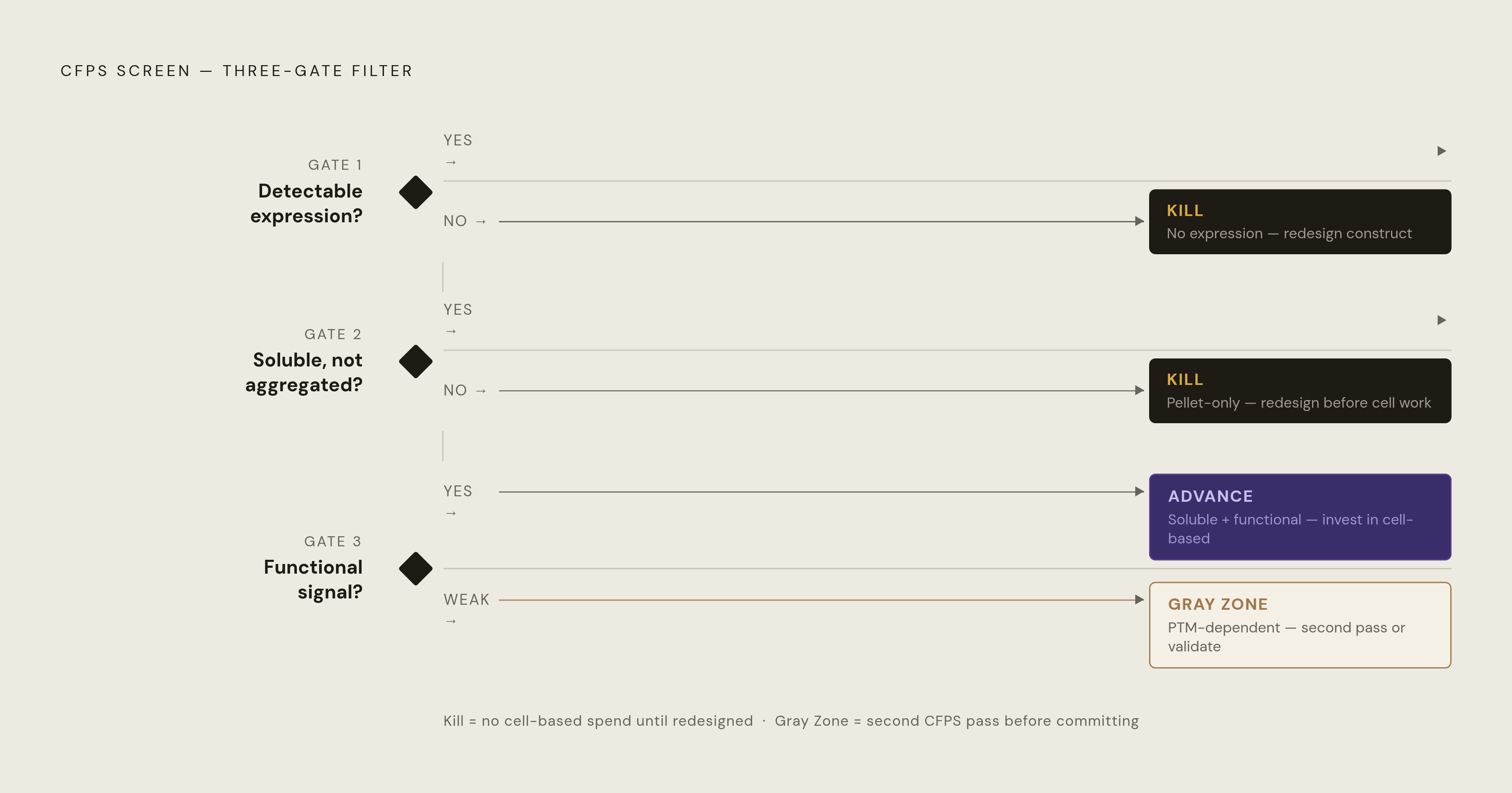
A first-pass filter needs to answer three questions, no more. Does the construct express at a detectable level? Is the expressed protein soluble, or does it end up in aggregate? And does it show any functional signal, binding, catalytic activity, a structural marker, appropriate to whatever class of protein it belongs to?
None of this is meant to reproduce cell-based yield. A CFPS screen is a ranking exercise. The absolute milligrams-per-liter number from a cell-free reaction won't match what a fermenter eventually produces, and it isn't supposed to. What matters is whether the signal is directionally reliable, and the evidence says it is: in a cell-free protein synthesis-based metabolic engineering screen of Ter homologs, every homolog that expressed in vitro was subsequently expressed in whole cells, and all but one worked on the first cell-based attempt. That's a strong empirical anchor for the whole filtering approach. If a construct fails to express or comes out insoluble in CFPS, betting on it in a cell-based campaign is a bet against the data. Killing it early is the entire point of running the filter. It's the entire point of running the filter.
Where CFPS has the clearest filtering advantage: protein classes that break cell-based early-stage testing
Some protein classes make cell-based early screening actively unreliable, and CFPS's advantage is sharpest exactly there.
Toxic proteins are the clearest case. Antimicrobial peptides, proteases, membrane-disrupting proteins, these are often lethal to the host cell before enough protein accumulates to measure anything. The usual cell-based workaround, forcing expression into inclusion bodies and refolding afterward, tends to leave you with a badly reduced fraction of active protein. CFPS sidesteps the entire problem, because there's no cell viability to threaten. Toxicity, in a cell-free reaction, is simply not a variable. Amin and colleagues demonstrated this directly: the cytotoxic protein onconase, which cannot be produced in standard cell-based systems without specialized strain engineering, was expressed and screened successfully in a CFPS reaction.
Membrane proteins present a related but distinct problem. Heterologous expression in E. coli routinely dumps membrane proteins into inclusion bodies, forcing researchers into modified strains and difficult purification protocols just to get a usable sample. CFPS handles this by adding lipidic mimetic components, detergents, nanodiscs, liposomes, directly into the reaction, giving the protein something membrane-like to fold into as it's synthesized. A high-throughput CFPS screen tested 61 eukaryotic membrane proteins across six different lipidic mimetic conditions, and 35 of the 61, 57%, came out soluble in at least one condition. That cell-free system produced soluble protein for more targets than a parallel E. coli-based comparison, and the whole workflow ran in 48 to 72 hours using microdialysis devices and standard 96-well plates. Getting that kind of hit-rate data on membrane protein solubility in three days, rather than the months a strain-engineering campaign would demand, is close to the ideal case for a filtering technology.
Disulfide-bonded and multi-domain proteins round out the list, with antibody fragments as the clearest example. Because the CFPS reaction is an open system, researchers can add disulfide isomerases, chaperones, and redox buffer directly, tuned to whatever the specific folding problem requires. The yield data backs this up concretely: adding DsbC and DnaK to an E. coli-based CFPS reaction raised monomeric scFv yield from 0.02 mg/mL to 0.2 mg/mL, a tenfold jump from two additives alone, and a two-stage refolding process pushed that further to 0.5 mg/mL of monomeric scFv while retaining structural integrity and function. Fab fragment production hit 0.3 to 0.4 mg/mL of purified, active, soluble protein from 1 mL reactions, without needing any disulfide-forming additives or chaperones. None of these numbers compete with a mature cell-based antibody production process, and they don't need to. They're more than sufficient for initial activity screening and biophysical characterization, which is what a filtering step asks of them.
How to structure the CFPS screen: practical setup for a filtering campaign
Screening hundreds of variants is genuinely tractable in CFPS, using 96- or 384-well plate formats, with microfluidic devices available for labs pushing toward even higher throughput. Reaction volumes stay small, so the cost per data point stays low. Across the design-protein-screening literature, hundreds of variants run in open, tunable CFPS reactions is the scale that keeps appearing as the practical sweet spot.
Template preparation is where a lot of the time savings actually live. Because PCR products go directly into the reaction, there's no cloning step, no transformation, no colony picking standing between a designed sequence and a first expression readout. That compression, from days of cloning work down to hours of PCR, is the practical mechanism that makes parallel screening of hundreds of constructs feasible.
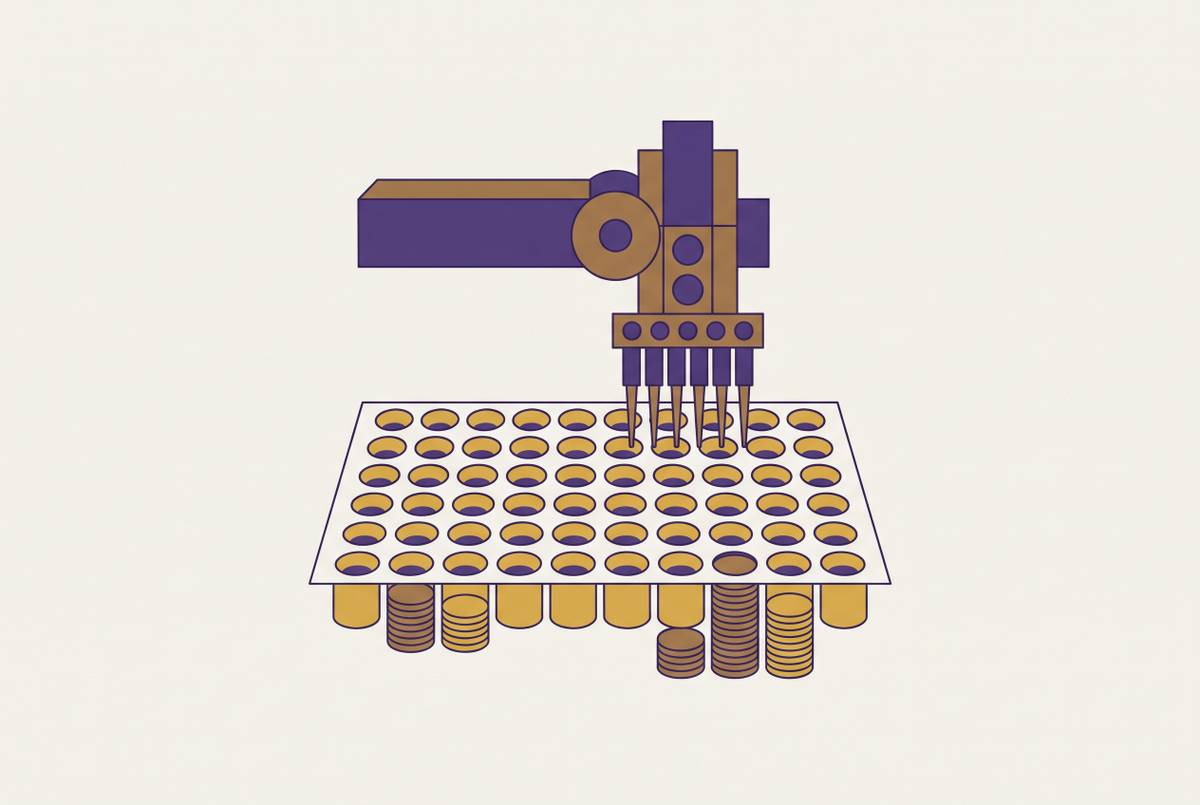
Automation matters at this scale, not as a nice-to-have but as a requirement. High-throughput CFPS is built around robotic liquid handling; platforms like the Opentrons OT-2 and Labcyte Echo show up in the research specifically because they can dispense the small, precise volumes CFPS reactions need. At hundreds of variants, manual pipetting isn't just slow, it introduces enough variability to confound the very ranking the screen is trying to produce. The equipment demands beyond that stay ordinary: standard incubators, standard plate readers, existing liquid-handling infrastructure. No specialized CFPS hardware required.
Readouts need to map to the three filtering questions directly. Expression gets confirmed with a fluorescent reporter fusion, or a gel or Western blot when absolute confirmation matters. Solubility comes from a straightforward supernatant-versus-pellet fractionation after centrifugation, a simple assay that carries a surprising amount of information for the effort it takes. Function depends on the target: an activity assay for an enzyme, a binding assay for a receptor or antibody fragment, a structural indicator where neither of those applies cleanly. For enzymes specifically, activity can often be measured directly in the CFPS reaction itself, no separate purification step needed.
Reading the data: which constructs advance, which get killed, and what the gray zone means
Some outcomes are unambiguous. A construct that expresses in the soluble fraction and shows a functional signal in CFPS is a strong candidate for cell-based investment, and the Ter homolog data provides real mechanistic backing for that call: cell-free expression signal predicted cell-based expressibility reliably on a first pass. For enzyme and biocatalyst variants specifically, the CFPS screen also surfaces which chaperone combinations, temperature conditions, and codon choices work best, information that carries forward directly into how the eventual cell-based expression should be set up.
The kill signals are just as clear, and just as useful. No detectable expression at all usually points to a fundamental construct problem, bad codon usage, a folding issue baked into the sequence, an unintended truncation, and it should be redesigned before spending anything on cell-based work. Expression that shows up only in the pellet means the protein made it but aggregated, which flags a construct that cell-based systems are unlikely to rescue without an engineering investment that may not be worth making until the construct has proven itself some other way. Both of these are cheap lessons to learn in a CFPS plate. The same lesson learned in a cell-based campaign costs a great deal more in both time and reagent spend.
Then there's a gray zone, and its limits deserve honesty rather than pretending the filter resolves everything. Constructs that need authentic, complex post-translational modification still require a cell-based system for the functional answer. CFPS solubility data remains useful there for narrowing the field, but it can't substitute for the final readout. Eukaryotic CFPS platforms, wheat germ extract, HEK293-based systems, and similar options, can partially model glycosylation and disulfide folding, but none of them replicate the full complexity of native glycan structures. Constructs sitting right at the solubility threshold deserve a second CFPS pass, varying chaperone composition or redox conditions, before anyone commits to a kill decision on a coin-flip result. And for yield-sensitive targets, where the manufacturing yield itself is the thing that matters most, CFPS was never built to answer that question. A construct advancing on CFPS data still needs cell-based scale-up validation before anyone treats yield as settled.
The filter narrows the field, so that the cell-based effort that follows gets spent on constructs that already have evidence behind them, rather than on the full, undifferentiated list. What it does is narrow the field, so that the cell-based effort that follows gets spent on constructs that already have evidence behind them, rather than on the full, undifferentiated list.
The economics of running the filter versus skipping it
Late discovery is expensive in a way that's easy to underestimate until it's tallied up. A construct that fails deep into a cell-based campaign, after cloning, transformation, culture scale-up, and purification, has already consumed weeks of researcher time and a meaningful amount of reagent budget, for a result a CFPS screen could have delivered in days. The gap between a lab running twenty experiments a quarter and one running two hundred comes from exactly this inefficiency. A lab running twenty experiments a quarter can instead run two hundred.
Running the filter costs comparatively little. CFPS at plate scale, in small reaction volumes, represents a fraction of what a full cell-based campaign costs, and the math tips in the filter's favor the moment it catches even a single late-stage failure before that failure reaches the cell-based stage. At the scale modern protein engineering actually operates at, hundreds of designed or evolved variants per project, the case stops being a judgment call. Linear cell-based testing of every single variant simply isn't something a lab can afford to do, in time or in reagent cost. CFPS filtering is what turns that serial queue into a parallel triage instead.
Reagent pricing has historically been a real obstacle to running screens at this scale; traditional CFPS kit costs can make plate-scale screening of hundreds of variants feel like a resource-constrained compromise rather than a routine step. That's the specific gap OpenCFPS™ pricing, starting at $25/mL, is built to close: making hundreds-of-variant screening something a lab budgets for as standard practice, rather than something it rations.
Sources
- Cell‐free protein synthesis system: A new frontier for sustainable biotechnology‐based products - Maharjan - 2023 - Biotechnology and Applied Biochemistry - Wiley Online Library
- Understanding Cell-free Protein Synthesis | Sino Biological
- pubs.rsc.org
- pmc.ncbi.nlm.nih.gov
- pubmed.ncbi.nlm.nih.gov
- academic.oup.com