Batch CFPS Versus Continuous Exchange Format for Milligram Yields
Continuous exchange format extends reaction time to boost eukaryotic protein yields tenfold.
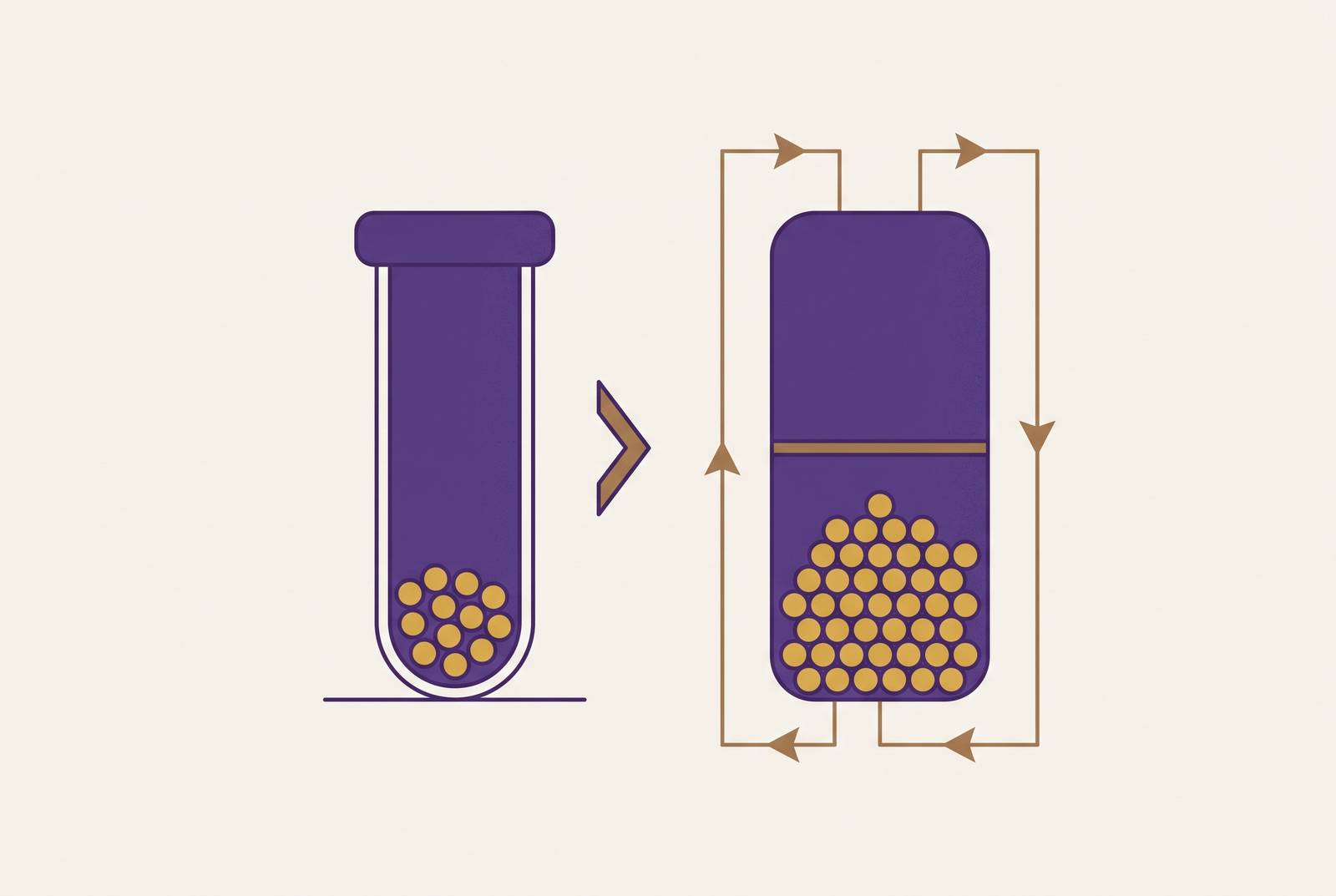
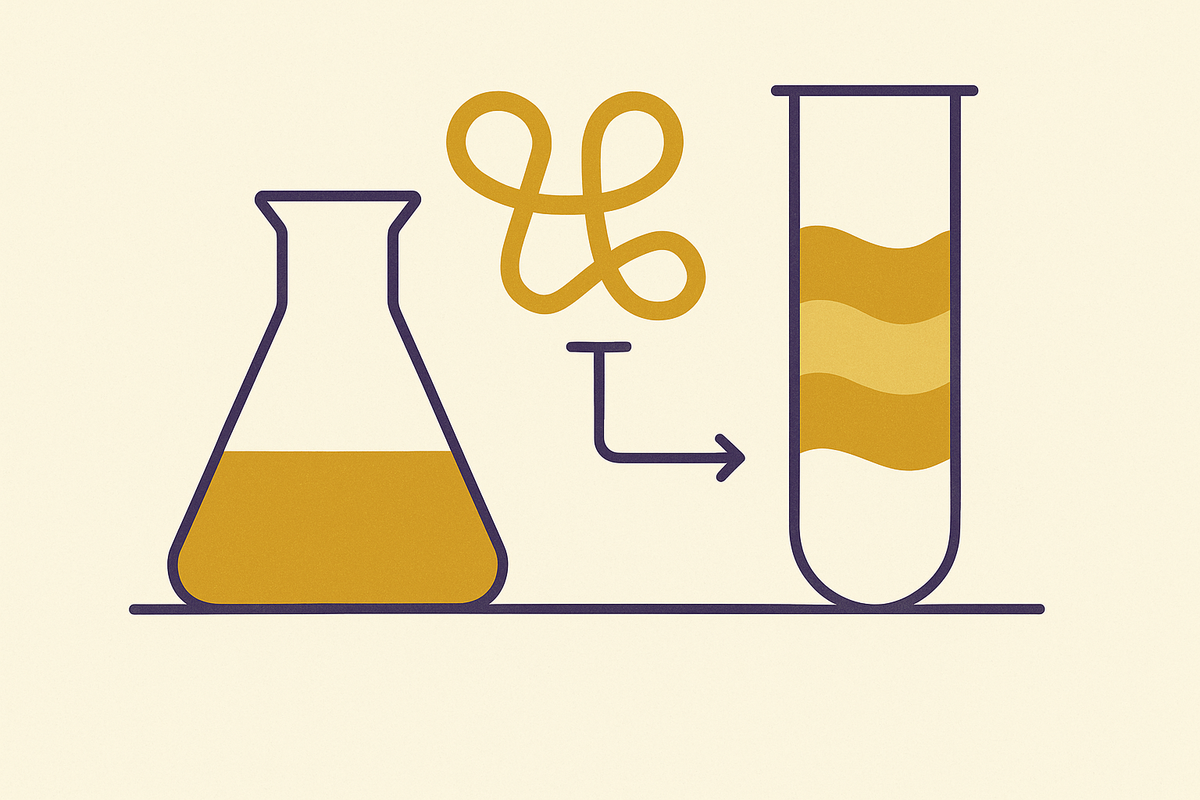
A batch cell-free protein synthesis reaction does not fail because the extract runs dry. It fails because of two physical processes that converge on the reaction at the same time: the exhaustion of energy substrates and the buildup of byproducts that actively shut down translation. A batch reaction is a sealed vessel. Nothing is added after the start, and nothing is removed, so phosphate, the capacity to regenerate ATP, and the pool of free nucleotides all decline from the first second the reaction runs, with no mechanism to replenish any of them.
The second process is what turns that decline into a hard stop. Every round of ATP hydrolysis that powers translation releases inorganic phosphate, and that phosphate does not sit inert in solution. It binds free magnesium ions, the same ions that nucleotide-dependent reactions, including protein synthesis itself, require to function. The shutdown this produces is not a gradual fade. It accelerates as phosphate accumulates: more phosphate means more magnesium sequestered, less functional translation machinery results, and the reaction's output curve does not taper so much as collapse.
What makes this especially difficult to engineer around is that the two failure modes are not independent. They are coupled to the same chemistry. The ATP regeneration system that keeps translation supplied with energy is the very process generating the phosphate that will eventually poison it. A scientist cannot simply add more of the regeneration chemistry to extend the reaction, because doing so only accelerates the accumulation of the byproduct that ends it. The ceiling this creates is a thermodynamic property of running a biochemical reaction in a closed container, and it has constrained batch CFPS as a production method for years, motivating a wave of active energy-regeneration strategies that extended batch reactions somewhat without ever removing the underlying constraint.
How continuous exchange cell-free format bypasses the batch ceiling
Continuous exchange cell-free synthesis, or CECF, does not fix the chemistry described above. It changes the container. Instead of a sealed tube, a CECF setup places the reaction in a chamber separated by a semipermeable membrane from a second, larger feeding chamber. Small molecules move freely across that membrane: fresh energy substrates and nucleotides diffuse into the reaction side, while the accumulating inorganic phosphate and other inhibitory byproducts diffuse out into the feed. This is the direct structural answer to the batch failure mode. The same phosphate buildup that sequesters magnesium and halts translation in a closed tube is continuously drained away, and the substrate depletion that starves ATP regeneration is continuously replenished from the feeding chamber.
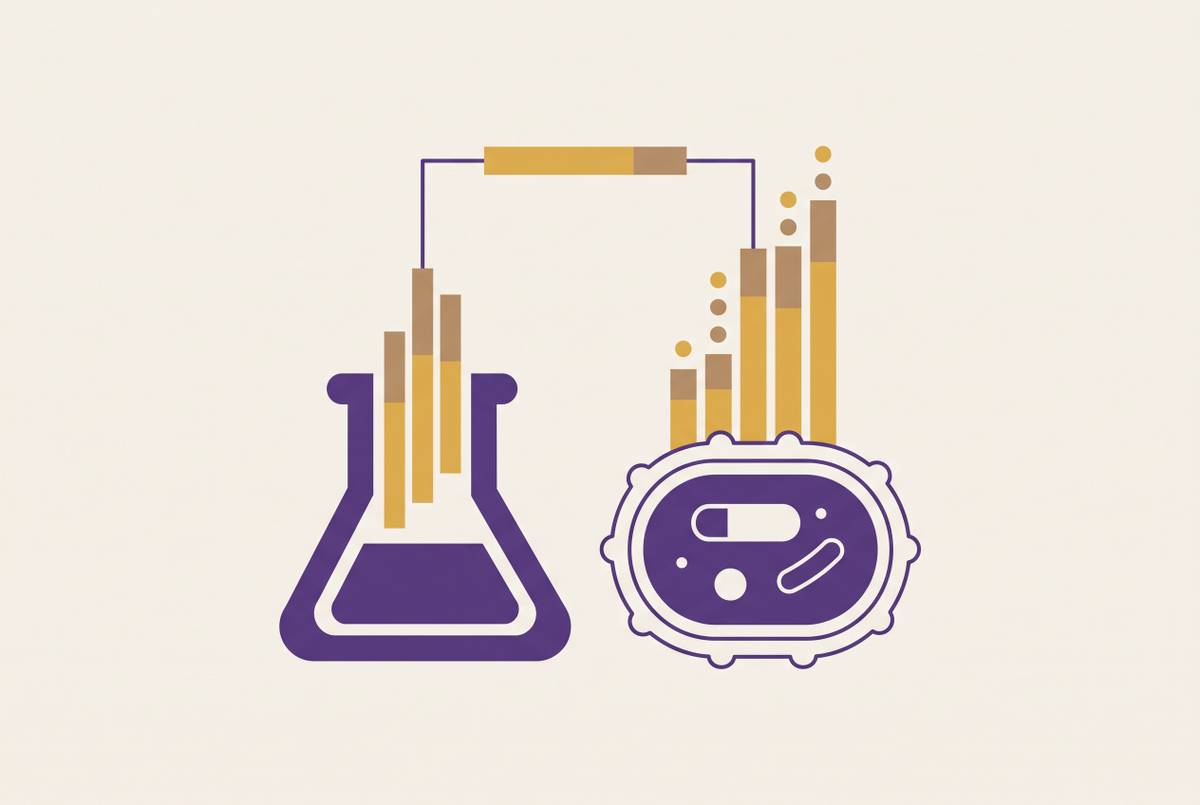
The practical effect is that the reaction is held far from the equilibrium point that kills batch synthesis, for a much longer stretch of time, and that extended window is the entire mechanism by which CECF produces more protein. Reaction durations that would exhaust a batch tube within hours extend to tens of hours in eukaryotic systems, and the added yield is a direct consequence of that added time, not evidence that CECF extracts are somehow more potent than batch extracts. Tong et al., writing in Synthetic and Systems Biotechnology in December 2026, document reaction times extended to tens of hours in eukaryotic CECF systems, with protein yield rising from roughly 40 µg/mL in batch to approximately 1 mg/mL. In the CHO-CECF system specifically, extending CFPS activity past three hours through dialysis produced a four-fold increase in protein output, from roughly 80 µg/mL in batch to approximately 300 µg/mL.
That membrane, however, introduces problems that do not exist in a sealed tube. Large molecules in the CFPS solution can clog the membrane over the course of a long reaction, degrading the exchange that the whole format depends on, and membrane fouling remains an active area of engineering work rather than a solved problem. Device geometry matters too: Jackson and Fan found that whether a CECF device is oriented horizontally or vertically materially changes synthesis outcomes, meaning CECF yield is sensitive to hardware configuration in a way that batch reactions, lacking any membrane or feeding chamber, simply are not. None of this argues against using CECF. It means a scientist adopting the format takes on a new set of engineering variables, membrane integrity and device geometry among them, that a batch reaction never requires managing in the first place.
The yield numbers that define milligram-scale feasibility in each format
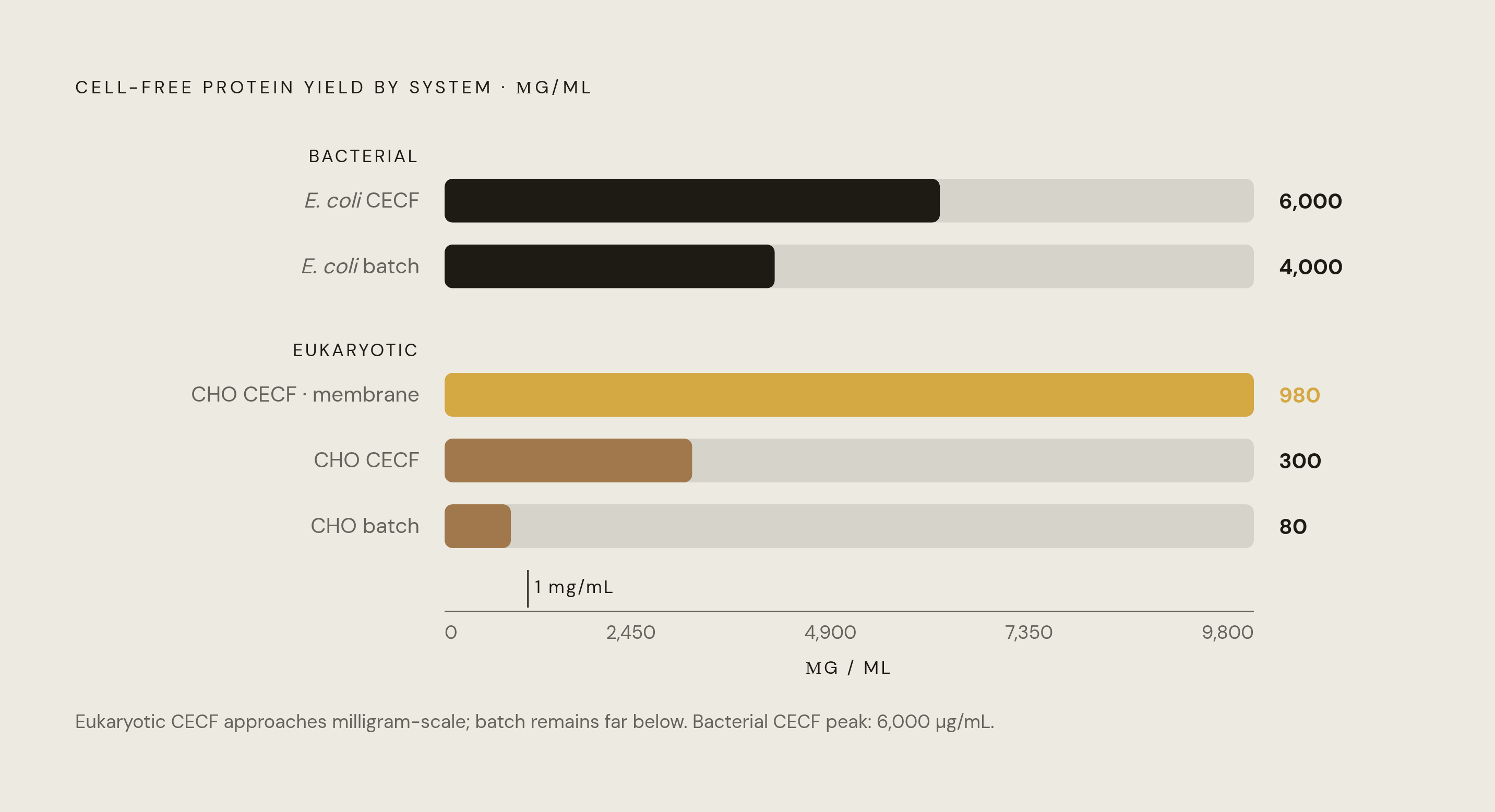
Set side by side, the yield data from both formats describe a consistent pattern rather than a scattered set of impressive numbers. In bacterial systems, the ceiling batch synthesis faces is real but comparatively high: an E. coli lysate-based batch system has demonstrated a record yield of 4 mg/mL, and prokaryotic CECF configurations have reached as high as 6 mg/mL. Both formats, in other words, can reach milligram-scale output when the extract is E. coli-derived, and the format choice in that case is a matter of degree rather than feasibility.
Eukaryotic systems tell a different story. The CHO-CECF system developed at Fraunhofer IZI-BB, an established benchmark rather than a current record, reached membrane protein yields as high as 980 µg/mL, reported at the time as the highest yield achieved in any microsome-containing eukaryotic cell-free system, and for the specific case of EGFR the shift from batch to CECF produced a 40-fold increase in yield for the same amount of labor.
The pattern that emerges from these figures sets the practical boundary for milligram-scale planning. For a protein that E. coli extract can express, batch format is a viable route to milligram quantities provided the extract and energy-regeneration system have been optimized. For a protein that requires eukaryotic translation machinery, CECF is the only cell-free route that comes close to milligram-scale output, because eukaryotic batch reactions do not clear that threshold under normal conditions.
The target protein's biology determines which format is correct
The choice between batch and CECF is downstream of a more basic question: what does the target protein need in order to fold and function correctly? That question dictates which lysate is usable, and the lysate choice, in turn, constrains which reaction format is realistic. Yield targets matter, but they are the second question, not the first.
Membrane proteins illustrate this most clearly. E. coli lysates do not retain the microsomal structures that a cell's native membrane system provides, while CHO and other mammalian lysates do. In the CHO-CECF system, those retained microsomal structures give a membrane protein a native-like lipid environment to fold into as it is synthesized, and that environment is what makes yields up to 980 µg/mL achievable. A batch reaction run with the same CHO lysate cannot reach that figure, because the limiting factor is reaction duration, and batch format cannot supply the sustained duration that a membrane protein's folding process needs.
Glycosylated proteins impose a similar constraint from the opposite direction. E. coli extracts lack glycosylation enzymes entirely, so any protein requiring authentic Fc modifications or complex N-linked glycans has to be made in mammalian or, at minimum, insect-derived lysate. Those eukaryotic lysates carry lower baseline yields than E. coli systems, which is precisely why they gain the most from the extended reaction time that CECF provides.
Toxic proteins invert the usual priority. The absence of a living host cell is the core advantage of cell-free synthesis for this class of target: a protein that would kill any expression organism it was produced in can simply be synthesized in a tube with no viability to protect. A 2025 bioRxiv preprint describes the efficient synthesis of active BsaI, a restriction endonuclease known for strong cytotoxicity, in an optimized E. coli CFPS system. For toxic proteins, batch format is frequently sufficient, because the binding constraint is whether any functional protein can be produced without the reaction destroying itself chemically first.
Disulfide-rich and aggregation-prone proteins present the case where duration alone does not solve the problem. Reproducing the oxidative folding pathways that these proteins rely on inside a living cell remains one of the central unsolved challenges across every CFPS format, batch or CECF alike. CECF extends how long a reaction runs, which helps when folding is simply slow, but it does nothing to correct a folding environment that is chemically wrong for the protein in question.
Platform diversity adds a further layer to this decision. LenioBio's ALiCE platform, built on plant-based cell-free extract, is described as the first eukaryotic CFPS system to combine post-translational modification capability, workable yield, and scalability that holds consistent from small-well screening through large bioreactor production, a reminder that lysate origin and format interact differently depending on the platform in question.
Where batch format retains an advantage: high-throughput screening workflows
None of the yield advantages documented above make CECF the correct choice in every circumstance. Batch format remains the right tool whenever the experimental goal is comparison across many variants rather than absolute yield from a single reaction, and screening campaigns are exactly that kind of goal.
Batch reactions fit directly into 96- and 384-well plate formats that automated liquid handlers are built around, which is structurally why they remain the right tool for screening. CECF dialysis devices, built around a membrane and a feeding chamber, do not fit that format at all, and this is a fundamental incompatibility with automated screening infrastructure rather than a minor inconvenience to work around. Low-volume batch CFPS run through automated workflows produces consistent results across replicates, and critically, yields measured at low-volume screening scale correlate with yields measured at large-scale production, a relationship demonstrated in biofoundry-integrated systems. Conditions that identify a winning variant in a 384-well plate carry forward reliably to the production run that follows.
CFPS integration with biofoundries has accelerated the Design-Build-Test-Learn cycle, and batch format is the enabler of that integration because it is plate-compatible. The workflow logic that follows from this is straightforward: screen hundreds of variants in batch format first, identify the candidate worth producing at scale, then move that single winner to CECF or to a scaled-up batch reaction for milligram-scale production. Batch and CECF function as complementary stages of a single pipeline when the workflow is structured this way.
Batch format also wins outright whenever the target protein is E. coli-expressible and milligram-per-mL yields are achievable without any exchange system. Introducing a CECF setup in that situation adds membrane management and hardware complexity without a yield benefit large enough to justify the added engineering burden.
Reagent economics and cost at milligram scale
Yield numbers and workflow fit are not the whole picture. Reagent and extract costs dominate the total cost of any milligram-scale CFPS run, and those costs do not fall evenly across formats. A 2025 bioRxiv preprint notes that most published CFPS studies report protein yields that leave production costs an order of magnitude higher than comparable cell-based methods, a gap that affects both formats.
CECF's larger feeding chamber volume means every run consumes more reagent than an equivalent batch reaction, and that overhead is most punishing in mammalian extract systems, where energy cocktails, nucleotides, and lysate preparation already account for most of the total production cost.
Prokaryotic and other microbial systems show that this cost structure is not fixed. A 2026 study in Biotechnology & Bioengineering applied reagent optimization to Pichia pastoris CFPS, using a modified Kozak sequence along with added PEG-6000 and spermidine, and achieved a substantial increase in yield alongside a large drop in cost per gram of protein produced. Pichia is eukaryotic but not mammalian, and the result demonstrates that the reagent optimization gains seen in E. coli systems are not confined to bacterial extract. They extend to other classes of eukaryotic lysate as well.
What all of this means for a scientist planning a milligram-scale run is that cost has to be evaluated format by format and extract by extract, not assumed from the yield numbers alone. A transparent, lot-QC-documented reagent system, such as the OpenCFPS™ platform from Sepia Biosciences, is designed to address the cost and opacity problems that have historically made CFPS economics variable, since lot-level QC data is what lets a scientist know whether a cost change between runs reflects a formulation issue or a format issue.
A practical decision framework for choosing batch or CECF
The decision between batch and CECF format resolves, in practice, into a short sequence of questions rather than a single yield comparison. Biologically, the question comes first: does the target protein require eukaryotic post-translational modification, a membrane-compatible lipid environment, or oxidative folding machinery that E. coli lysate cannot provide? If the answer is yes, the lysate choice is already constrained to a eukaryotic source, since eukaryotic batch yields typically fall in the 50–300 µg/mL range and milligram-scale output is not routinely achievable in eukaryotic batch, while CECF is the only cell-free path to near-milligram yields for proteins requiring eukaryotic machinery.
The second question concerns scale of effort rather than scale of yield: the goal is either to compare many candidate variants or to produce milligrams of one already-chosen protein. Screening work belongs in batch format regardless of its lower per-reaction yield, because the plate compatibility and automation fit that batch provides are not available in any CECF configuration, and screening-scale results reliably predict production-scale outcomes when the workflow carries a validated variant forward.
Economically, the next question follows: does the protein in question come from an E. coli-expressible target, where batch format alone can already reach milligram-scale yields, or does it require a mammalian or other costly eukaryotic extract, where CECF's yield advantage has to be weighed against its higher reagent overhead per run? For toxic proteins, a fourth consideration overrides all of the above: the binding constraint is not yield at all but whether any functional protein can be recovered before the reaction destroys the toxic target or itself, a condition under which batch format's simplicity is usually sufficient.
Format choice in cell-free protein synthesis is a matter of matching a reaction's physical constraints, the closed-system ceiling of batch and the membrane-dependent extension of CECF, to what a specific protein needs and what a specific budget and timeline allow.
Sources
- Eukaryotic cell-free protein synthesis: Chassis diversification, system engineering, and emerging applications - ScienceDirect
- High-yield production of “difficult-to-express” proteins in a continuous exchange cell-free system based on CHO cell lysates
- High-yield production of “difficult-to-express” proteins in a continuous exchange cell-free system based on CHO cell lysates
- Cell-Free Protein Synthesis in Miniaturized Array Devices and Effects of Device Orientation - ScienceDirect
- Optimizing Human Cell-Free System for Efficient Protein Production - PMC
- High-yield production of “difficult-to-express” proteins in a continuous exchange cell-free system based on CHO cell lysates - PMC
- A simplified and highly efficient cell-free protein synthesis system for prokaryotes
- A cell-free future for protein production