Protein Purification Strategies Downstream of Cell-Free Synthesis
Designing purification steps at the reaction stage prevents failures on the bench.
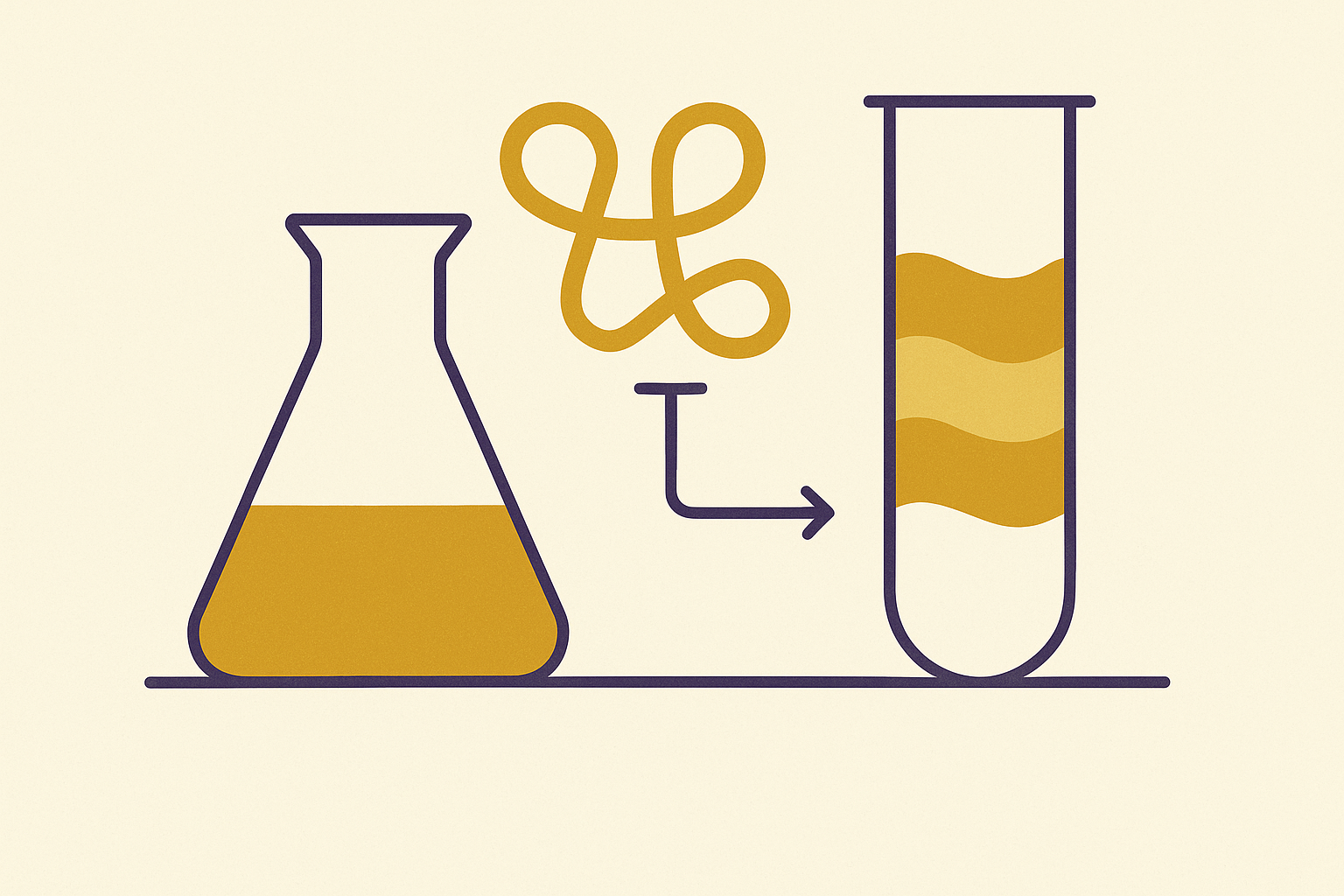
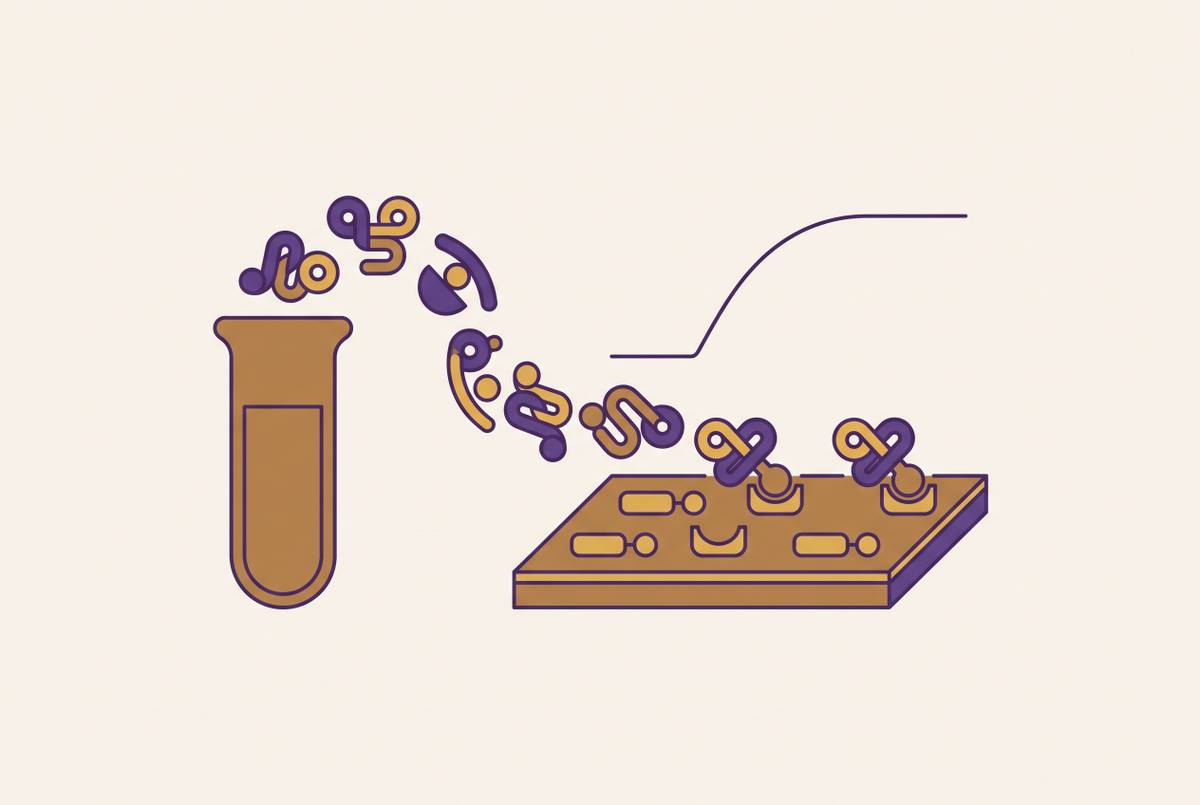
coli fermentation, is solving the wrong problem. The reaction will clarify poorly, bind inconsistently, and elute at lower purity than it would from a conventional lysate with the same tag, because the cause sits upstream of the column. A CFPS reaction mixture is built on purpose: energy substrates, salts, polyethylene glycol, free amino acids, transcription and translation factors, and, in crude lysate systems, the full set of host-cell proteins carried over from the source organism, all present at concentrations that look nothing like a bacterial fermentation supernatant or a mammalian culture harvest. Choosing a chassis, whether E. coli crude lysate, wheat germ, CHO, or the fully defined PURE system, is an expression decision and a purification decision made before a single resin is chosen. A 2020 review in BioDrugs lays out the downstream menu: separation of soluble and insoluble debris and media components, purification, formulation, bioconjugation, and refolding may all be required, but depending on the protein and the application, only some of these steps, or even just one, actually apply. What determines which steps a given protein needs is the composition of the matrix it starts in, not a fixed checklist borrowed from a different expression platform. The rest of this piece works through that logic step by step, matrix type by matrix type, failure mode by failure mode, so you make purification choices at the reaction design stage, not by trial and error at the bench.
Crude lysate and PURE system matrix differences that matter for purification
Crude lysate and PURE system reactions present purification problems that differ in kind, not just in degree, because the contaminant load, the background protein concentration, and the enzymatic activity still present in each system are built on completely different premises. Crude lysate systems, whether drawn from E. coli, wheat germ, or CHO cells, retain the full complement of host-cell proteins, nucleic acids, lipids, and metabolites that survived lysis and clarification. That background is rich, it is variable from batch to batch, and it has to be treated as a real competitor for resin binding sites and a real source of co-eluting contaminants. The PURE system takes the opposite approach: built from individually purified translation components, it removes most of the host-cell protein background that crude lysate carries, but it replaces that problem with a defined set of recombinant proteins, ribosomes, translation factors, and polymerase, that still have to be separated from the target protein at the end of the reaction. Neither system is free of background; they simply carry different kinds of it, and the purification strategy has to be built around whichever kind is present.
Eukaryotic crude systems add a consideration that bacterial lysates don't carry. The BioDrugs review notes that eukaryotic cell-free systems are endotoxin-free and lack the complex plasma membrane that complicates protein purification in other systems, a real practical advantage for any downstream assay sensitive to endotoxin contamination, including many cell-based and in vivo applications. Eukaryotic systems carry the same batch consistency problem as bacterial lysates. Reproducibility remains one of the persistent barriers to wider CFPS adoption, and variability in lysate quality across batches has a direct, significant effect on protein yield. That yield variability doesn't stay contained to the expression step. It changes the load that reaches the purification step every time. A purification protocol tuned to one lysate batch may fail to perform the same way on the next one.
Clarification before capture: removing the matrix before it removes your yield
Clarification in a CFPS workflow is not the housekeeping step it's sometimes treated as. Crude lysate matrices carry particulates, nucleic acid aggregates, and membrane fragments that, if they reach the capture step unaddressed, foul resin surfaces and cut dynamic binding capacity well below what the same resin would achieve with a cleaner load. The standard tools, centrifugation and filtration, have to be matched to the specific particulate profile of the matrix in front of them. A CFPS reaction run in the presence of phospholipid vesicles or detergent, as is common in membrane protein expression modes, carries a completely different particulate burden than an aqueous reaction built around a soluble, cytoplasmic target, and the clarification method has to reflect that difference rather than default to whatever protocol is already on the shelf.
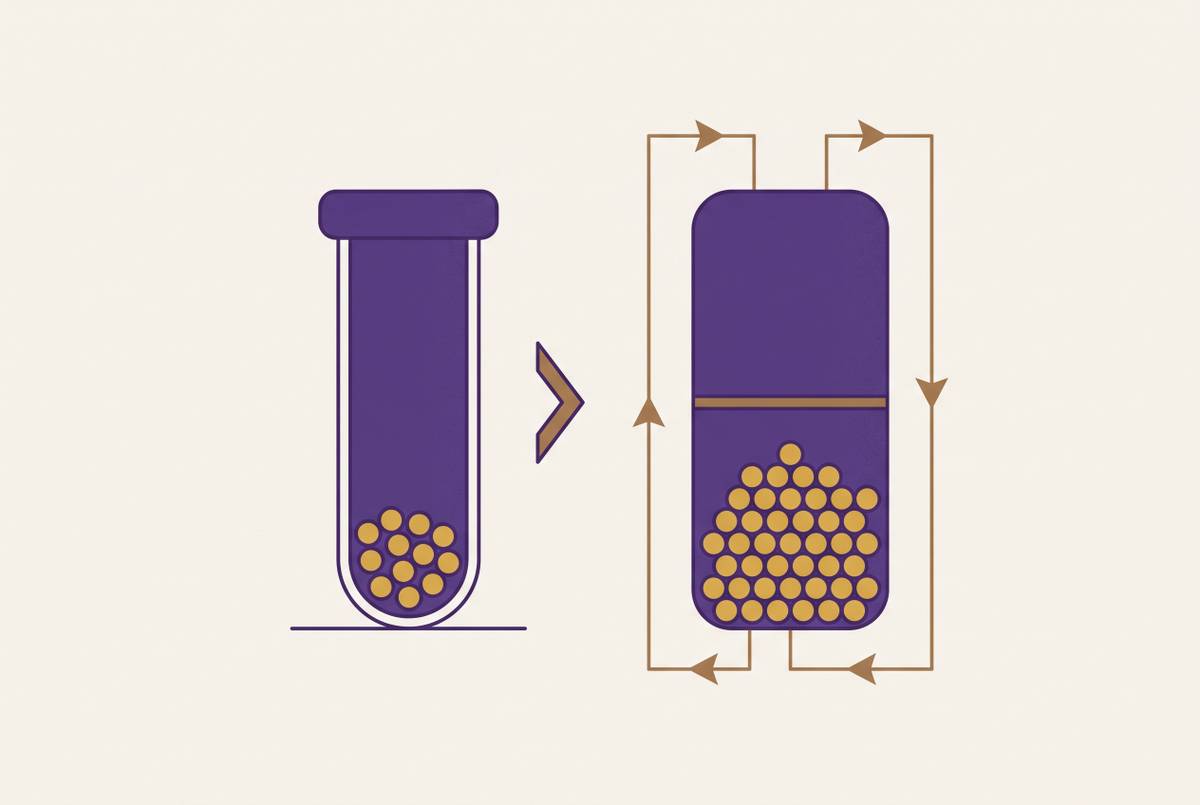
Plate-format and high-throughput CFPS add a geometric constraint on top of the chemical one. Centrifugation of 96-well or 384-well plates behaves differently than centrifugation of a single tube or column, and that format limitation narrows the set of clarification methods that are actually practical at scale. A clarification approach built for single-tube reactions needs rework before it scales into a plate, and the purification plan has to account for that before the plate ever goes into the centrifuge.
Affinity capture as the dominant first-capture strategy in CFPS
His-tag IMAC is the default first-capture method downstream of CFPS, for the same reasons it dominates conventional purification: a polyhistidine tag on the target binds nickel or cobalt ions immobilized on a resin, contaminants wash through, and imidazole displaces the target protein at elution. That mechanism is simple in principle, but the CFPS reaction matrix introduces interference that a conventional lysate doesn't. Energy regeneration systems and buffer components specific to CFPS reactions can compete with or suppress the histidine-nickel interaction, so if you didn't design the reaction buffer with the downstream capture step in mind, both yield and purity drop. Imidazole concentration carried over from the lysis or reaction buffer is one specific control point: carryover imidazole has to be kept low enough that it doesn't block binding before the target protein ever reaches the column, and that constraint belongs in the reaction design stage, not as a fix applied after a failed purification run. Cobalt resin, used instead of nickel, buys higher selectivity at some cost to total yield, a reasonable trade when the crude lysate background is heavy and purity is the priority over maximizing recovery.
The most consequential breakdown occurs at the plate scale. Casteleijn et al., writing in Scientific Reports in 2018, found that imidazole elution performs poorly when IMAC is run in batch, the typical mode for multiwell plate purification, because batch IMAC operates under equilibrium binding conditions, unlike the non-equilibrium conditions that flow-based IMAC achieves on a packed column. That inefficiency traces to the format, not to any defect in the resin chemistry itself: the same nickel or cobalt chemistry that performs well in a column underperforms once it's run as a batch process in a well. That finding doesn't argue for abandoning IMAC in plate formats. It argues for designing the elution step around batch equilibrium conditions, or for evaluating alternative capture chemistries built for high-throughput use; split-intein mediated capture is one of these, and one sourced analysis found it reached 89 to 93 percent efficiency onto solid surfaces.
Split-intein capture and other tag-based alternatives for integrated CFPS workflows
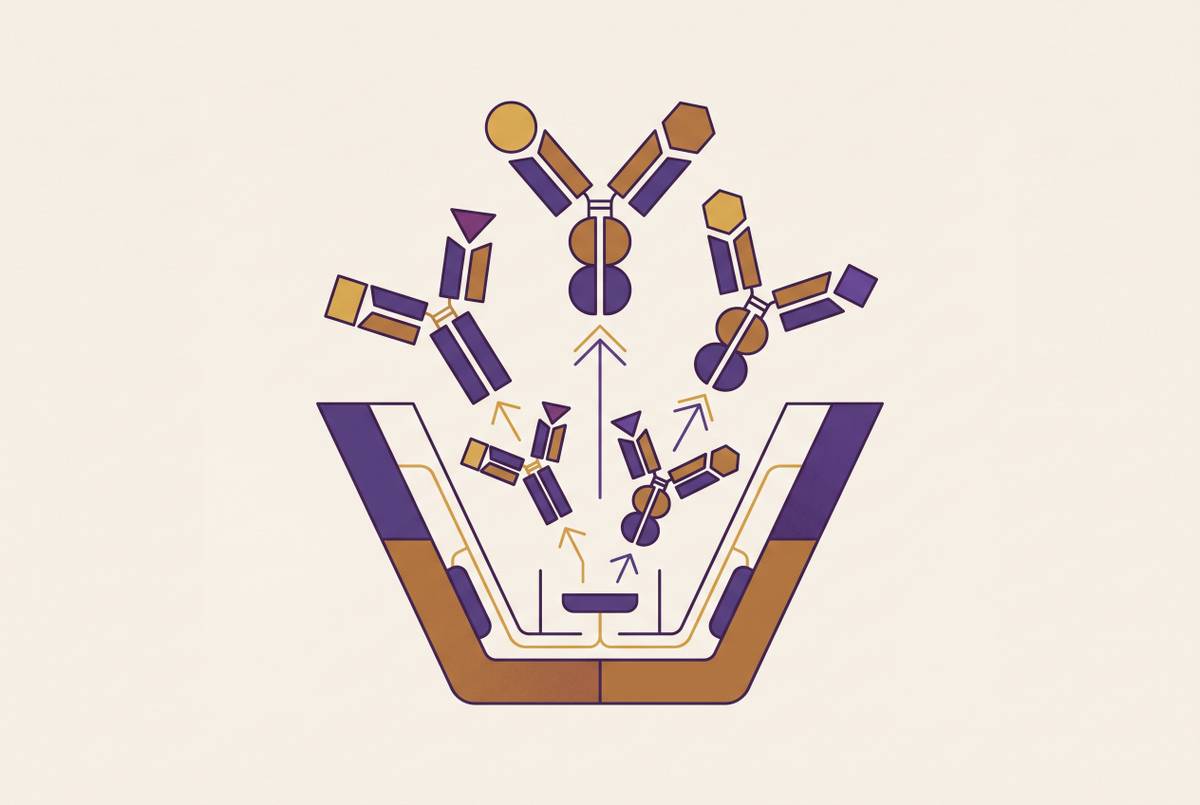
The choice between IMAC and a split-intein approach is a workflow design question more than a head-to-head contest: what does the protein need to be at the end, a purified sample ready for structural work, a bioconjugate, a labeled probe, and which capture chemistry reaches that endpoint with the fewest intervening steps starting from a CFPS reaction. Split-intein mediated capture answers that question for a specific set of use cases by folding capture, splicing, bioconjugation, and release into a single vessel, with no buffer exchange and no concentration step required between them.
Casteleijn and colleagues demonstrated the approach in 2018 using the pharmaceutical protein ciliary neurotrophic factor. Split-intein mediated capture onto a solid surface reached 89 to 93 percent capture efficiency; light-triggered release worked as an alternative to imidazole elution; and biotin transferred from the capture peptide directly to the target protein without any additional purification step. The payoff the authors describe is concrete: in principle, the full integrated workflow, expression, capture, light-triggered release, and bioconjugation, can be completed in one day, compared with the weeks that traditional methods typically require.
That integration is possible specifically because CFPS reactions are open systems. The capture reagent can be added directly into the reaction mixture, or the reaction itself can be designed to terminate in a capture-ready state, neither of which a living-cell expression system can offer, since a cell's internal environment can't be opened up and modified mid-reaction the way a CFPS tube or well can.
Target protein properties and the CFPS matrix
The proteins researchers most often choose CFPS to produce, toxic, membrane-associated, disulfide-bonded, or multi-domain, each bring their own purification demands, and those demands compound whatever matrix-specific challenges are already in play. Difficulty doesn't stop at the expression step, because it travels with the protein into the purification workflow.
Toxic proteins change what purification has to address. The BioDrugs review notes that CFPS can express cytotoxic proteins that can't be produced in living cells at all, and that its open reaction environment lets you characterize some of these proteins right away, with no purification step in between. When the CFPS reaction itself serves as the assay environment, you have to ask whether purification is even the right next step.
Membrane proteins carry their solubilizing agents with them. These proteins make up roughly half of all major drug targets, by the BioDrugs review's figure, and they're notoriously difficult to produce in cell-based systems. CFPS allows their expression with added detergents, lipids, or nanodiscs, and each of those additives becomes part of the reaction matrix: the clarification method and the capture chemistry both have to be designed around whatever solubilizing agent is present.
Disulfide-bonded proteins depend on reaction conditions, redox potential, the addition of the enzyme DsbC, that are tuned specifically to support correct bond formation. Those same conditions change the composition of the matrix and can alter how the target protein behaves on a resin, so the conditions that make high-yield, correctly folded disulfide-bonded protein possible are the same conditions the purification step has to be built to accommodate.
Multi-domain proteins raise a different concern, one that becomes visible only after capture. The BioDrugs review highlights CFPS's advantage in producing folded eukaryotic multi-domain proteins, since it overcomes toxicity and quality problems that cell-based systems run into. A protein coming off a capture resin in the right molecular weight range isn't necessarily folded correctly, so correct folding has to be confirmed downstream, making analytical polishing steps essential. The general pattern holds across all four categories: the more structurally demanding the target protein, the earlier the purification strategy has to be designed alongside the expression conditions, rather than added on afterward once the reaction is already running.
Purification design for plate-format and automated high-throughput CFPS
High-throughput CFPS, used for variant screening across dozens or hundreds of reactions in parallel, only delivers on its speed advantage when purification is built into the plate-format workflow from the start, rather than scaled down from a protocol written for single-tube reactions. A recent review of automated cell-free systems describes CFPS as well suited to small-volume, high-throughput, repeatable workflows, and notes that its open reaction environment and reproducibility make it compatible with liquid-handling automation. Purification at plate scale runs into constraints that single-reaction protocols don't meet, and you have to solve those before the throughput advantage becomes real.
The batch-IMAC inefficiency Casteleijn and colleagues documented in 2018 matters most in this plate-format context, where flow-based IMAC isn't a practical option. That constraint pushes labs toward alternative capture strategies built for batch conditions from the outset, magnetic bead-based affinity capture among them, or on-resin conditions deliberately optimized for equilibrium binding. Reagent and buffer volumes in 96-well or 384-well plates also limit wash and elution volumes, and those limits directly affect how much purity and concentration you can achieve in the final eluted protein. You need to model those volume constraints into the purification plan before you run the first plate, not discover them empirically after a disappointing first attempt. If you build a reagent system with plate and liquid-handler compatibility as a design requirement rather than a feature added on later, it gives labs a real head start, because standardizing at the reagent level removes one more variable each lab would otherwise have to solve on its own.
Reproducibility of the purified product as a function of upstream matrix consistency
A purification protocol can be technically correct in every step, matched to the right matrix, the right clarification method, the right capture chemistry, and still produce inconsistent results from one run to the next if the CFPS matrix feeding it isn't consistent itself. Lot-level lysate quality sets a ceiling on what purification can achieve downstream. No amount of resin optimization, buffer tuning, or elution redesign compensates for a batch of lysate that behaves differently from the one the protocol was validated against, because the purification step is reacting to whatever load the matrix actually delivers, not to the load the protocol assumes it will receive. Reproducibility concerns in CFPS appear as much at the reagent and lysate production stage as at the bench where purification happens. Standardizing the matrix itself, batch to batch, lot to lot, is not a side concern to purification design; it is the condition that makes a purification protocol validated once actually worth trusting the second, tenth, and hundredth time it's run.