Benchmarking CFPS Yield Against E. Coli Recombinant Expression
Cell-free synthesis beats E. coli for toxic proteins but loses on cost at scale.
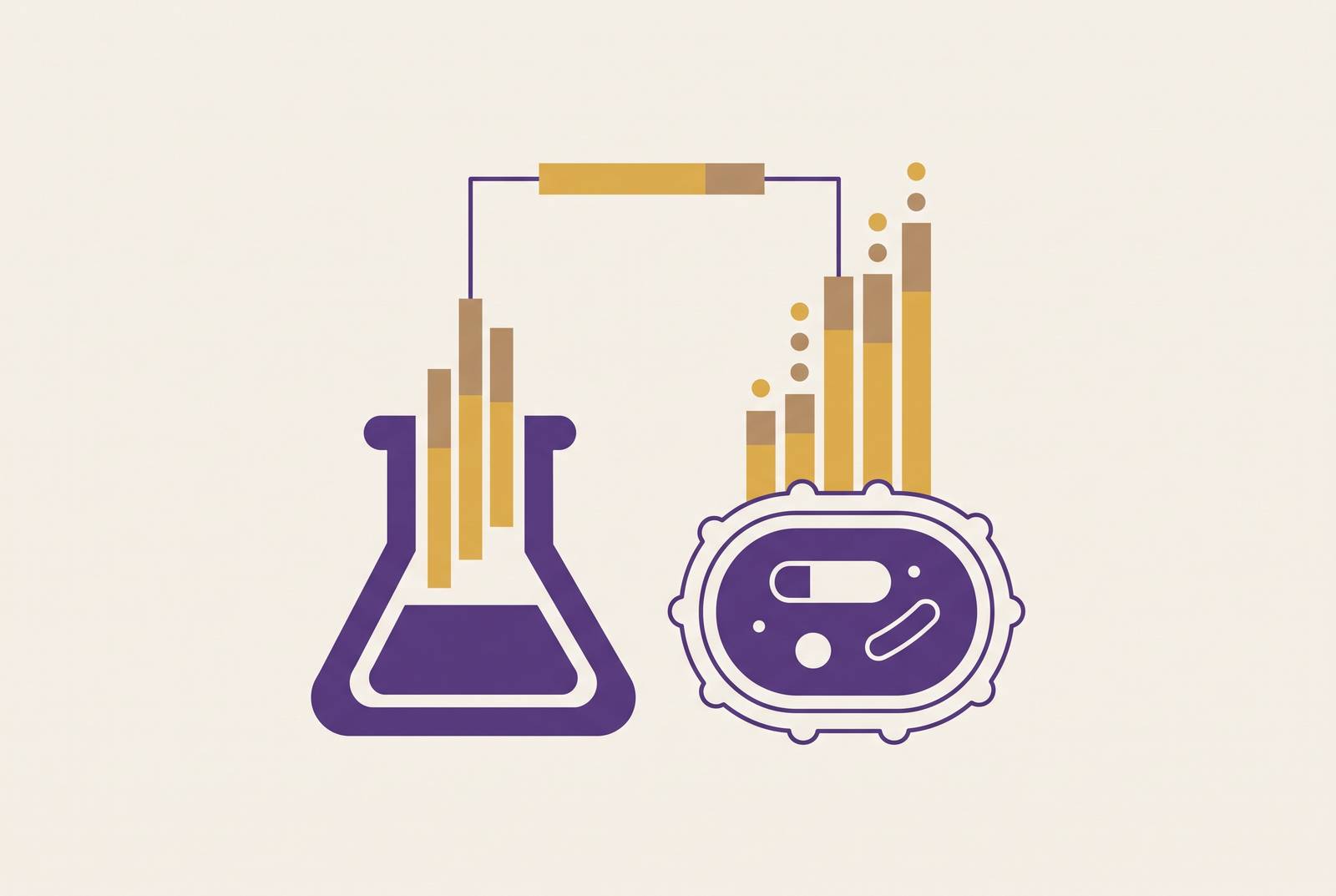
Comparing cell-free protein synthesis (CFPS) to E. coli recombinant expression as a simple yield contest obscures the question that actually matters to a working lab: which system delivers functional protein in adequate quantity, for this target, at this stage of the project. A milligram figure printed without context tells a researcher almost nothing about whether that protein will fold correctly, whether it will be recoverable in soluble form, or whether the number can be reproduced next week with a different lysate batch.
Part of the difficulty is that the two systems don't even measure yield on the same clock<sup>1</sup>. CFPS yield comes from a reaction volume running for a matter of hours. E. coli recombinant expression accumulates its yield over multi-day cultures. Setting these numbers side by side without accounting for time, scale, and the downstream loss that comes from insoluble or inactive product produces a comparison that looks precise but isn't. A further complication is that CFPS itself is not one system: E. coli-based cell-free expression platforms remain the dominant format for efficient cell-free gene expression, and that category spans crude lysate preparations, the fully defined PURE system, batch reactions, fed-batch configurations, and genome-engineered strains, each with its own yield ceiling. A structured comparison, organized by protein class and project phase, gives a researcher something a single number cannot: a basis for choosing the right tool for the target in hand.
Mechanistic basis of yield differences between expression systems
The yield gap between these systems traces back to how each one supplies the energy and raw materials that translation requires. Living E. coli cells regenerate ATP, amino acids, and cofactors continuously, drawing on metabolism that runs for hours to days without external intervention. CFPS batch reactions have no such renewal system. They start with a fixed pool of substrates and run until that pool is exhausted, typically stalling within hours.
What CFPS loses in reaction duration, it can recover in concentration of effort. A living cell has to divide its resources among growth, membrane maintenance, and a long list of housekeeping functions, alongside whatever recombinant protein it has been asked to produce. A cell-free reaction has no such competing demands: every component in the tube is available to synthesize the target protein, with nothing diverted to cell survival. That redirection of translational machinery explains why CFPS can out-yield in vivo expression on difficult targets despite running for a fraction of the time.
The internal composition of CFPS systems varies just as much as the comparison with E. coli does. Conventional E. coli-derived CFPS systems rely on reaction buffers built from as many as 35 components, a complexity that makes systematic optimization difficult and leaves the system vulnerable to batch-to-batch variability rooted in extract preparation: lysis protocol, fermentation batch, and strain all leave a mark on the final lysate. A simplified eCFPS system developed at Shandong University pushed past that complexity, reducing the essential core reaction components from 35 to 7 while maintaining or improving protein expression levels, and pairing that reduction with a "fast lysate" protocol that eliminates the traditional runoff and dialysis steps. The PURE system takes a different route to the same problem: it replaces crude lysate with fully defined, purified components. Nuclease and protease activity drop, and each element becomes individually tunable, but batch yield falls well below what crude lysate systems deliver.
Yield benchmarks for soluble, well-behaved proteins: where E. coli recombinant expression holds the advantage
For a protein that folds readily, carries no toxicity to the E. coli host, and is needed at multi-milligram or gram scale, in vivo E. coli recombinant expression delivers a lower cost-per-milligram than any current CFPS batch format can match. That advantage rests on decades of fermentation optimization and on the continuous substrate supply a living culture provides, and no batch CFPS reaction can replicate those conditions at manufacturing scale. Anyone weighing these systems should treat this as the strongest honest objection to defaulting to CFPS for routine production work: the economics of scale-up still favor the cell.
That economic advantage is conditional, though, and the condition matters. Even for a target that expresses cleanly in both systems, CFPS can compress the path from DNA to characterized protein from days to hours, a difference with real value during early candidate triage when dozens of constructs are still in play. The cost advantage of in vivo expression only materializes once a target has been validated and a construct has been fixed. Before that point, the question is not which system is cheaper per milligram but which system gets a researcher an answer fastest, and on that question the two systems are answering different needs rather than competing on the same axis<sup>1</sup>.
Cytotoxic proteins: the category where CFPS yield benchmarks are not merely competitive but uniquely enabling
Some proteins cannot be produced in living cells at any useful yield, because the protein itself kills or arrests the host before enough of it accumulates. CFPS sidesteps that constraint by operating entirely outside a living cell. There is no host to kill, so there is no ceiling imposed by toxicity.
The restriction endonuclease BsaI makes the case concretely. Its DNA-cleaving activity is highly cytotoxic to host E. coli cells, making in vivo expression notoriously difficult. The simplified eCFPS system developed at Shandong University expressed active BsaI despite that cytotoxicity, so it recovered functional protein from a target that would have arrested or killed a living host before it could accumulate anything useful.
For this class of target, the relevant comparison is not CFPS yield against E. coli yield. It is CFPS yield against zero. Any functional protein recovered from a cell-free reaction represents a gain that in vivo expression structurally cannot deliver, no matter how the culture is optimized. A researcher looking at a CFPS yield that seems modest in absolute terms, for a cytotoxic target, is looking at the only system among the two that produced anything<sup>1</sup>.
Aggregation-prone and structurally complex proteins: yield as a measure of soluble, active product
A high total yield number from E. coli recombinant expression can hide a serious problem: much of that protein may end up misfolded in inclusion bodies, leaving an effective yield of soluble, active protein that is lower than what CFPS delivers in a fraction of the time. Total protein and usable protein are not the same measurement, and conflating them produces a comparison that favors whichever system makes more material, regardless of whether that material does anything.
The simplified eCFPS system illustrates the distinction directly. It synthesized functional, self-assembling vimentin, a cytoskeletal protein prone to aggregation, demonstrating that an open reaction environment can support correct folding of a structurally demanding target. An E. coli-based CFPS system developed for artificial spidroin production shows the same principle applied to a different structural challenge: repetitive, aggregation-prone proteins that are notoriously difficult to express in living cells found a workable path through cell-free synthesis. A de novo optimized cell-free system achieved soluble and active expression of human tumor necrosis factor-alpha (TNF-α), a target whose expression as inclusion bodies has been repeatedly reported in E. coli under standard inducible promoters. That result shows CFPS system optimization translating directly into active-protein yield rather than simply more total protein.
So if you read published comparisons, benchmark soluble active yield rather than band intensity on an SDS-PAGE gel, since gel density conflates insoluble and soluble product and tells you nothing about function. Membrane proteins extend the same principle further: CFPS allows production without strain engineering, avoids the inclusion body formation common in heterologous E. coli hosts, and permits solubilizing agents to be added directly to an open reaction. If you add the right additives, a cell-free reaction can produce folded, functional membrane protein where in vivo expression yields only insoluble material.
High-throughput variant screening: where CFPS yield-per-experiment outperforms E. coli recombinant expression on a workflow basis
CFPS can synthesize protein directly from linear DNA templates. A researcher bypasses transformation, colony selection, and the multi-day culture period that in vivo E. coli expression requires before any protein is in hand. That compression, from days down to hours per variant, is the decisive advantage at the screening stage, where the question is not how much protein a single reaction yields but how many variants can be tested before a deadline arrives.
Reaction volumes scale down to the microliter level, so you can test large variant libraries in parallel on standard plate formats in a way colony-picking and sequential culture scaling never permit. The robust E. coli-based CFPS application platform developed at Tsinghua University was built explicitly around this mode of operation, designed as a tool for programmatic, reproducible use across many targets rather than as a method for producing a single protein at maximum yield.
The standard objection says CFPS yield per reaction runs lower than what a flask culture produces, but that doesn't hold once you reframe the comparison at library scale. The real comparison is dozens or hundreds of CFPS reactions run in parallel against the same number of sequential cloning-expression cycles. At the screening stage, a yield that is merely good enough to measure activity, multiplied across many variants in a single afternoon, delivers more usable information than a maximal yield obtained from one construct over several days.
Batch vs. fed-batch configurations and reaction format
Standard CFPS batch reactions are energy-limited by design. They typically stall within hours as substrates deplete, and this configuration underlies most of the published yield comparisons that circulate in the literature, making it the main source of the apparent yield gap against sustained E. coli cultures. Extended or fed-batch configurations, which replenish energy substrates during the reaction, push yields substantially higher and narrow that gap considerably for milligram-scale production. If you compare published numbers, check which format produced them before you draw conclusions.
Genome engineering adds a separate axis of optimization. E. coli strains lacking release factor 1 (RF1) improve cell-free protein synthesis by suppressing RF1 competition at amber stop codons, which enables more efficient incorporation of non-standard amino acids. That improvement raises the yield ceiling of crude lysate systems no matter what energy regeneration strategy the reaction uses. The practical consequence for benchmarking is that a CFPS yield figure from a batch reaction, a fed-batch reaction, and an RF1-knockout lysate run in batch mode are three distinct numbers. Citing "CFPS yield" without specifying which of these formats produced it understates what an optimized system can actually deliver.
Reproducibility and lot-to-lot consistency as a hidden dimension of the yield comparison
A yield figure obtained from a single CFPS reaction is not a production specification. The number that actually matters operationally is the yield that can be reliably reproduced across different lysate batches, different operators, and different labs, and crude lysate systems face a genuine structural challenge here: extract quality shifts with the producing strain, the fermentation batch, and the lysis protocol used to prepare it. A number that cannot be reproduced on the second attempt is not a benchmark, whatever it looked like the first time.
Reproducibility, it turns out, is achievable even in crude lysate systems when the formulation behind them is sufficiently defined and documented. The Tsinghua platform demonstrated robustness to failure across batches of cell lysates, across users, across locations, and across the synthesis of different target proteins, establishing that batch-to-batch consistency is not inherently incompatible with crude lysate chemistry. The PURE system reaches consistency by a different route: with every component defined, each concentration individually tunable, nuclease and protease activity reduced, and no dependence on variable fermentation batches, lot-to-lot consistency becomes structurally easier to achieve, at the cost of the lower batch yields that defined systems carry.
Reagent transparency lets a lab act on a yield drop instead of merely suffering it. When a formulation is documented and its components are known, a dropping yield is diagnosable and correctable. When the formulation is opaque, the same drop is an unexplained failure with no systematic remedy available. When you publish lot-level QC data alongside open formulations, you treat yield reproducibility across lots as more than a secondary concern. It is the foundation that any production claim has to rest on. A researcher weighing systems should ask not only what yield a system reports, but what yield can be expected reliably, and how a change in that yield would even be detected.
A decision framework for choosing between CFPS and E. coli recombinant expression based on target and project phase
coli recombinant expression is a staged decision, and the right system for early-stage variant screening or difficult-target characterization is frequently not the right system for later-stage scale-up of a validated, tractable construct. If you organize a framework around target biology and project phase, that staged decision gets concrete footing.
CFPS is the appropriate choice under these conditions:
- The target is cytotoxic to E. coli, where in vivo expression offers no viable path to functional protein.
- The target is aggregation-prone or forms inclusion bodies in vivo, a problem addressable with folding additives that cannot be introduced into a living cell without disrupting it.
- The project is in an early-stage phase involving many candidate variants, where the hours-per-variant timeline and microliter-scale parallelization of CFPS outweigh any per-reaction yield disadvantage.
- The construct is still unfixed, and the value of a fast answer exceeds the value of a cheap one.
E. coli recombinant expression becomes the stronger choice once a target is validated, tolerated well by the host, and needed at multi-milligram or gram scale, where its cost-per-milligram economics at scale have no current equivalent in CFPS batch formats. Choosing correctly between the two means reading past the headline yield number toward the protein class in question, the phase of the project, and the reproducibility a lab can actually expect to carry forward from one lysate batch to the next<sup>1</sup>.
Sources
- A simplified and highly efficient cell-free protein synthesis system for prokaryotes
- Development of a robust Escherichia coli-based cell-free protein synthesis application platform - PMC
- Developing an E. coli-Based Cell-Free Protein Synthesis System for Artificial Spidroin Production and Characterization
- Improving Cell-Free Protein Synthesis through Genome Engineering of Escherichia coli Lacking Release Factor 1 - PMC
- A De Novo Optimized Cell-Free System for the Expression of Soluble and Active Human Tumor Necrosis Factor-Alpha
- Cell-free gene expression
- A simplified and highly efficient cell-free protein synthesis system for 1
- Development and comparison of cell-free protein synthesis systems derived from typical bacterial chassis - PMC