Bispecific and Multispecific Antibody Fragment Production in CFPS
Cell-free synthesis overcomes structural barriers that kill bispecific antibody fragment production.

Bispecific and multispecific antibody fragments fail in production for structural reasons: multi-domain folding, disulfide bond register, cytotoxicity, and format diversity all stack against the same cell-based workflows that work well for conventional monoclonal antibodies.
Why bispecific and multispecific antibody fragments are structurally harder to produce
Two structural paradigms define bispecific antibody production, and each carries its own distinct set of problems. IgG-like full-length formats must solve heavy-chain heterodimerization and light-chain mispairing. When a single cell co-expresses two heavy chain-light chain pairs, it can produce a mixture of ten different antibody molecules, and only one of those ten has the correct bispecific structure. The other nine are waste, and separating the correct species from the mispaired ones is its own purification burden layered on top of expression.
Fragment-based, Fc-free formats, which include scFv tandems, diabodies, BiTEs, and tandem Fabs, sidestep the chain-pairing lottery entirely because they are built as single polypeptides or simplified chain combinations. Affinity-tag fusion compounds the difficulty further: bispecific fragments generally require peptide tags for purification, and those tags can interfere with folding and function while raising the construct's immunogenicity risk.
The patent literature in this space reflects just how hard chain pairing is to solve inside a cell. Each of these engineering clusters is a patch applied to a biological system that was never built to produce two different antibody arms from the same cell at the same time. Understanding why these patches exist reveals the case for a completely different production architecture that solves the problem at its root.
Limits of cell-based expression for this protein class
Cell-based expression systems fail on bispecific and multispecific fragments at the exact points where this protein class is most demanding. Cytotoxicity is one of those points: fragment formats that engage immune effector cells, or that carry payloads toxic to the host, can kill or severely impair the cell line before enough protein accumulates to be useful. That is a direct conflict between the construct's biological function and the survival of the cell manufacturing it.
Chain pairing is a second point of failure, and it cannot be controlled from outside the cell. Mammalian cell expression gives multi-domain fragments the oxidizing conditions they need, but you pay for that with slower timelines and far higher infrastructure overhead.
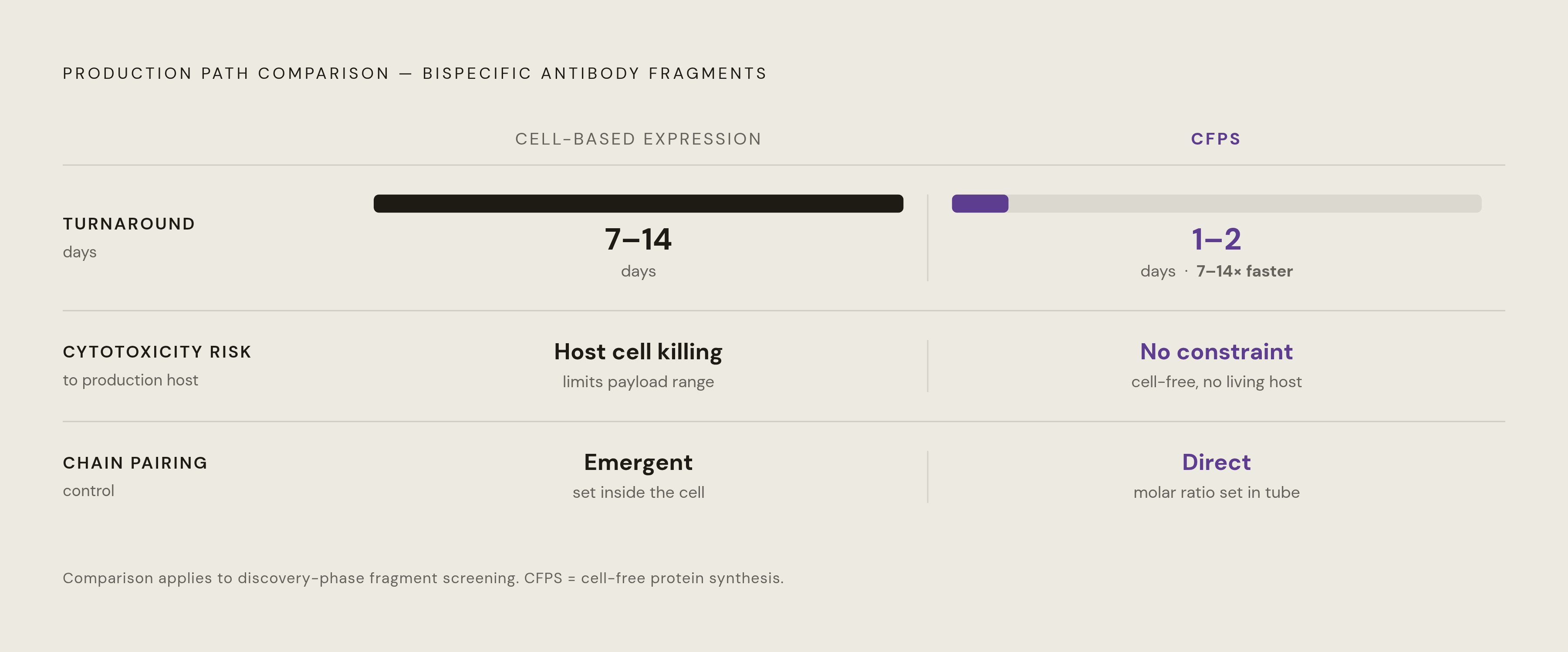
Timeline is the fourth constraint, and it is an economic one as much as a technical one. In vivo protein expression can require one to two weeks per construct, and for discovery teams iterating across large bispecific variant libraries, that per-cycle cost becomes prohibitive well before it becomes merely inconvenient. These limits are not hypothetical. Conventional cell-based systems failed to express and purify FGFR3-TACC3, an oncogenic receptor tyrosine kinase fusion, to a yield or quality sufficient for comparative study. The production method itself, not the biology being studied, was what blocked the science.
None of this displaces cell-based expression from the role it plays well. Gram-per-liter scale for late-stage manufacturing remains squarely in the domain of mammalian and microbial cell culture, and nothing here argues otherwise. The argument concerns the discovery and early-development phase, where fragment-based bispecifics are most structurally demanding and where cell-based systems are weakest relative to the alternative.
What CFPS's open-reaction architecture directly solves for multi-domain fragments
The open reaction environment of cell-free protein synthesis is a direct solution to the specific engineering constraints that fragment-based bispecific antibodies impose. CFPS gives researchers an open reaction environment with direct control over protein synthesis, so you can set heavy-to-light chain molar ratios in the tube rather than leave them to a cell's internal transcriptional balance. When the ratio is a parameter you set, the chain-pairing lottery that plagues cell-based co-expression simply does not apply.
Redox tuning works the same way. Chaperone supplementation follows the same logic: optimization strategies including chaperone supplementation, redox tuning, and post-expression refolding protocols have been shown to enhance solubility and recover properly folded, functional protein from aggregated or misfolded intermediates, tools that are difficult or impossible to deploy with the same precision inside a living cell.
Misfolding itself becomes a recoverable event. A two-stage refolding protocol has successfully recovered active proteins from misfolded precipitates. In a cell-based system, misfolded protein gets degraded or locked into irreversible inclusion bodies. In an open CFPS reaction, that same material can be reprocessed. Cytotoxicity, the constraint that kills host cells before fragment formats like BiTEs can accumulate, disappears as a limiting factor in a cell-free context: a 2025 CFPS system demonstrated efficient synthesis of the active restriction endonuclease BsaI despite its strong cytotoxicity, and the same logic extends to antibody fragments built around cytolytic mechanisms. Speed closes the case. CFPS can produce protein in a matter of hours and normally requires one to two days for the full experimental procedure, compressing each design-build-test cycle relative to the one-to-two-week timeline that in vivo expression demands.
Fragment-based formats are where CFPS has the clearest near-term advantage over full-length IgG-like bsAbs
Not every bispecific format benefits equally from cell-free production, and that needs to be said directly. Fragment-based, Fc-free formats, the scFv tandems, diabodies, BiTEs, and tandem Fabs, are where CFPS's advantages concentrate most tightly, because their structural requirements line up precisely with what CFPS can control. These fragments are smaller, and they do not require Fc glycosylation for their primary function. The one post-translational modification CFPS has historically struggled with, complex N-glycosylation, is simply not a requirement for this subclass. Multi-chain assembly can be tuned directly inside the reaction rather than left as an emergent property of a cell's secretory pathway: stoichiometry, folding order, and linker geometry are all design variables a researcher can manipulate in the tube.
One format illustrates this fit particularly well. An Fc fusion with a protease recognition site inserted around the hinge region has been described as an ideal strategy for producing bispecific antibody fragments, and that format slots naturally into CFPS workflows, where Fc scaffolding for purification and protease access can be engineered directly into the template.
Full-length, antibody-like bispecifics sit in a different position. Platforms such as knobs-into-holes and CrossMAb have been optimized specifically for mammalian cell expression over years of development, and CFPS can express these formats, with at least one cell-free platform showing greater than 95 percent correct heavy chain pairing, but the effector-function and glycosylation requirements of full-length formats narrow the relative advantage CFPS holds. Use CFPS for fragment-based discovery and early characterization, and turn to cell-based systems when a full-length format with Fc effector function is required for the final therapeutic candidate.
Validated CFPS workflows for scFv and Fab production, with binding confirmation
CFPS has moved well past producing detectable bands on a gel. It has been validated for producing scFvs and Fabs that retain antigen-binding function, which is the actual bar fragment production needs to clear. A 2025 preprint from Lawrence Livermore demonstrated an E. coli-based CFPS system for efficient production of scFvs and Fabs, with binding validated through fluorescence correlation spectroscopy to determine binding equilibrium constants between antibodies and the receptor binding domain of SARS-CoV-2 spike protein. That is functional binding characterization, not a mere confirmation that protein was expressed.
The ALiCE® platform, built on tobacco BY-2 cell lysate, has demonstrated a knob-in-hole format bispecific antibody with over 95 percent correct heavy chain pairing, alongside a BiTE construct with confirmed binding activity and robust expression and functionality. ALiCE® HTPE, launched in April 2025, extended this into rapid, parallel synthesis of monoclonal antibodies, VHH nanobodies, Fabs, and multi-specifics in a high-throughput format, offering an end-to-end service from DNA sequence to purified, analyzed protein and compressing timelines from four weeks down to as little as three days.
The FGFR3-TACC3 case stands as a direct head-to-head result. OpenCFPS™ from Sepia Biosciences supports milligram-scale production of difficult proteins, including multi-domain and disulfide-rich targets, in plate-compatible formats backed by documented formulations and lot-level QC data, which lets the folding optimization and redox-tuning strategies described in the literature above be applied with reagents a lab can actually reproduce.
How plate-based CFPS workflows support high-throughput bispecific fragment screening
What makes CFPS most decisive for bispecific fragment discovery is the ability to run many variants in parallel on standard lab infrastructure, with no specialized fermentation or cell-culture setup required beyond ordinary incubators and liquid-handling systems. That shift from one-construct-at-a-time to many-constructs-in-parallel is what turns CFPS from a production method into a discovery engine.
AI-guided design integration is already built into commercial workflows. In September 2025, LenioBio and AffinityAI combined AI-guided protein design with high-throughput cell-free expression, and that same month an AI-driven, automated design-build-test-learn workflow demonstrated active-learning optimization of CFPS, with the cell-free reaction serving as the production step inside a closed optimization loop. Droplet-based systems push throughput further still: a droplet-based, AI-guided combinatorial screening platform using a fluorescence-based coding and decoding system, called DropAI, reported the potential to screen very large numbers of combinatorial reactions per day through parallelization, a capability directly relevant to groups running deep diversity screens across bispecific linker and domain combinations.
Commercial convergence of cell-free and AI-guided design is also underway. The Sino Biological XPressMAX Cell-Free Protein Synthesis Kit, launched in May 2026, is positioned for AI-driven high-throughput antibody and protein screening and has been used in Tencent AI for Life Sciences Lab protein-design research, a sign that this convergence is commercial. The underlying economic argument stays consistent across all of these platforms: CFPS allows fast protein generation, often within hours, which considerably shortens the design-build-test cycle, and for teams evaluating many linker lengths, domain orientations, and pairing combinations across a bispecific fragment library, that cycle compression is what actually drives the decision. Reagent systems built for this scale matter here too. OpenCFPS™ is formulated for plate and automation compatibility as a first-class design requirement, and the same reaction chemistry that produces functional scFvs in a single tube scales directly into 96- and 384-well formats without needing to be re-optimized for the new format.
Reagent reproducibility and transparent formulation for bispecific fragments
Multi-domain antibody fragments expose reagent variability more severely than almost any other protein class, because their correct folding depends on exactly the reaction parameters that vary when a formulation is opaque or poorly standardized: redox potential, chaperone activity, and energy substrate concentration. In general, a CFPS workflow still struggles to reproduce results, and consistency is hard to achieve even between members of the same lab, let alone across different research groups. That general problem lands hardest on the most structurally demanding targets, which is precisely the fragment class this piece has been describing.
Cost compounds the issue. At those prices, a lot of complex fragment expression failing is a significant budget event. Recent progress on this front is genuine: a 2026 Nature Communications study achieved substantial cost reductions through optimized reagent formulation, reaching gram-per-liter protein production at meaningfully lower cost per gram, evidence that the cost ceiling in CFPS is an engineering problem being actively solved.
Opacity in reagent formulation creates a specific and costly failure mode for fragment expression. When a redox-sensitive, multi-domain construct underperforms, a researcher working with an undocumented formulation has no way to tell whether the problem sits in the protein design or in the reagent itself. If a reagent system publishes lot-level activity data, energy substrate concentrations, and redox buffer composition, a fragment expression team can separate a protein design problem from a reagent problem, a distinction that can save weeks of misdirected optimization. Sepia Biosciences documents OpenCFPS™ formulations openly and publishes lot-level QC data, which makes that troubleshooting loop tractable for difficult multi-domain fragments and supports standardization across lab members and across institutions. For this protein class, transparent formulation is a research infrastructure decision.
Practical decision framework for choosing CFPS over cell-based expression for a given bispecific fragment project
Four concrete factors, stage, format, throughput need, and target toxicity, give researchers a principled basis for choosing between CFPS and cell-based expression on a given bispecific fragment project, rather than defaulting to whichever platform the lab already has running.
CFPS is the stronger choice when the target is a fragment-based, Fc-free format, such as an scFv tandem, BiTE, diabody, or tandem Fab, because this is the format class where CFPS's chain-ratio control, redox tuning, and chaperone access apply most directly. CFPS is also the stronger choice when the construct is cytotoxic or engages cytolytic mechanisms that would kill a host cell before enough protein could accumulate, when the project sits in discovery or early lead generation and needs many variants run through short cycles at plate-compatible quantities sufficient for SPR, BLI, or ELISA, and when turnaround time is a binding constraint: CFPS normally requires one to two days for the experimental procedure, against one to two weeks for in vivo expression.
But between those two extremes sits a milligram-scale sweet spot that is easy to underestimate. CFPS also functions beyond screening: yields at the 24-well plate scale translate into sub-milligram to low-milligram quantities, and larger reaction volumes support milligram-scale production sufficient for binding kinetics, structural characterization, and early assay development, the quantities that actually bridge discovery and development. OpenCFPS™ from Sepia Biosciences, priced starting at $25/mL, is formulated for exactly this use case, documented, plate-compatible, and priced to support the throughput that bispecific fragment discovery actually requires. For this protein class, CFPS has earned its place as a first choice, not a fallback.
Sources
- Rapid Antibody Fragment Production and Binding Analysis ...
- Production of Bispecific Antibody Fragments from Fc Fusion
- Cell‐free protein synthesis system: A new frontier for sustainable biotechnology‐based products - Maharjan - 2023 - Biotechnology and Applied Biochemistry - Wiley Online Library
- A simplified and highly efficient cell-free protein synthesis system for prokaryotes