Data Management Pipelines for Plate-Based CFPS Variant Screens
Automated pipelines transform raw CFPS signals into trustworthy variant rankings.

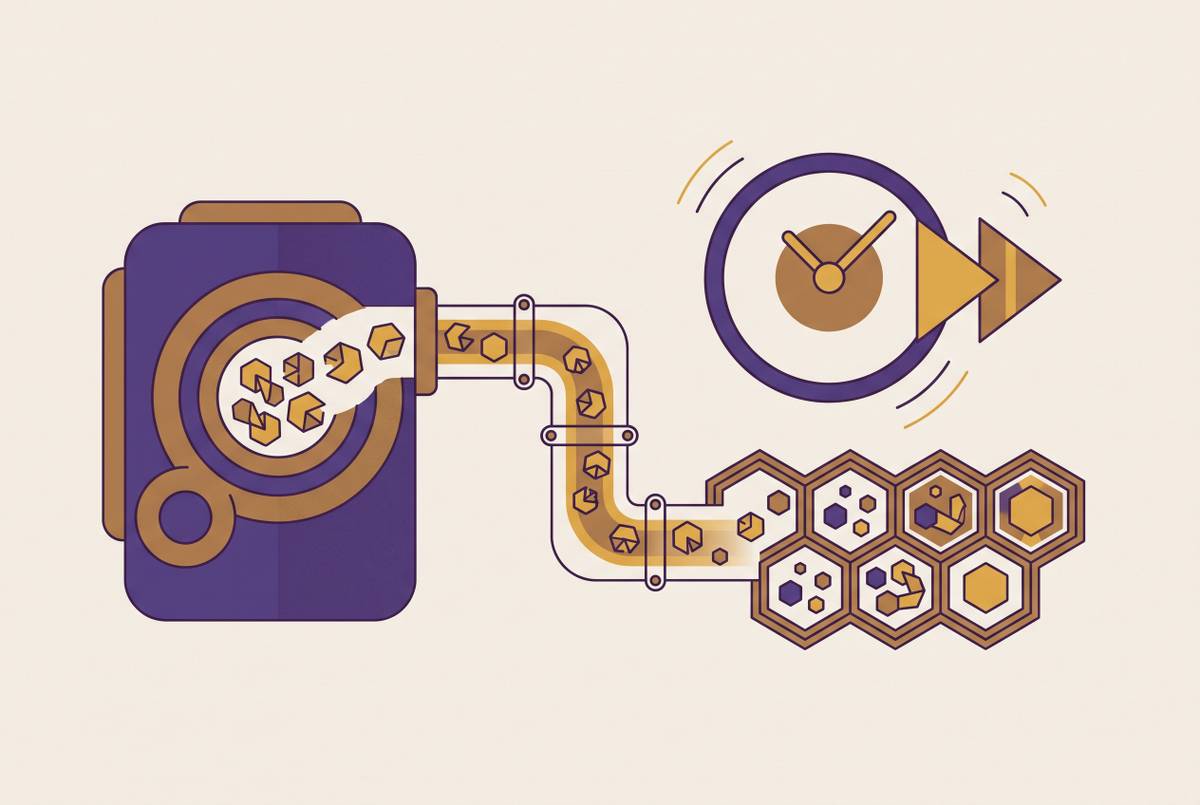
Plate-based CFPS variant screens require data management pipelines designed with the same rigor as the expression workflow. Rapid synthesis is useful only when raw signals become trustworthy, sequence-linked scores in time for the next decision. That requires planned capture, quality filtering, normalization, construct annotation, and ranking, supported by reagent metadata that makes differences between runs interpretable.
Why plate-based CFPS screens overwhelm ad-hoc analysis
CFPS removes the transformation step, allowing constructs to move from DNA to measurable signal without cloning or colony picking. The bottleneck therefore moves downstream to data handling. The University of Edinburgh protease study, published in ACS Synthetic Biology, screened 48 random variants within 6 hours, followed by 32 targeted variants in a second round. At that pace, analysis must support the next library design between rounds.
A 384-well plate produces at least one raw value per well, while replicates, repeated timepoints, and multiple fluorescence channels compound the volume. A value without its construct identity, control comparison, or quality status cannot support a defensible ranking. Without a pipeline established beforehand, the researcher faces spreadsheet archaeology precisely when an ML model or a go/no-go decision needs clean data.
The five stages every CFPS data pipeline must handle
The pipeline begins with signal capture, which preserves raw instrument output in a form that downstream tools can read. Quality filtering then finds wells with synthesis failure, evaporation, edge effects, or dispensing problems. Normalization corrects systematic within-plate and plate-to-plate variation under documented assumptions. Annotation links these values to the construct identity, variant sequence, plate position, and synthesis metadata. Ranking or scoring converts those linked measurements into the fitness values needed by the next experiment or computational step.
The order is part of the experimental design. Quality failures must be identified before they distort normalization, and normalized values must be linked to sequences before they can guide variant selection. Each stage answers a different question, from whether a measurement is trustworthy to what biological construct it describes. Treating them separately makes their assumptions and decisions auditable.
Signal capture: what the plate reader gives you and what it doesn't
The reader exports measurements keyed to wells. In a 384-well format, those identifiers run from A1–P24, while construct identities live in a separate plate map. What the exported values mean depends on the assay format, detection mode, reaction volume, and timing. The Edinburgh workflow used FRET-based activity measurements, whose ratiometric signal contains fold-change information and reduces sensitivity to well-to-well volume variation compared with endpoint fluorescence intensity alone.
Timing determines how much information survives capture. A single endpoint collapses kinetics into one value. The 2026 biorXiv 384-well CFPS optimization study explored reads across the reaction lifetime, which can distinguish stalled synthesis from slow synthesis. Those distinctions are unavailable when only the final signal is retained.
The practical requirement is to lock and test the export format, column headers, and well-ID convention on a dummy plate before screening. Proprietary exports can resist parsing, partial plate loads can create blank rows, and software orientation can disagree with the physical plate. The plate map must therefore be created and version-controlled before loading, rather than reconstructed after ambiguous results appear.
Quality filtering: catching the wells that will mislead the ranking
Quality filtering should apply rules before normalization begins. At 384-well scale, visual inspection is not merely slow. It also risks applying different standards to similar failures, introducing inconsistency into the data the pipeline is meant to clean. Peripheral wells should be flagged by position because evaporation and temperature gradients differ from those affecting interior wells. The pipeline should also take in dispense-failure logs from acoustic liquid handling, including the Echo 650, automatically.
Synthesis failures need a different rule from positional warnings. Wells at or below the empty-vector control signal should be excluded from normalization calculations rather than assigned zero, which would distort the plate distribution. Every plate should also have wild-type, known-active positive, and no-DNA negative controls in set positions. If those controls fall outside expected ranges, the plate should be flagged for investigation before experimental wells are processed.
Flagging must not become silent deletion of data. The annotated output should retain flagged wells and their status, while the ranked list excludes them. This separation preserves the audit trail without allowing suspect measurements to influence variant selection.
Normalization: the stage where reagent consistency either earns its keep or exposes its absence
Normalization models systematic variation in a reproducible reagent system, while an uncharacterized change in lysate performance leaves its treatment as a removable baseline shift uncertain. Percent-of-positive-control normalization divides each signal by the plate’s wild-type reference, while Z-score and median-absolute-deviation methods use the distribution of values on the plate. These methods make different assumptions about the prevalence of active variants, so library composition affects which comparison is defensible.
A bridging set of reference constructs across plates helps with batch-effect correction when runs take place on different days or use different lysate lots. Controls alone do not explain every batch difference. Lot-to-lot changes in kinetic parameters can undermine reproducibility, and total reagent protein concentration is not a reliable predictor of in-assay performance. Functional lot QC shows how reagents perform in ways that concentration measurements cannot, so a batch-correction model can use that measured performance as a covariate.
Using one lysate lot avoids some immediate comparisons, but it is not a sufficient plan for a multi-week screen that exhausts that lot. Establish lot bridging from the start, before plates require rerunning.
Construct annotation: linking a number in a well to a sequence in a library
The plate map supplies the join key between assay measurements and sequence records. Its chain connects well ID, construct ID, variant sequence or sequence-record pointer, DNA template lot, synthesis date, and lysate lot. Those links must be validated at ingest.
In the Edinburgh study, sequence-activity data went straight into the ALDE ensemble deep learning model. Its proposals for the next 32 variants depended on the linkage between sequences and activities from the initial 48-variant screen. A labeling error could therefore misdirect the next experimental round. Corrected plate maps should supersede earlier versions without deleting them, preserving what changed and when.
Construct records should also state the source and concentration of the DNA template. The optimization study identified DNA template design, reaction composition, and lysate genotype as principal determinants of CFPS performance. Template variation is therefore a potential confound. Recording it shows that sequence alone may not explain every measured difference in a sequence-activity table.
Ranking and scoring: translating normalized activity into decisions the next experiment can use
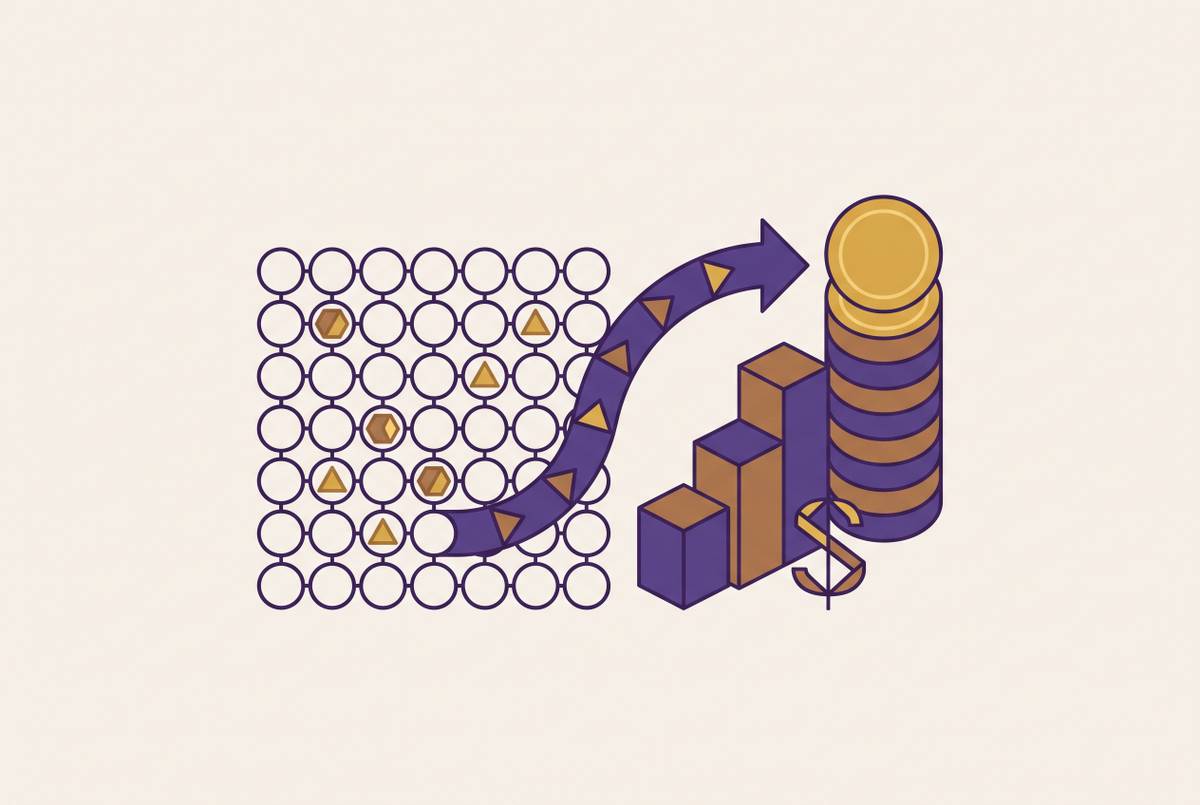
The downstream use determines the appropriate score. An ML-guided campaign needs continuous activity values rather than binary active/inactive calls, because discretization discards the gradient information used to propose variants. Hit confirmation needs uncertainty as well as rank. Replicate spread or confidence intervals distinguish a strong point estimate driven by an outlier from one supported by agreement across replicates.
The fitness metric must also match the assay. Fold-improvement over wild-type accommodates plate-to-plate baseline shifts, signal-to-background ratio depends on the noise floor, and normalized specific activity requires a separate protein-yield estimate. The antibody sdFab workflow used AlphaLISA signal as a proxy for binding interaction strength, making normalized AlphaLISA signal appropriate for functional ranking. Expression-only fluorescence, by contrast, requires a separate activity assay before supporting a functional claim.
The final artifact should be machine-readable without manual repair. A CSV or Parquet file can provide one row per variant with construct ID, normalized score, replicate statistics, and QC status. Provenance fields should include plate ID, lysate lot, and run date.
Pipeline infrastructure: what to build, what to adopt, and what the field has not standardized yet
The hardware layer has converged more than the data layer. Acoustic dispensers, multi-mode plate readers, and robotic plate handlers form a documented stack for high-throughput CFPS, while data management remains less standardized. The automated 384-protein-per-week purification platform had plans for LIMS integration but had yet to put it in place.
A minimal pipeline need not become a LIMS project. Python with pandas can ingest native instrument exports, join a validated plate map, apply QC rules, run normalization with documented parameters, and export ranked results with provenance. The essential requirement is a reproducible path through those operations. For ML-guided work, copying the output file should be enough to pass it to a framework such as ALDE, with no need to reformat it by hand.
LIMS helps track plates, rounds, and operators when there are too many for flat files to track reliably. Adoption should follow that demonstrated need. However, there is no published, community-standard CFPS plate-screen pipeline analogous to sequencing-read-to-variant-call workflows in genomics. Teams must still design their data interfaces intentionally, and publishing working implementations would address a genuine infrastructure gap.
How reagent transparency changes what the pipeline can actually know about its own outputs
Provenance is more useful when it describes reagent performance. A lysate lot identifier establishes which material was used, but it does not explain whether that material differed functionally from another lot. That distinction limits what batch correction can establish. Without characterized performance, a pipeline cannot confidently separate an apparent biological improvement from a reagent effect across runs.
Crude-lysate systems offer cost efficiency with compositional opacity, while the PURE system offers compositional control at higher cost. For plate screens sensitive to reagent cost per well, documented crude-lysate formulations with functional lot QC provide a practical middle path. The metadata should include protein yield per lot and activity against a standard reporter. These measurements address whether the reagent produces active protein, rather than merely how much total protein it contains.
OpenCFPS™ publishes lot-level QC data and documents its formulations openly. This allows a pipeline to record characterized lot performance and use it in batch-effect models, rather than treating the lot name as the full explanation. When a variant advances to confirmation or scale-up, a chain linking sequence, plate position, normalized signal, and lot QC makes the basis for promotion auditable by a second researcher.
Putting it together: what a screen-ready pipeline looks like before the first plate runs
The instrument parser should be tested on a dummy export, and the plate-map schema should define well ID, construct ID, sequence pointer, template lot, lysate lot, and run date under version control. Control positions and expected ranges should be fixed. Rules for edge-well, dispense-failure, and synthesis-failure checks should be in place before normalization runs.
Normalization assumptions should be documented against the library design, including whether most variants are expected to be inactive or clustered around modest activity. Functional QC for the intended reagent lot should be stored as metadata. The ranked-file format should then be tested by importing it into the downstream ML framework or hit-confirmation tracker.
The Edinburgh workflow established its FRET assay, CFPS system, and sequence-activity table before the ML-guided round began. The corresponding pre-screen test is a pilot plate containing wild-type, a characterized active variant, and negative controls distributed across positions. Its purpose is to establish whether the complete pipeline produces the expected ranking before library plates run.