CFPS for Virus-Like Particle Assembly and Vaccine Research
Cell-free systems let researchers test VLP designs in hours instead of weeks.

Cell-free protein synthesis (CFPS) addresses three linked obstacles in virus-like particle (VLP) vaccine research, namely slow design iteration, inconsistent assembly, and limited screening throughput. By separating protein production from living cells, it makes expression and assembly conditions directly controllable. Its value is a faster path from antigen design to functional particles, provided that system choice, reagent consistency, and scale-up evidence support the target.
Why VLP-based vaccines are hard to develop at speed
VLPs display authentic surface epitopes and can elicit robust humoral and cellular responses without replication risk because they lack viral genetic material. Those advantages depend on correct particle assembly. A productive expression reaction is therefore insufficient if the resulting proteins form inconsistent or poor-quality structures. Vaccine development must resolve protein production and particle architecture together, rather than treating assembly as an automatic consequence of expression.
The resulting bottlenecks are slow design iteration, inconsistent particle assembly, and poor scalability at the screening stage. In cell-based workflows that require stable lines, an antigen insert change, linker modification, or capsid variant introduces another round of clone selection, line construction, and optimization. Each cycle can take weeks to months. Toxicity compounds that delay because some VLP components impair the cells producing them, forcing low-yield compromises before researchers can assess the candidate itself.
How CFPS works and why its open-system architecture changes the production equation for VLPs
CFPS uses cell extract containing transcription and translation machinery, supplemented with energy sources, amino acids, and a DNA template. The reaction has no intact cellular membrane or functional genome, so production is decoupled from maintaining a viable organism. This changes what researchers can control directly. Instead of accommodating a host’s survival requirements, they can adjust the environment in which the target protein is synthesized and assembled.
That access makes pH, redox potential, chaperone concentration, cofactors, and energy supply experimental variables rather than largely hidden properties of cellular expression. Redox tuning can promote disulfide bonds, while parallel reactions can test different assembly conditions without new cell lines. For VLP work, this is the architectural advantage that connects faster production to more systematic control of particle quality.
Extract diversity adds flexibility to that architecture. E. coli lysates offer low cost, high productivity, and scalability, while eukaryotic extracts provide options for targets requiring post-translational modifications. The platform is not tied to one organism. Extract choice can therefore follow the target’s biological requirements without giving up the open reaction format that makes those requirements easier to investigate.
Toxic and assembly-challenging VLP proteins that cell-based systems struggle to produce
Removing the viability constraint is especially useful when the desired protein damages its production host. Proteins that disrupt membranes, interfere with ribosomes, or disturb cell division can trigger stress responses that limit yield or kill the cell. CFPS removes that conflict, allowing researchers to investigate proteins whose expression is difficult or impractical in living cells.
Smith et al. 2012 demonstrated production and incorporation of the toxic protein A2 into Qβ VLPs in a cell-free system. Assembly chemistry offers another point of control. Tuning the redox environment can introduce stabilizing disulfide bonds, a manipulation that is difficult to control in the reducing interior of a living cell.
Membrane proteins remain a genuine boundary condition. Although CFPS avoids the cellular toxicity associated with overexpression, adequate lipid bilayers or detergent micelles still have to be supplied. Providing those environments remains an active technical challenge, so the toxicity advantage does not imply that every membrane-containing VLP is straightforward to produce.
What rapid iteration actually looks like in CFPS VLP design
Colant et al. 2021 used E. coli CFPS to test tandem-core HBcAg VLP designs containing influenza antigen inserts. The study varied the arginine-rich region of HBcAg, peptide linker lengths around the inserts, and the plasmid vector backbone. These were distinct design variables within one platform. Linker optimization combined with the optimized pJL1 backbone raised titers at least fourfold over the original construct and substantially reduced low-molecular-weight impurities.
That result grounds the iteration argument in both quantity and quality. The platform let researchers test changes to scaffold structure, insert presentation, and expression design without building a new stable cell line each time. Researchers could add a new DNA template straight to the reaction. Templates generated through PCR, gene synthesis, or saturation mutagenesis make the workflow template-driven rather than clone-dependent, with variants tested simultaneously and design cycles compressed from weeks to hours.
This flexibility is particularly useful for pre-characterized carrier scaffolds such as HBcAg, where heterologous antigens introduce a large insert-and-linker design space. CFPS makes systematic exploration feasible by shortening the interval between a sequence change and experimental feedback, so redesign can follow evidence rather than the availability of another cellular production cycle.
High-throughput screening of VLP variants in multiwell plate formats
Parallel iteration extends naturally into multiwell screening because CFPS reactions run at 20 µL scale in 96-well or 384-well plates. Dozens to hundreds of variants can be synthesized and assessed in one experimental session. The throughput has a concrete protein-engineering precedent. A 2025 protease study used CFPS to screen 138 protein variants, each of which took only 6 hours to produce and assess, with tens running at the same time in the same plate.
The protease study shows how fast experiments can run with plate-based CFPS, though the same performance has yet to be shown for every particle architecture. Linear DNA templates can supply the variants, while fluorescence readouts or mass spectrometry support automated result collection. For VLPs, the corresponding opportunity is to map buffer composition, redox state, chaperone addition, and antigen insert length across multiple constructs.
Researchers can investigate the reaction environment as well as the sequence, rather than restricting screening to whatever conditions a host tolerates. Droplet-based workflows using fluorescence-activated droplet sorting extend pooled library screening to ten-thousand to one-million variants. That broader capability expands the available screening formats, although it is not itself evidence of a VLP library at that scale.
Scaling from a screening reaction to gram-quantity VLP production without re-optimization
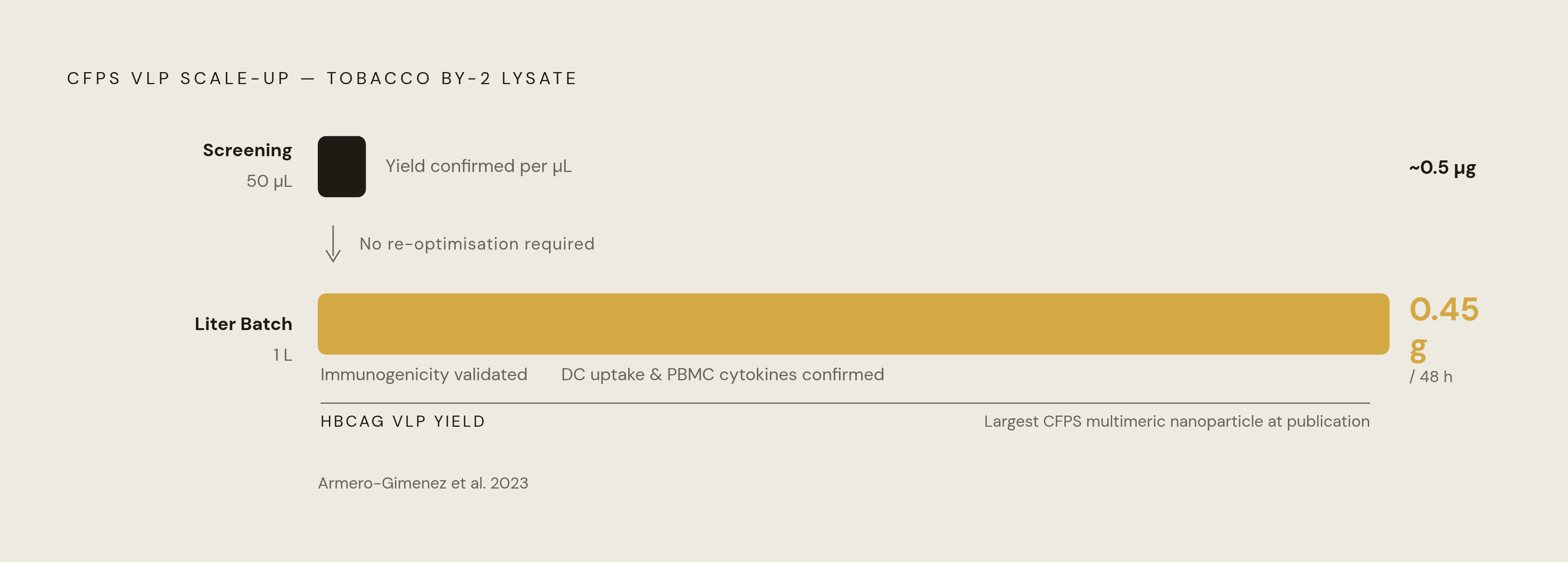
Armero-Gimenez et al. 2023 scaled HBcAg VLP production in tobacco BY-2 lysate from 50 µL to 1 L without reducing protein yield per milliliter. The liter-scale batch produced approximately 0.45 grams of native HBcAg VLP within 48 hours. At publication, it was described as the largest CFPS reaction producing a multimeric protein nanoparticle. This provides VLP-specific evidence that the platform can extend beyond screening volumes.
Yield alone would leave the essential question unanswered. The same study assessed biological function through recognition and endocytosis of fluorescently labelled VLPs by human dendritic cells, using flow cytometry and confocal microscopy. It also measured cytokine production in peripheral blood mononuclear cells. These findings support the immunogenicity of the BY-2-derived particles, connecting scaled production to the functional properties required of a vaccine research candidate.
The scale-up advantage comes from retaining reaction chemistry. Moving cells from shake flask to bioreactor requires further optimization of oxygen transfer, feeding strategy, and process controls. CFPS can preserve parameters established during screening. E. coli systems have also demonstrated multiple grams per liter for well-optimized proteins, but that productivity reference is not a gram-quantity VLP result. The BY-2 experiment supports the screening-to-production bridge without establishing optimization-free scaling for every target.
Which CFPS system to use for a given VLP target
The choice starts with the modifications the target needs, then takes into account throughput and how much will be produced. No extract is optimal for every VLP. For early screening, the recommended starting point is E. coli CFPS when the capsid can fold and assemble without eukaryotic post-translational modifications. It costs little, produces high yields, and has been used at milligram-scale, making it a good fit for fast construct testing, as the tandem-core influenza work shows.
When glycosylation or other modifications are required for folding or immune recognition, a eukaryotic system is the appropriate next consideration. Options include wheat germ, tobacco BY-2, Pichia pastoris, CHO, and insect cell Sf9 extracts. The choice is not a universal ranking. The BY-2 work demonstrates liter-scale feasibility for HBcAg, while Pichia-based CFPS has produced HBcAg VLPs with characteristics comparable to those obtained through in vivo and in vitro production.
Choosing a system with later production in mind can spare researchers a change of expression hosts between screening and scale-up. Membrane-containing targets introduce an additional requirement for lipid bilayer or detergent micelle supplementation, which remains under development. Stage of work also sets the boundary. CFPS supports iterative screening and early candidate selection, but it does not replace cell-based manufacturing for very large commercial volumes.
Why reagent transparency and lot-level consistency matter more in VLP work than in standard protein expression
For parallel screening to be useful, researchers need reactions they can compare. Crude lysates differ with growth conditions, lysis efficiency, and endogenous enzyme activity, and those differences can go unseen unless each lot is characterized. VLP assembly is especially sensitive to its environment. Variation tolerable in simple soluble-protein expression can produce inconsistent particle architecture, undermining comparisons between constructs even when protein production appears acceptable.
The tandem-core study illustrates how sensitive particle quality can be to design changes. Removing the C-terminal arginine-rich region of HBcAg produced asymmetric particles of poor quality. This construct result matters when tracing a defect, because an uncontrolled reagent is another possible cause of a particle’s faulty structure and makes it harder to interpret the design result.
Defined formulations and published lot-level quality-control data address the reproducibility and yield concerns that have discouraged CFPS adoption. PURE-type reconstituted systems control component stoichiometry, but cost and preparation complexity have limited their use in high-throughput VLP screening. Transparency provides a basis for systematic troubleshooting. OpenCFPS™ offers a concrete example through documented formulations, published lot-level QC data, and pricing designed for high-throughput work. Such documentation helps researchers distinguish formulation variables from construct variables and supports reproducibility across laboratories.
Where CFPS-based VLP research is moving and what it enables that was not previously feasible
Plate-based screening, scalable reaction chemistry, and documented reagents together make broader antigen-engineering experiments practical. For suitable targets, a new antigen sequence can progress to an immunogenically characterized VLP candidate without constructing a stable cell line, compressing a months-long workflow into days. This capability is expanding. Complex assembly mechanisms still limit which candidates can be made at a commercially viable scale.
The protease study demonstrated CFPS as an experimental engine for model-driven protein variant workflows, supplying functional data to train and validate computational designs. VLP-specific applications remain an extension of that evidence. Separately, non-natural amino acid incorporation opens possibilities for surface chemistry beyond standard amino acids, including bioorthogonal conjugation handles for attaching adjuvants or targeting ligands.
The practical value extends to candidates that fail. Some viral architectures are still too complex for CFPS to produce commercially viable candidates, but fast testing can reveal those dead ends before teams invest in cell-based manufacturing infrastructure. For teams managing limited budgets, early negative results preserve resources for more tractable designs. CFPS makes “fail fast” a useful outcome of vaccine research even when production falls short.
Sources
- Synthesis and Assembly of Hepatitis B Virus-Like Particles in a Pichia pastoris Cell-Free System
- VLP (Virus-Like Particles) Vaccines
- Escherichia coli-Based Cell-Free Protein Synthesis for Iterative Design of Tandem-Core Virus-Like Particles
- Rapid screening and scaled manufacture of immunogenic virus-like particles in a tobacco BY-2 cell-free protein synthesis system