Isotopic Labeling of Proteins Using Cell-Free Synthesis for NMR
Cell-free protein synthesis achieves isotopic labeling precision that living cells cannot.
Multidimensional NMR spectroscopy of proteins runs on isotopic enrichment. If ¹⁵N, ¹³C, and ²H are not incorporated into the polypeptide, the spectrum has no chemical shift resolution fine enough to assign individual resonances or to extract structural and dynamic information. That dependency is not incidental to the technique; it is the technique. For large proteins, uniform labeling alone does not solve the problem, because hundreds of overlapping resonances make a uniformly labeled spectrum unreadable, and you need a strategy to cut spectral complexity down to a manageable number of signals. Methyl-TROSY experiments, which read out ¹³CH₃ probes against an otherwise deuterated background, have pushed solution NMR into high-molecular-weight complexes that were once the exclusive domain of crystallography and cryo-EM, but the method only works if specific methyl groups in specific subunits can be labeled independently of everything else in the complex. The labeling scheme chosen before synthesis begins decides which experiments you can even run, and which biological questions you can ask of the finished sample. It functions as a scientific constraint set at the bench, not a logistical detail to be sorted out later.
How living cells undermine isotopic labeling precision
Cell-based expression systems struggle to deliver a single labeled amino acid species cleanly into a target protein, because a living cell runs a metabolic network that actively redistributes isotopic label across its amino acid pools. Transaminases and related interconversion pathways move ¹⁵N or ¹³C from the amino acid you supply onto other amino acids the cell happens to need, so the final protein ends up with label in positions nobody intended to enrich. Hoffmann, Löhr, Laguerre, Bernhard, and Dötsch identified this scrambling problem as one of the main limits on selective labeling in cell-free systems as well, and they singled out aspartate, asparagine, glutamine, glutamate, and alanine as the amino acids most prone to it, precisely the residues most useful for NMR assignment strategies. The consequence on the spectrum is concrete: peaks appear where a researcher cannot assign them with confidence, label gets diluted across multiple residue types, and much of the sensitivity advantage that selective labeling was supposed to provide gets eaten away by the ambiguity. But even where scrambling can be kept under control, living cells impose a second, independent constraint. The target protein must not poison its host, must fold correctly inside the cellular environment, and must survive the cell's own proteolytic surveillance machinery long enough to accumulate, and that trio of requirements disqualifies a meaningful share of the proteins NMR researchers most want to study.
Open-system control over the amino acid environment in CFPS
Cell-free protein synthesis sidesteps this problem at its source by removing the living cell from the reaction. A lysate supplies ribosomes, tRNAs, aminoacyl-tRNA synthetases, and translation factors, but no intact cell stands between the researcher and the reaction to regulate which nutrients enter or how metabolites get interconverted once they are inside. Because the researcher defines the amino acid composition of the reaction directly, a single ¹⁵N- or ¹³C-labeled amino acid can go in on its own while the other nineteen stay unlabeled, so in principle one residue type carries all the signal and the rest of the protein stays dark. The open format also removes toxicity and viability from the list of constraints: proteins that would kill a bacterial culture or collapse into inclusion bodies inside a cell can be synthesized in a reaction vessel with no cell left to protect. The dialysis-mode cell-free protocol shows how far this control extends in practice: the target protein can be measured by NMR directly in the presence of every unlabeled protein already in the reaction mixture, with no chromatographic purification needed before the sample goes into the magnet. Every labeling strategy discussed from here forward, uniform, selective, or methyl-specific, depends on this open-system property as its foundation.
Residual scrambling in lysates and the engineering responses to it
Open-system control reduces scrambling but does not eliminate it. Cell lysates retain a measure of residual metabolic enzyme activity even after the cell itself is gone, so some label interconversion still occurs in cell-free reactions, again concentrated in ¹⁵N labels on aspartate, asparagine, glutamine, glutamate, and alanine. Two engineering strategies have taken on this residual problem, and they approach it from opposite directions. The Stablelabel approach, developed by a Goethe University group (Levin, Löhr, Dötsch, Bernhard, and colleagues, 2023), works by subtraction: it introduces cumulative chromosomal mutations into E. coli strain A19 to knock out the specific lysate enzymes responsible for scrambling, yielding an S30 lysate in which interconversion at the problem amino acid families is measurably reduced. Neither strategy is the obviously correct one to the exclusion of the other; they represent two different engineering philosophies applied to the same underlying chemistry. Both are possible in the first place, which is what matters. A CFPS reaction does not behave like a sealed black box that researchers can only observe and accept. Its composition is knowable down to the enzyme level and modifiable by strain engineering or reagent formulation, and that modularity is what makes systematic improvement of labeling fidelity possible. A living cell offers no equivalent option: its metabolic network cannot be surgically edited for the span of a single protein production run without disrupting the cell's viability along with everything else.
Three labeling strategies enabled by cell-free control: uniform, selective, and methyl-specific
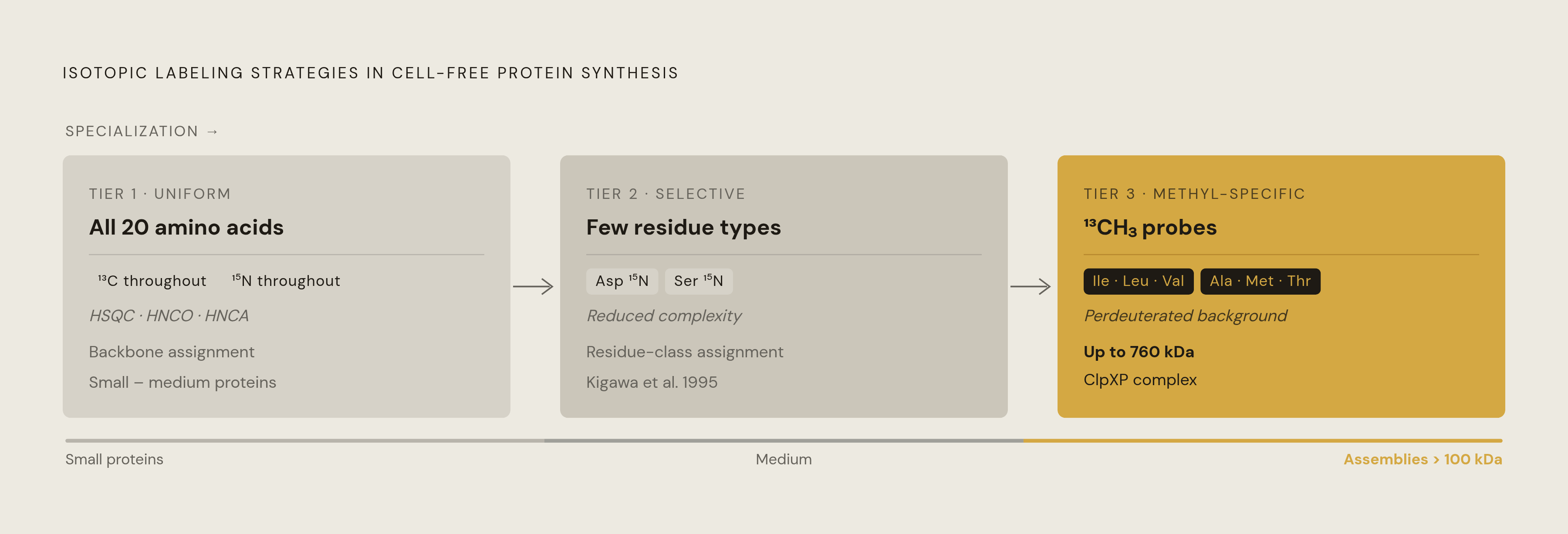
The open-system property described above supports three distinct isotopic labeling regimes, and you can move between them without switching expression hosts, which is one of the defining practical advantages of working in a cell-free pipeline. Each regime answers a different NMR question, and you can place the three in a natural order of increasing specialization.
Uniform labeling is the simplest and the most direct. All twenty amino acids go into the reaction in labeled form, so the resulting protein is uniformly enriched in ¹³C and ¹⁵N for the full suite of backbone assignment experiments, including HSQC, HNCO, HNCA, and related triple-resonance methods. Wheat germ CFPS, developed by the Endo and Sawasaki group at Ehime University and later adopted by the Center for Eukaryotic Structural Genomics, demonstrated that a single researcher can translate many genes in parallel and obtain protein within two days. That result established uniform labeling at scale as a routine throughput operation in a properly configured cell-free pipeline, not a specialized feat reserved for a handful of labs.
Selective, amino-acid-specific labeling narrows the question. You can label one amino acid type, or a small handful, while the rest stay unlabeled, so spectral complexity drops and you can get residue-type assignment without running the full set of backbone experiments. Kigawa, Muto, and Yokoyama demonstrated this in 1995 with aspartate- and serine-selective ¹⁵N-labeling of the human c-Ha-Ras protein in an E. coli cell-free coupled transcription-translation system, confirming efficient, selective labeling by ¹H-¹⁵N HSQC. This confirmed that single-residue-type selectivity was achievable in CFPS at milligram-scale yield from a small reaction volume. Selective labeling earns its keep most clearly when a target protein is too large for a complete backbone assignment but the researcher instead needs to assign a specific residue class, such as active-site residues, interface residues, or flexible loops. If several samples each carry a different labeled subset, combinatorial selective labeling can reconstruct a full backbone assignment without ever uniformly enriching every residue in a single preparation.
Methyl-specific labeling reaches furthest. Methyl groups on isoleucine, leucine, valine, alanine, methionine, and threonine serve as NMR probes in large proteins and complexes, and against a perdeuterated background their ¹³CH₃ signals stay sharp and sensitive even at very high molecular weight. Because each cell-free reaction is an independent, open system, you can synthesize different subunits of a heteromeric complex under entirely different labeling schemes and then bring them together afterward, a capability the next section examines directly.
Subunit-specific methyl labeling of the 760 kDa ClpXP complex: what CFPS makes possible that cell-based expression cannot
The 760 kDa ClpXP AAA+ proteolytic machine is the case that draws the sharpest line between cell-free and cell-based expression. ClpXP is a heteromeric complex, and one of its components is unstable and poorly soluble on its own, to the point that it cannot be produced independently in sufficient quantity for reconstitution. Researchers resolved this (RSC Chemical Biology, 2026, vol. 7, issue 2, pages 260 to 268) by exploiting the open nature of cell-free synthesis rather than fighting against the instability directly. A multi-step expression protocol synthesized ClpP and ClpX sequentially, in separate cell-free reactions, each carrying its own independently chosen isotopic labeling scheme. The stable ClpP core was then introduced directly into the synthesis reaction producing ClpX, so that newly made ClpX was stabilized by ClpP before it had the chance to aggregate. That co-synthesis strategy only works when the expression environment is open and its composition is fully under the researcher's control, which a living cell's interior cannot offer.
The outcome was a stable, functional 26-subunit ClpXP complex carrying ¹³CH₃ labeling on alanine and methionine methyl groups, placed selectively on either ClpP or ClpX. From that sample, researchers acquired high-quality 2D solution NMR spectra of the intact 760 kDa assembly, used diffusion-ordered NMR spectroscopy to characterize its oligomeric size in solution, and observed structural rearrangements triggered by ADP binding, dynamic information that demands a labeled, functional complex and that no static structure could supply. ClpX's instability had previously blocked production of ¹³CH₃ methyl-labeled ClpXP. This was not an incremental improvement over a workable cell-based method; it was an experiment with no prior working route, made possible for the first time by the structure of the cell-free system itself. ClpXP stands for a broader category: unstable, multi-subunit, high-molecular-weight complexes where the subunit interdependence that keeps the assembly functional is the same interdependence that defeats cell-based labeling strategies.
Membrane proteins as a second class of targets where CFPS labeling is structurally necessary
Integral membrane proteins form a second, long-standing barrier in NMR structural biology, distinct from the instability of large unstable complexes but just as resistant to cell-based solutions. E. coli remains the most economical system for producing isotope-labeled protein, yet it has limited success with mammalian membrane proteins specifically, and high-level expression of these targets in cellular systems tends to produce insertion and aggregation problems that degrade sample quality before a labeling scheme even enters the picture. The obstacle is structural: a membrane protein needs a lipid environment to fold and behave correctly, and a bacterial culture offers no mechanism for a researcher to define or substitute that environment. Cell-free synthesis changes what is possible here for the same reason it changes what is possible for ClpXP. An open reaction can combine isotopic labeling control with a defined lipid-environment supplement in the same vessel, at the same time, because nothing about the system requires a living cell to accept and use what is added. That combination, isotopic precision plus a controllable lipid environment, has no equivalent in cell-based expression, where a researcher cannot add a defined bilayer composition to a culture and expect the cell to incorporate it on demand.
Practical format decisions: batch, dialysis, and continuous-exchange modes for NMR-grade yields
Choosing a labeling scheme only gets you halfway to a sample ready for NMR. The reaction format decides how much protein comes out and how long the synthesis runs, and matching format to application matters as much as the labeling chemistry itself.
Batch mode is the simplest and the fastest to set up, but the reaction components deplete quickly, which caps both the yield and the useful lifetime of the reaction. That makes batch mode well suited to small-scale screening, checking construct viability, solubility, and label incorporation, before committing larger quantities of labeled amino acids to a preparative run.
Dialysis and bilayer-diffusion formats extend the reaction's working life by continuously resupplying substrates. The dialysis-mode protocol typically produces the target protein at a concentration near 1 mg/mL in an E. coli extract system, a concentration sufficient for direct NMR analysis without prior chromatographic purification. A bilayer diffusion variant, in which the translation mixture is underlaid beneath a feeding buffer using a pipetting robot, sustains synthesis substantially longer than a batch reaction and integrates directly into automated liquid-handling workflows.
Continuous-exchange cell-free dialysis extends this principle furthest: it maintains substrate supply and byproduct removal over the longest reaction times among the formats discussed here. Eukaryotic CFPS systems have shown linear scalability from sub-milliliter plate-well volumes up to one-liter preparative reactions without meaningful loss of yield. That scalability carries a specific practical payoff: the same reaction chemistry used to screen a construct library in microliter volumes carries directly over to full NMR sample production, with no re-optimization step required in between. That continuity, not any single format being inherently superior, is what sets cell-free workflows apart from the fixed, single-scale commitments that cell culture imposes.
High-throughput construct screening before committing to NMR-grade labeled production
Producing a milligram quantity of an isotopically labeled protein costs real money in labeled amino acids and real time at the bench, and committing those resources to a construct that turns out to be poorly behaved is a loss a research program can avoid. The fix is to validate the construct first, at small scale, in the same expression system that will eventually produce the labeled material. CFPS fits this role well: reactions run in hours rather than days and scale down into microtiter plate formats, so screening protein fragments for solubility and stability, the same properties that predict NMR sample quality, costs a fraction of what a full preparative labeling run would cost. The CESG wheat germ platform validated this logic end to end: small-scale cell-free reactions served as predictive indicators of whether a protein could be obtained in sufficient quantity and quality for structural work, and those same small-scale reactions often produced enough material for bioanalytical and functional characterization before any labeled preparative run began. Automation made this practical at real scale, with the CESG platform combining robots for small-scale translation, large-scale production, and automated His₆-tag purification into a single pipeline. The underlying logic for any researcher planning an NMR project is straightforward: screen in cell-free, produce in cell-free, label in cell-free. The same reaction chemistry governs every stage, so a construct that expresses poorly in a 50 µL screening well will express poorly in a 10 mL continuous-exchange reaction, which closes off the kind of late, expensive surprise that happens when screening is done in one host system and production in another.
Reagent system transparency as the foundation of reproducible labeled samples
NMR structural work depends on reproducibility at a strict level: two independent preparations of the same labeled protein need to produce spectra with chemically equivalent chemical shifts and line widths, or the multi-experiment assignments and dynamics analyses built on top of them stop being trustworthy. Everything this article has described, open-system control over amino acid composition, engineered reductions in lysate scrambling, the choice among uniform, selective, and methyl-specific schemes, the match between reaction format and yield, rests on one shared property: the reaction's chemistry is knowable in detail, openly visible to the researcher. That knowability is what lets a researcher trace an unexpected result back to its cause. A peak that shifts, a label that scrambles, a yield that drops can be attributed to a specific, correctable element of the reaction.
A reagent platform only delivers on that promise if its formulation and quality control are documented openly enough for a researcher to act on them. Sepia Biosciences' OpenCFPS™ platform is built on that premise: openly documented formulations paired with lot-level QC data give NMR researchers the composition-level knowledge needed to standardize labeled sample preparation, diagnose scrambling or yield anomalies when they appear, and compare results across independent runs with confidence that differences in the data reflect the biology and not the reagents. That transparency is what turns cell-free synthesis from a convenient but opaque reagent kit into a precision isotopic labeling engine, the role this entire argument has asked it to play from the first section onward.
Sources
- Subunit-specific isotope labelling of heteromeric complexes using cell-free protein expression: application to the 760 kDa ClpXP molecular machine - PubMed
- Cell-Free Protein Synthesis Technology in NMR High-Throughput Structure Determination
- Cell-free protein production and labeling protocol for NMR-based structural proteomics
- Cell-Free Protein Synthesis for Analysis by NMR Spectroscopy
- Protein labeling strategies for liquid-state NMR spectroscopy using cell-free synthesis - ScienceDirect
- Cell-free protein synthesis for analysis by NMR spectroscopy - PubMed
- Protein labeling strategies for liquid-state NMR spectroscopy using cell-free synthesis - PubMed
- Cell-free synthesis and amino acid-selective stable isotope labeling of proteins for NMR analysis