CFPS Reaction Scale-Up Without Proportional Cost Increase
Optimizing yield, not volume, cuts CFPS costs per gram.

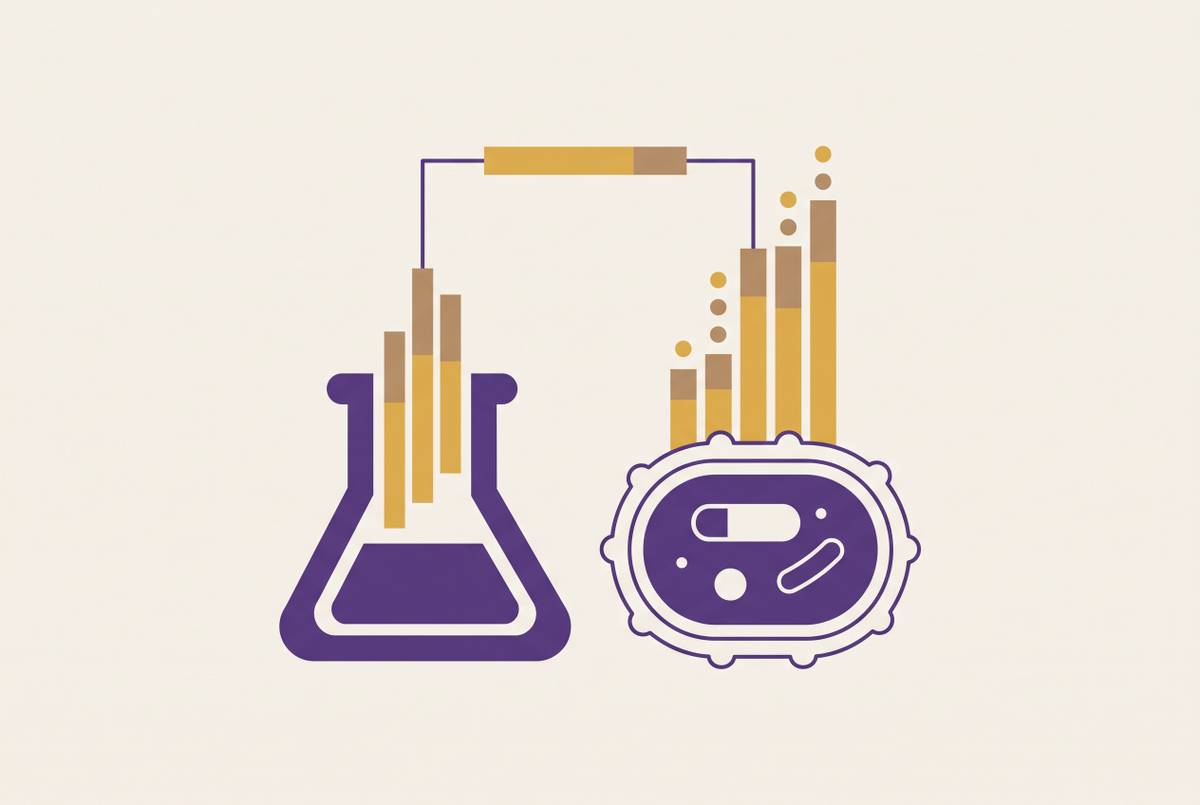
Cell-free protein synthesis has a cost problem, but not the one most labs think they're solving. Reagent costs make up roughly 75% of all material costs associated with cell-free expression, and separate industry estimates put the reagent share of total operational expense at 70 to 85%. Given numbers like that, the instinct is to treat scale as the enemy: more volume means more reagent, means more spend, means a reaction that only makes financial sense in a research plate and never in production. That instinct is a misdiagnosis. When a CFPS system produces well under the protein-per-liter yields the chemistry is capable of, reagent spend dominates the budget no matter what size the reaction is run at. Cost per gram of protein is a ratio: reagent spend on top, protein yield on the bottom. A lab can improve that ratio by attacking either side of it, at any volume, and the moment yield rises, cost per gram falls regardless of how much liquid is in the vessel. Scale isn't the variable driving cost. Yield is, and yield is something a lab can engineer.
The three levers that improve yield without scaling reagent spend
Yield in a CFPS reaction is the product of at least three levers that can be adjusted independently of one another: the chemistry used to regenerate ATP, the amount of oxygen available to the reaction, and the design of the reagent formulation itself. Each one can move yield up without requiring a proportional increase in reagent spend, and each has been demonstrated with real numbers.
Start with energy regeneration. The ATP regeneration system is usually the single most expensive and most yield-limiting part of a CFPS reaction, because high-cost phosphorylated substrates are the default choice in many formulations. A 2026 study in Biotechnology and Bioengineering on Pichia pastoris CFPS systematically screened chemical additives and tested lower-cost glycolytic intermediates as substitutes for those substrates in ATP regeneration. Swapping in the cheaper glycolytic chemistry cut cost and raised yield at the same time, which is the rare case where a single change improves both halves of the cost-per-gram ratio at once.
Oxygen availability is the second lever, and it becomes the binding constraint as reaction volume grows. If a reaction is small, run in microliter volumes, it doesn't have much trouble staying oxygenated. Past a certain volume, oxygen runs out before the reagents do, which stops the reaction well short of its chemical potential. A 2025 Nature Communications study tested this directly: moving a reaction from 15 microliters to 4 milliliters while supplementing oxygen raised yield from roughly 2.4 g/L to roughly 3.7 g/L. Cost per gram fell from approximately $60 to well below that figure, with the entire gain coming from letting the existing chemistry run to completion.
The third lever is the formulation itself. Each added component in a CFPS reagent system adds both a cost line and a new place for batch-to-batch variation to appear. Cutting a formulation down to its essential components, without giving up yield, lowers material cost and narrows the number of places a batch can go wrong at the same time. None of these three levers requires scaling reagent spend to get more protein out of the reaction. They require knowing which part of the chemistry is actually limiting the yield, and fixing that part.
Scale as a Yield Advantage
The common assumption is that bigger CFPS reactions are inherently less efficient than small ones, as if volume itself introduces some kind of chemical penalty. But when the yield levers above are actually engaged, the data doesn't support that assumption. In several documented systems, yield per liter holds steady as volume increases, and in some cases larger reactions outperform small ones.
The clearest demonstration comes from the ALiCE tobacco BY-2 lysate system, which showed linear yield scaling across a wide range of volumes, from 100-microliter reactions up to 10 and 100 milliliters, for both a cytosolic reporter protein (eYFP) and a multi-domain microsomal glycoprotein (glucose oxidase). Preliminary data from 1-liter reactions run in a commercial bioreactor, the first litre-scale reactions reported for a eukaryotic CFPS system, showed no significant yield difference compared with 50-microliter reactions. That result matters economically because fixed costs, like the labor and materials that go into lysate preparation, spread across far more product as volume rises, so cost per gram holds flat or improves as the batch size grows.
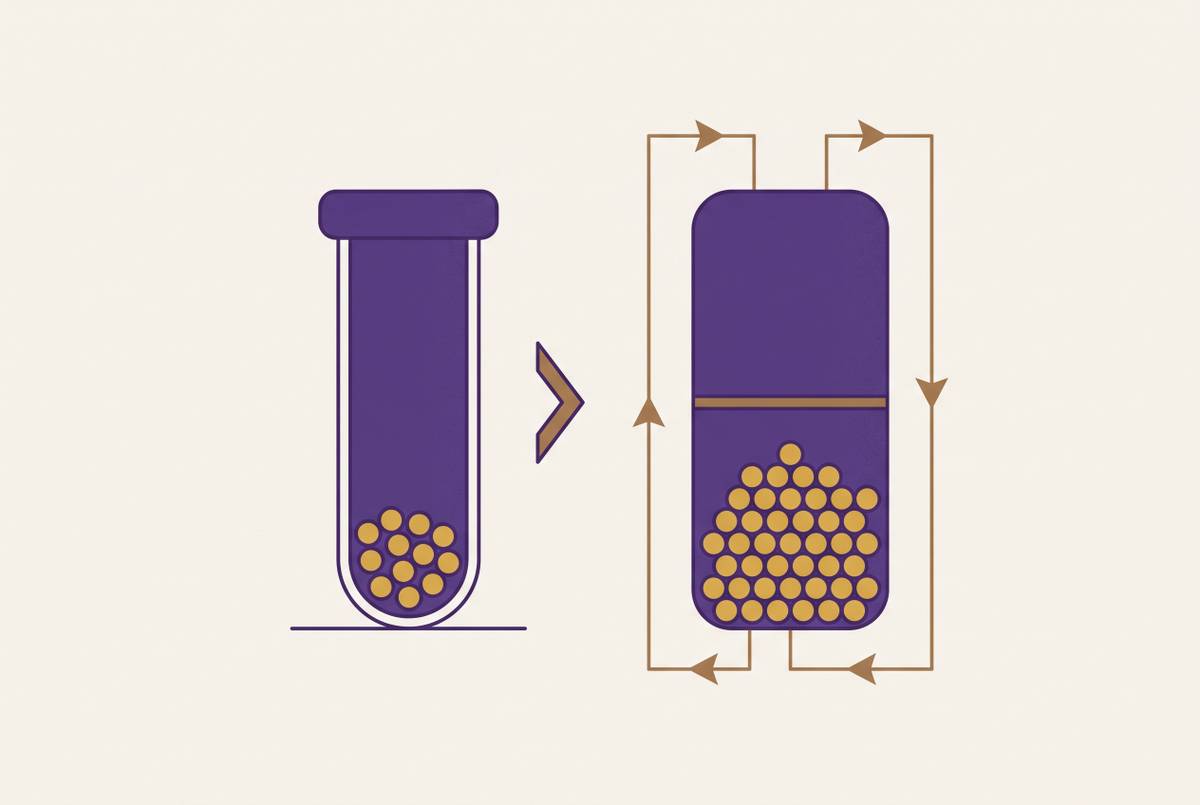
Continuous-exchange cell-free (CECF) systems push this further: a semipermeable membrane separates the reaction chamber from a feed chamber, so fresh substrate can come in and waste products can go out over a much longer run. That extended run time is what breaks through the yield ceiling that limits standard batch reactions. coli batch reactions already reach 1 to 2.3 milligrams per milliliter, CECF formats can reach as high as 20 milligrams per milliliter in wheat germ systems. None of that gain came from pouring in more reagent. It came from keeping the reaction running longer.
Shaker bioreactors round out the picture. Eukaryotic CFPS has been scaled up from microplate format by many orders of magnitude using shaker bioreactors, reaching volumes suited to industrial production. The ceiling on CFPS scale turns out to be an engineering question of reactor design and process control, not a limit written into the chemistry.
Difficult Proteins and the Yield-Economics Argument
The yield-economics case gets stronger once the target protein is one that cell-based systems struggle to produce. For toxic, insoluble, or multi-domain proteins, there often isn't a meaningful cell-based cost per gram to compare against, because cell-based expression frequently fails to produce usable protein regardless of how much time or money goes into it.
Membrane proteins are the sharpest example. Overexpressing a membrane protein inside an intact cell routinely kills the cell or causes the protein to misfold, because the cell's own membrane has no slack capacity for an overloaded insertion process. CFPS avoids that failure mode because the reaction happens in an open system, so detergents, lipids, or nanodiscs can be added directly during synthesis, producing folded and functional membrane protein without endangering a living cell. A multi-strain bacterial CFPS consortium demonstrated this kind of range directly, synthesizing proteins across a broad size window from 20 to 160 kDa at higher quantities than conventional systems, including Cas9 (159 kDa) at roughly three times the yield of a standard E. coli extract and roughly five times that of an S30 extract.
The economic comparison that matters here is CFPS cost per gram against the full sunk cost of a cell-based workflow, months of strain engineering included, that ends in no usable protein. Framed that way, the yield gains described in the previous two sections apply with extra force to exactly the targets a research program cares most about getting right.
High-Throughput Workflows and the Per-Gram Yield Advantage
The per-gram cost advantage from optimized CFPS doesn't stop once you make a single protein. It compounds across variant libraries, and that compounding is where most protein engineering budgets actually get spent. Any workflow that needs to express dozens, or thousands, of protein variants before picking a lead candidate turns CFPS into the economically dominant option by a wide margin.
Plate-based automation is what makes that compounding possible in practice. Because CFPS reactions don't need a living cell to stay viable, every well in a plate can carry a different reaction condition on its own, but cell-based expression can't do that, since every condition change there means starting a new culture from scratch. That difference makes the 384-well plate, not the single tube, the real unit of CFPS economics.
Enzyme engineering at library scale shows you what that unit of economics buys. A Nature Communications paper reported 1,217 enzyme variants evaluated across 10,953 unique cell-free reactions, with an augmented ridge regression model trained on that dataset predicting variants with 1.6- to 42-fold improved catalytic activity. Screening at that scale only made financial sense because CFPS compressed the cost of expressing each individual variant down to a level that thousands of reactions could absorb.
A protease engineering workflow pairing CFPS with machine learning iteration makes the same point from a different angle. Each round of design and testing took a matter of hours, against roughly a week for a comparable round of E. coli expression and purification. That workflow needed only a small number of variants across two rounds to land on one with a fourfold improvement in its activity fitness score. Faster, cheaper screening doesn't just save money per reaction. So a machine learning loop can run tight enough rounds to actually converge on a better variant quickly.
Batch-to-batch variability is the real cost multiplier that kills the economics, and it has tractable solutions
None of the yield gains described above matter if the batches producing them can't be trusted to repeat. Irreproducible lysate preparation inflates the effective cost per usable gram of protein well past anything a yield optimization can claw back, because a failed or inconsistent batch doesn't just lower yield, it can throw away the whole reaction. Standardization is part of the same cost equation as the three levers above.
The cause of that variability is narrower than it looks. Batch-to-batch inconsistency in CFPS isn't an unavoidable side effect of working with a biologically complex extract. Research on these systems shows that minor variation in a single parameter, even a small pipetting error, can swing yield substantially, so the problem is tractable once you identify and control the right variable.
Large-scale lysate manufacturing data backs that up in a counterintuitive way. Lysates prepared from 50-liter cultures, tested across many batches under varied process interruption conditions, showed that incubation periods before and after centrifugation of the culture increased variability between replicates but didn't necessarily reduce CFPS activity overall. That finding runs against the standard assumption that lysate materials need to stay cold at every step of the process, and it opens real flexibility in how large-scale manufacturing logistics can be run without sacrificing output.
Formulation transparency turns these findings into something labs can act on. When the components in a reagent system are fully documented and lot-level quality control data is published alongside them, a lab can trace a variability problem back to its source and fix it, instead of treating inconsistency as an inherent cost of doing cell-free work. That shift, from unexplainable variation to a controlled process parameter, is the bridge to the structural fix the rest of this argument depends on.
Reagent Transparency as the Structural Fix
Every lever covered in this piece, ATP substrate choice, oxygen management, formulation simplification, magnesium titration, depends on one condition: knowing precisely what is in the reagent system being used. A lab can't optimize a substrate it can't identify, can't titrate a component it doesn't know is present, and can't trace a batch failure to its source without a documented formulation to check it against. Opacity in reagent design doesn't just slow down troubleshooting. It blocks the yield optimization that the entire cost argument in this piece rests on. Scale was never the structural obstacle to affordable CFPS. The obstacle was not knowing enough about the reaction to make it yield what the chemistry is actually capable of, and that's a problem transparency solves directly.
Sources
- Optimizing Pichia Pastoris Cell‐Free Protein Synthesis to Improve Economics - Wu - 2026 - Biotechnology and Bioengineering - Wiley Online Library
- Design-driven optimization of low-cost reagent formulations for reproducible and high-yielding cell-free gene expression
- Design-driven optimization of low-cost reagent formulations for reproducible and high-yielding cell-free gene expression
- Cell-free protein synthesis and vesicle systems for programmable therapeutic manufacturing and delivery - PMC
- Cell-free protein synthesis as a method to rapidly screen machine learning-directed protease variants