Insoluble Protein Solubility Tagging and Refolding in CFPS

In recombinant bacterial expression, inclusion bodies are still the main way things fail. When a heterologous protein folds poorly or aggregates during synthesis in E. coli, it accumulates as dense, insoluble particles that require solubilization and refolding before any downstream application. The consequence is a workflow problem that compounds at every stage: what cannot be recovered in soluble form cannot be assayed, characterized, or advanced without additional intervention.
The structural difficulty is that the host cell must stay alive. Researchers cannot introduce high concentrations of denaturants, manipulate redox conditions mid-expression, or supplement the reaction with exogenous chaperones without compromising the organism the system depends on. This viability constraint is not a minor inconvenience. It is the single feature of cell-based expression that makes insoluble protein rescue so persistently difficult, and it explains why a therapeutically promising enzyme such as serratiopeptidase, which forms insoluble aggregates in E. coli, has required laborious refolding workflows that yield only a fraction of the starting material.
How CFPS removes the viability constraint that makes insoluble protein rescue so hard
Cell-free protein synthesis (CFPS) removes the cell, and that changes the problem. It is that the reaction environment can be manipulated without regard for host viability. This makes solubility and refolding levers genuinely tunable rather than constrained by what a living organism can tolerate.
The specific levers that become available are the ones most directly blocked in vivo. Magnesium concentration, nucleotide levels, cofactors, and energy substrates can all be adjusted in a CFPS reaction without consequence. Exogenous chaperones can be supplemented directly into the reaction at defined concentrations. You can set the redox potential to support disulfide bond formation, with no organism to protect. Each of these interventions addresses a known contributor to protein aggregation, and each is simply off-limits inside a living E. coli cell. The toxic protein case makes the argument concrete: a protein that kills its host before reaching usable quantities poses no such problem in a cell-free reaction, because there is no host to kill.
Speed is a secondary but real advantage. CFPS begins immediately after addition of the nucleic acid template, compressing timelines from days or weeks to hours. The documented levers of chaperone supplementation and custom redox conditions follow directly from the open architecture, and they are what make the platform capable of addressing insolubility in ways that cell-based systems cannot match.
What solubility tags actually do and how their mechanisms differ
Solubility-enhancing tags are not interchangeable accessories. They actively promote folding during translation, and selecting the wrong one carries real costs: either persistent insolubility or a downstream cleavage problem that damages the very protein the tag was meant to protect. The major solubility enhancers, MBP, SUMO, NusA, GST, and thioredoxin, share a common purpose but differ in mechanism, size, and what happens at the removal step. The mechanisms are not uniformly described as active co-translational chaperoning, which is itself a reason to treat each tag as a distinct tool rather than a commodity.
MBP deserves particular attention because its solubilizing activity is intrinsic and tag-autonomous. It can be reproduced in a simple in vitro system without any additional cellular factors, which is precisely why it transfers so well to a CFPS context where the researcher controls what else is present in the reaction. SUMO has a distinct advantage at the other end of the workflow: protease cleavage generates a native N-terminus, whereas TEV, thrombin, and Factor Xa leave residual amino acids. If the N-terminal sequence affects activity or downstream assays, that difference is decisive.
The tag taxonomy should also clarify what a solubility tag is not. His6 is a purification tag, not a solubility tag. Combining it with MBP or SUMO, as His6-MBP or His6-SUMO, provides both immobilized metal affinity chromatography (IMAC) purification and solubility enhancement. Using His6 alone while expecting improved solubility is a design error. NusA matches MBP in solubility promotion but carries an additional cost: at 55 kDa it is the largest common fusion tag, which reduces the target protein yield per gram of total expressed protein. In high-throughput or resource-constrained workflows, that trade-off is consequential.
Why tag selection decisions play out differently inside a CFPS reaction than in cells
CFPS changes which tag properties matter most. In CFPS, researchers can add chaperones directly to the reaction at defined concentrations, stacking them with the intrinsic activity of a tag such as MBP. A combination that is unavailable in vivo becomes routine, and tags that act autonomously therefore gain relative value.
Redox tuning is the other differentiating lever. Disulfide-rich proteins require an oxidizing environment that is lethal or severely growth-inhibiting in the bacterial cytoplasm. In CFPS, the redox potential can be set with glutathione ratios or other additives without touching cell viability. The same logic applies to the screening process itself. You can test multiple tag constructs in parallel in a single plate and get results in hours, not the days needed to grow and harvest cell-based cultures. It changes the trade-offs between them, because the constraints that once forced compromises, the fixed chaperone pool, the redox incompatibility, the serial timeline, are no longer fixed.
Serratiopeptidase: what soluble CFPS expression looks like for a protein that E. coli cannot handle
Serratiopeptidase is a therapeutic enzyme with established clinical relevance in treating arthritis, bronchitis, and potentially thrombolytic applications. In E. coli, it forms insoluble aggregates and requires laborious refolding. The 2023 study by Meng et al. reported that rational selection of cell extracts and construction of expression vectors achieved soluble expression of this enzyme in an E. coli-based CFPS system, with proteolytic and anti-inflammatory activity confirmed directly in the crude reaction mixture, without purification.
The case matters because it is not a model protein chosen for convenience. Activity assayed directly in the crude CFPS reaction mixture is also a readout that cell-based expression cannot offer. What the study does not establish is which solubility tag was used, or how tag strategies compare head-to-head. It should be read as proof of platform capability, not as a tag-selection guide.
Refolding within CFPS: when to use it and what protocols have been demonstrated
Even with the best tags and chaperone supplementation, some proteins will aggregate. The question becomes whether a post-expression refolding step can recover functionally meaningful yields. The baseline constraint is that recovery rates from refolding workflows set a ceiling on throughput, and standard denaturation-refolding approaches typically recover only a fraction of the starting material.
The 2025 review by Arakawa et al. frames detergent-based solubilization and refolding as a cost-effective alternative to chaotropic denaturants, with slow or stepwise removal of ionic detergents identified as critical to maintaining solubility during refolding. The CFPS-FCS study from 2025 demonstrates a two-stage refolding protocol for insoluble scFv antibody fragments within a CFPS workflow, while Fab fragments were expressed and characterized directly. An insolubilizing-tag strategy has also been demonstrated in wheat cell-free systems, where a fusion protein between fluorescent protein mVenus and an insolubilizing tag was synthesized and then re-solubilized, so controlled insolubility followed by recovery is a legitimate design choice, not merely a failure mode to be avoided.
Staphylokinase variant screening: how CFPS enables activity ranking without purification
Staphylokinase is a fibrin-specific thrombolytic with therapeutic potential, and the challenge is screening variants efficiently enough to identify improved candidates without purifying each one. The traditional approach to this problem takes several days per candidate because it needs multistep processes. A CFPS-based platform changes the arithmetic: a chromogenic plasminogen-activation assay delivers reliable functional readouts directly from the crude reaction mixture.
The key result from the 2026 study is that activity rankings from crude CFPS reactions closely matched rankings obtained from purified proteins. Crude-mixture assays work because the proteins are expressed in soluble, active form. Purification is therefore unnecessary for extracting useful information, and a multi-day purification-then-assay workflow collapses into same-day decisions.
Putting the levers together: a decision framework for tag selection and refolding in CFPS
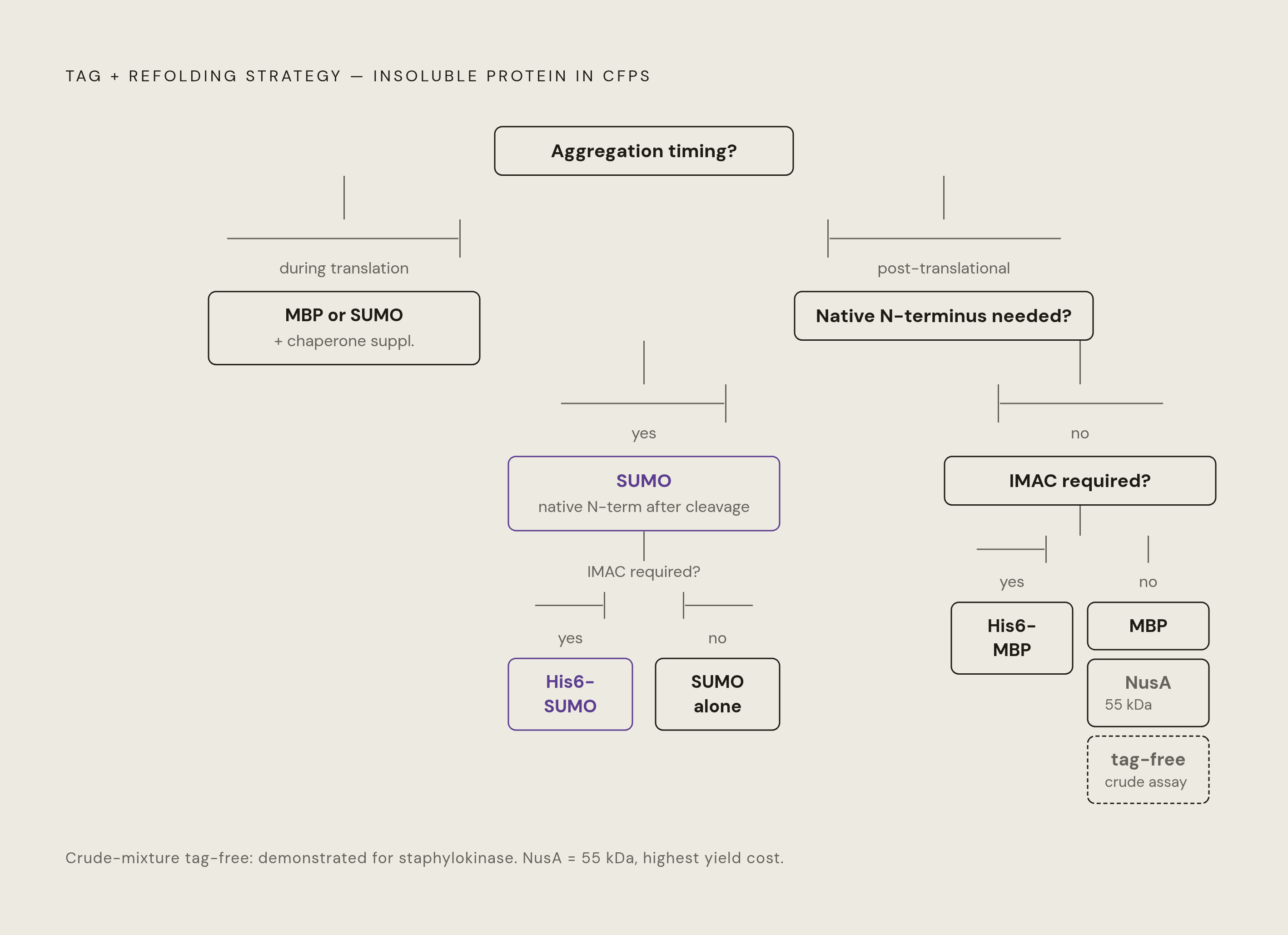
The right approach for an insoluble protein in CFPS is not a single tag or a single refolding buffer. It is a decision tree that starts with the protein's known failure mode and assigns levers accordingly. Does the protein aggregate during translation, or after it? Translation-time aggregation argues for a strong solubility tag, with MBP or SUMO as first choices, plus chaperone supplementation. Post-translational aggregation argues for redox tuning and a refolding protocol.
Tag selection follows from downstream requirements. If the native N-terminus matters after cleavage, SUMO is preferable to MBP or NusA because protease cleavage generates a native N-terminus. If yield per reaction volume is the primary constraint, MBP is preferable to NusA because the smaller tag imposes less yield dilution. If IMAC purification is required alongside solubility enhancement, His6-MBP or His6-SUMO is the appropriate tandem construct. And if the downstream assay can tolerate a tag-on protein, as in the staphylokinase case where crude-mixture activity was sufficient, tag removal may be deferred or skipped entirely.
Refolding decisions follow a parallel logic. If aggregation is unavoidable, detergent-based solubilization is preferable to chaotropic denaturants for cost and protein compatibility reasons, with stepwise detergent removal treated as critical. For antibody fragments specifically, the two-stage CFPS refolding protocol demonstrated for scFv provides a concrete starting point. If recovery rates from refolding are too low for the intended throughput, the strongest argument is to revisit tag selection rather than continue optimizing the refolding step. The parallel-screening advantage should be used at the tag-selection stage itself: testing MBP, SUMO, NusA, and TRX in parallel plate-format reactions identifies the best performer in hours, avoiding weeks of sequential cell-based construct testing. This screening workflow is currently the most practical substitute for a general rule about tag selection.
Reproducibility and reagent consistency: the constraint that determines whether these strategies transfer across experiments
None of these strategies transfer reliably between experiments if the cell extract itself is a variable. Reproducibility is the central unresolved challenge in CFPS practice. Consistency is hard to achieve between lab members, and it is essentially unsolved across research groups. The sources of variability are known: extract-to-extract differences, DNA template batch variation, pipetting differences in plate-format experiments, and instrument-related issues in fluorescence readouts. Lot-to-lot variability of cell extract is a source of experimental noise even in well-controlled plate-based formats.
The practical consequence is significant. Without lot-level QC data, the answer is unknowable. This is the argument for treating documented formulations and lot-level QC data as prerequisites rather than optional refinements. Visible, documented formulation and lot-level QC data give researchers the ability to distinguish tag effects from reagent variation, which is what makes a solubility strategy interpretable across experiments. A 2026 Nature Communications study found that systematic formulation optimization can achieve yields at a fraction of previous cost, so the economics are improving. That improvement matters because replication across conditions and lots is what turns individual successes into reliable methods.
What the current evidence supports and where the open questions remain
What is demonstrated is specific and meaningful: soluble expression of proteins that fail in E. coli, exemplified by serratiopeptidase; activity-readable crude-mixture screening, exemplified by staphylokinase; antibody fragment refolding within a single-day workflow via the two-stage scFv protocol; and automated plate-format parallel expression at 96-reaction scale on the Protein Production Sweden / University of Gothenburg Obi-Wan OT-2 platform. These cases establish that CFPS-based solubility tagging and refolding has moved beyond proof-of-concept for particular protein classes. What is not yet demonstrated is equally important. Cost-competitive production yields for industrial quantities remain out of reach. The 2026 Nature Communications formulation study achieved improved yields and cost reduction, but industrial-scale CFPS remains constrained by reagent economics relative to cell-based fermentation. The open scientific question is whether generalizable guidelines for tag selection across target types can be developed. The literature currently reports case-by-case successes, and there is no consensus on which tag works best for which protein structural class in CFPS specifically. Machine learning integration offers a prospective path forward: a 2025 biorxiv study demonstrated CFPS as a screening tool for ML-guided protease variant improvement, suggesting that CFPS-generated activity data could eventually train models that predict optimal tag and refolding conditions. That direction is promising but not current practice. For a researcher deciding whether to use CFPS for an insoluble target today, the platform is most clearly justified when the protein is toxic to host cells, when parallel screening of multiple constructs is required, or when the timeline for obtaining functional protein matters. It is least justified as a direct replacement for established cell-based production at industrial scale. The strategies described here are most effective when the goal is obtaining soluble, active protein quickly and testing conditions systematically, not when the goal is competing with fermentation economics at volume.
Sources
- Solubility tags for the expression and purification of bioactive peptides
- Method for refolding proteins containing free cysteine residues
- Solubilization and refolding of inclusion bodies by detergents - ScienceDirect
- Cell-Free Expression of a Therapeutic Protein Serratiopeptidase
- Research Progress Fusion Tags for Recombinant Protein Production - Yuan - 2025 - Biotechnology and Applied Biochemistry - Wiley Online Library
- Rapid Antibody Fragment Production and Binding Analysis Using Cell-Free Protein Synthesis Combined with Fluorescence Correlation Spectroscopy